AQA · GCSE · Biology
Course version: 8461 · Version from Sept 2018
They should be able to explain why: • Petri dishes and culture media must…
Full specification wording
Culturing microorganisms (biology only): They should be able to explain why: • Petri dishes and culture media must be sterilised before use • inoculating loops used to transfer microorganisms to the media must be sterilised by passing them through a flame • the lid of the Petri dish should be secured with adhesive tape and stored upside down • in school laboratories, cultures should generally be incubated at 25°C.
Culturing microorganisms requires aseptic technique to avoid contamination.
Checked against the AQA 8461 specification (opens in a new tab) on .
- Point 5 of 11
- 3 key terms
Study notes
From the checked teaching notes for this specification point.
The idea
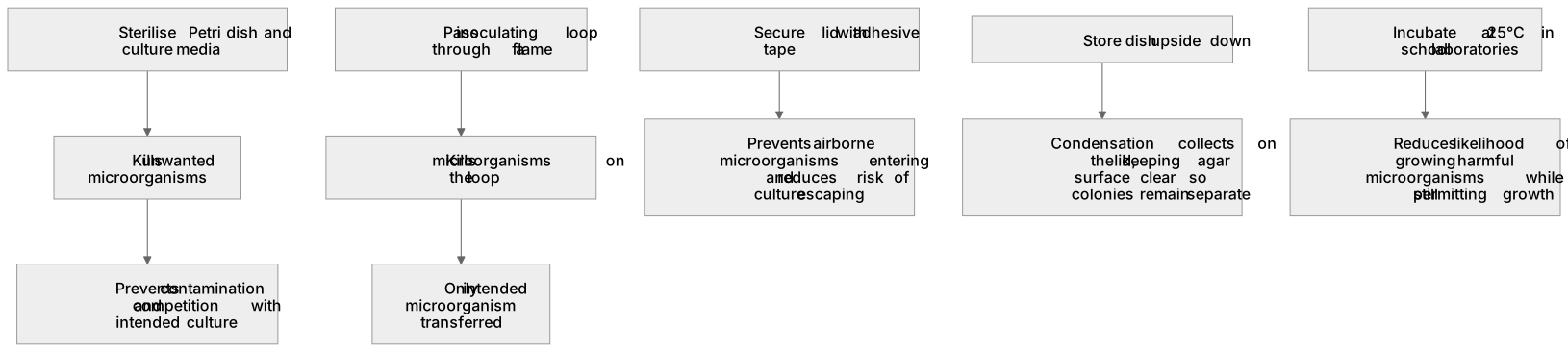
Culturing microorganisms requires aseptic technique to avoid contamination. Petri dishes and culture media are sterilised before use to kill unwanted microorganisms that would otherwise grow and compete with, or contaminate, the intended culture. Inoculating loops are sterilised by passing them through a flame, which kills microorganisms on the loop so only the intended species is transferred. The lid is secured with adhesive tape to prevent airborne contamination and to stop the culture escaping, and the dish is stored upside down so condensation runs onto the lid rather than onto the culture, preventing colonies from merging. In school laboratories, incubation is generally at 25°C because this reduces the risk of growing harmful human pathogens while still allowing microbial growth.
What earns the marks
- Explain that sterilising Petri dishes and culture media kills unwanted microorganisms, preventing contamination and competition with the intended culture.
- Explain that passing an inoculating loop through a flame sterilises it, so only the intended microorganism is transferred and false results are avoided.
- Explain that securing the lid with adhesive tape prevents airborne microorganisms entering and reduces the risk of the culture escaping.
- Explain that storing the dish upside down allows condensation to collect on the lid, keeping the agar surface clear so colonies remain separate and identifiable.
- Explain that incubation at 25°C in school laboratories reduces the likelihood of growing microorganisms harmful to humans, while still permitting growth for study.
- Recognise that these measures together form aseptic technique, which keeps cultures pure and protects the worker and the environment.
Common mistakes and how to put them right
Thinking the lid should be completely sealed.
Put it right: Taping all around prevents oxygen entry and can encourage anaerobic growth; the lid is secured but not fully airtight.
Believing 25°C is chosen because microorganisms cannot grow at higher temperatures.
Put it right: Many grow well above 25°C, but higher temperatures increase the risk of culturing human pathogens.
Assuming sterilising the loop is only about cleaning it.
Put it right: The purpose is to kill microorganisms so the transfer is pure and results are valid.
Exam tips
- Link each precaution to a clear consequence, such as contamination, competition, condensation or pathogen risk, rather than just naming the step.
- Use the term aseptic technique when explaining the set of precautions as a whole.
- When explaining the 25°C rule, refer to the reduced risk of harmful microorganisms rather than claiming growth is impossible at other temperatures.
Try the lesson
The start of the Culturing microorganisms (biology only): They should be able to explain why: • Petri dishes and culture media must be sterilised before use • inoculating loops used to transfer microorganisms to the media must be sterilised by passing them through a flame • the lid of the Petri dish should be secured with adhesive tape and stored upside down • in school laboratories, cultures should generally be incubated at 25°C. lesson, made from checked teaching notes for this specification point.
Have a go first
Why must Petri dishes and culture media be sterilised before they are used to culture microorganisms?
Listen
Culturing microorganisms requires aseptic technique to avoid contamination. Petri dishes and culture media are sterilised before use to kill unwanted microorganisms that would otherwise grow and compete with, or contaminate, the intended culture. Inoculating loops are sterilised by passing them through a flame, which kills microorganisms on the loop so only the intended species is transferred. The lid is secured with adhesive tape to prevent airborne contamination and to stop the culture escaping, and the dish is stored upside down so condensation runs onto the lid rather than onto the culture, preventing colonies from merging. In school laboratories, incubation is generally at 25°C because this reduces the risk of growing harmful human pathogens while still allowing microbial growth. A strong answer earns marks for these points. Explain that sterilising Petri dishes and culture media kills unwanted microorganisms, preventing contamination and competition with the intended culture. Explain that passing an inoculating loop through a flame sterilises it, so only the intended microorganism is transferred and false results are avoided. Explain that securing the lid with adhesive tape prevents airborne microorganisms entering and reduces the risk of the culture escaping. Explain that storing the dish upside down allows condensation to collect on the lid, keeping the agar surface clear so colonies remain separate and identifiable. Exam tip: Link each precaution to a clear consequence, such as contamination, competition, condensation or pathogen risk, rather than just naming the step.
See it
Key words
Say what each word means before you turn the card.
Aseptic technique
Try answering aloud or in your head before turning the card.
Sterilising
Try answering aloud or in your head before turning the card.
Incubation at 25°C
Try answering aloud or in your head before turning the card.
See every definition
- Aseptic technique
- A set of measures that keeps cultures pure and protects the worker and the environment.
- Sterilising
- Killing unwanted microorganisms on Petri dishes and culture media before use, preventing contamination and competition with the intended culture.
- Incubation at 25°C
- In school laboratories this reduces the likelihood of growing microorganisms harmful to humans, while still permitting growth for study.
Label the diagram
Some boxes have lost their names. Pick the right name for each number.
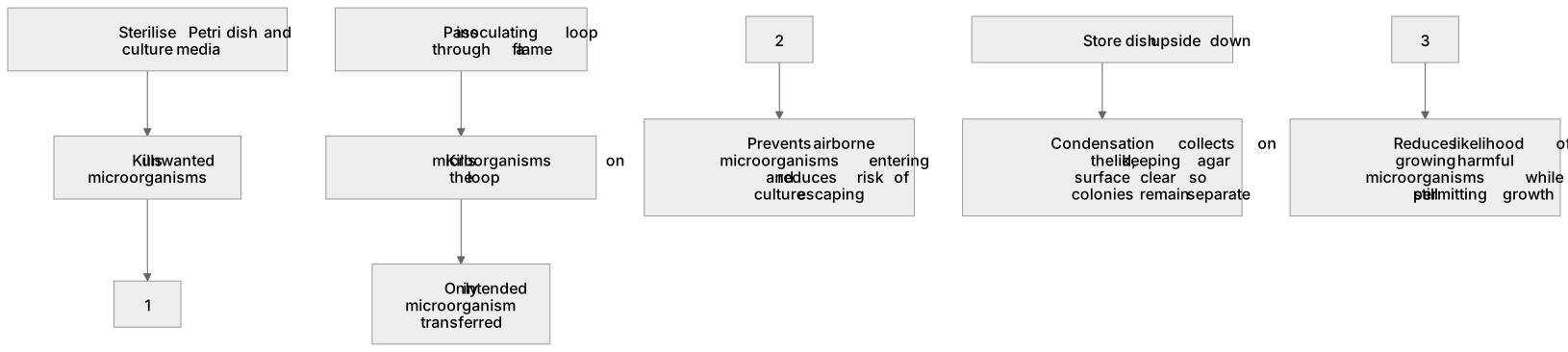
1Box 1
2Box 2
3Box 3
There is more to this lesson
The full lesson goes on to check your understanding and help you earn the marks. Create a free account to carry on, with your progress saved.
A week of Premium from your first lesson · Then the free plan continues · No card, no charge
Test your understanding of Culturing microorganisms (biology only): They should be able to explain why: • Petri dishes and culture media must be sterilised before use • inoculating loops used to transfer microorganisms to the media must be sterilised by passing them through a flame • the lid of the Petri dish should be secured with adhesive tape and stored upside down • in school laboratories, cultures should generally be incubated at 25°C.
Active recall beats re-reading. Take an instant quiz now to test what you’ve learned and lock it into long-term memory.
A week of Premium from your first lesson · Then the free plan continues · No card, no charge