AQA · GCSE · Biology
Course version: 8461 · Version from Sept 2018
Very low doses of the drug are given at the start of the clinical trial. •…
Full specification wording
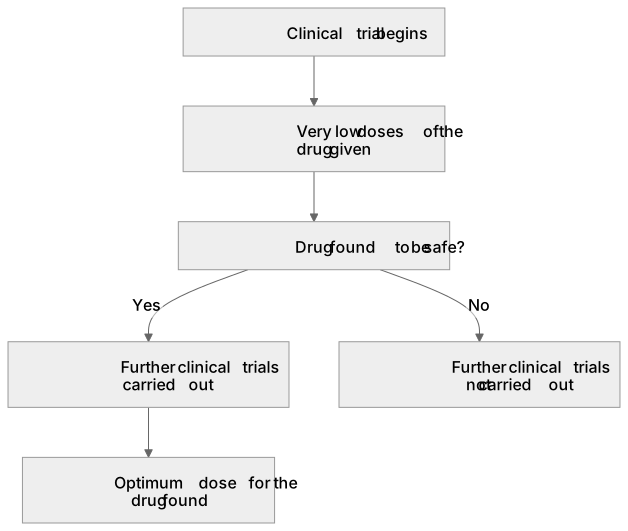
Discovery and development of drugs: Very low doses of the drug are given at the start of the clinical trial. • If the drug is found to be safe, further clinical trials are carried out to find the optimum dose for the drug.
Clinical trials test a new drug in humans after laboratory and animal testing.
Checked against the AQA 8461 specification (opens in a new tab) on .
- Point 9 of 9
- 2 key terms
Study notes
From the checked teaching notes for this specification point.
The idea
Clinical trials test a new drug in humans after laboratory and animal testing. They begin with very low doses to reduce the risk of harm, because the effects in humans are not yet fully known. Healthy volunteers or patients are monitored closely for safety and side effects. If the drug is found to be safe at these low doses, further clinical trials are carried out with more participants. These later trials increase the dose gradually to find the optimum dose: the dose that gives the best therapeutic effect with acceptable side effects. For example, a trial might start at 1 mg, then test 5 mg, 10 mg and 20 mg, recording how symptoms and side effects change. The optimum dose is not simply the highest dose; it balances benefit against harm. This staged approach protects participants and produces reliable evidence for licensing.
What earns the marks
- Clinical trials in humans begin with very low doses to minimise the risk of serious harm because the drug's effects in humans are not yet known.
- Participants are monitored for safety, side effects and any therapeutic effect at each dose level.
- If the drug is found to be safe at low doses, further clinical trials are carried out with larger groups and/or different doses.
- Later trials aim to find the optimum dose, which is the dose giving the best balance of therapeutic benefit and acceptable side effects.
- The optimum dose is identified by comparing results across dose groups rather than by assuming that a higher dose is always better.
- Ethical and regulatory approval is required before each stage, and participants give informed consent.
Common mistakes and how to put them right
Thinking that clinical trials start with the optimum dose.
Put it right: Very low doses are given first to check safety before doses are increased.
Confusing the optimum dose with the maximum dose.
Put it right: The optimum dose balances therapeutic effect against side effects.
Believing that animal testing alone proves a drug is safe for humans.
Put it right: Clinical trials in humans are still needed to assess safety and find the optimum dose.
Exam tips
- When explaining why low doses are used first, link your answer to safety and the unknown effects of the drug in humans.
- If asked how the optimum dose is found, describe comparing therapeutic effects and side effects across different dose groups.
- Use the phrase 'optimum dose' precisely, and avoid writing that it is simply the highest dose tested.
Try the lesson
The start of the Discovery and development of drugs: Very low doses of the drug are given at the start of the clinical trial. • If the drug is found to be safe, further clinical trials are carried out to find the optimum dose for the drug. lesson, made from checked teaching notes for this specification point.
Have a go first
In a clinical trial, why are very low doses of a new drug given to the first volunteers?
Listen
Clinical trials test a new drug in humans after laboratory and animal testing. They begin with very low doses to reduce the risk of harm, because the effects in humans are not yet fully known. Healthy volunteers or patients are monitored closely for safety and side effects. If the drug is found to be safe at these low doses, further clinical trials are carried out with more participants. These later trials increase the dose gradually to find the optimum dose: the dose that gives the best therapeutic effect with acceptable side effects. For example, a trial might start at 1 mg, then test 5 mg, 10 mg and 20 mg, recording how symptoms and side effects change. The optimum dose is not simply the highest dose; it balances benefit against harm. This staged approach protects participants and produces reliable evidence for licensing. A strong answer earns marks for these points. Clinical trials in humans begin with very low doses to minimise the risk of serious harm because the drug's effects in humans are not yet known. Participants are monitored for safety, side effects and any therapeutic effect at each dose level. If the drug is found to be safe at low doses, further clinical trials are carried out with larger groups and/or different doses. Later trials aim to find the optimum dose, which is the dose giving the best balance of therapeutic benefit and acceptable side effects. A common slip: Thinking that clinical trials start with the optimum dose: the error is skipping the low-dose safety stage. Instead, very low doses are given first to check safety before doses are increased. Exam tip: When explaining why low doses are used first, link your answer to safety and the unknown effects of the drug in humans.
See it
Key words
Say what each word means before you turn the card.
Clinical trials
Try answering aloud or in your head before turning the card.
Optimum dose
Try answering aloud or in your head before turning the card.
See every definition
- Clinical trials
- Tests of a new drug in humans that begin with very low doses to reduce the risk of harm because the effects in humans are not yet fully known.
- Optimum dose
- The dose that gives the best therapeutic effect with acceptable side effects, balancing benefit against harm rather than being simply the highest dose.
Label the diagram
Some boxes have lost their names. Pick the right name for each number.
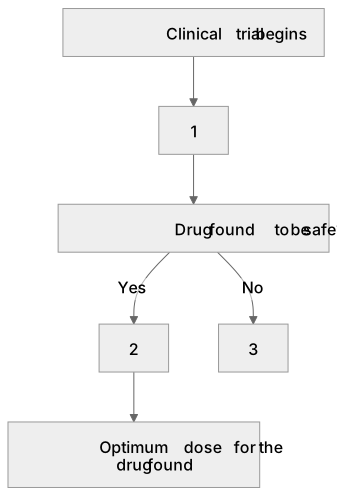
1Box 1
2Box 2
3Box 3
There is more to this lesson
The full lesson goes on to check your understanding and help you earn the marks. Create a free account to carry on, with your progress saved.
A week of Premium from your first lesson · Then the free plan continues · No card, no charge
Test your understanding of Discovery and development of drugs: Very low doses of the drug are given at the start of the clinical trial. • If the drug is found to be safe, further clinical trials are carried out to find the optimum dose for the drug.
Active recall beats re-reading. Take an instant quiz now to test what you’ve learned and lock it into long-term memory.
A week of Premium from your first lesson · Then the free plan continues · No card, no charge