AQA · GCSE · Biology
Course version: 8461 · Version from Sept 2018
Clinical trials use healthy volunteers and patients.
Full specification wording
Discovery and development of drugs: Clinical trials use healthy volunteers and patients.
Clinical trials test a new drug in humans after laboratory and animal testing.
Checked against the AQA 8461 specification (opens in a new tab) on .
- Point 8 of 9
- 4 key terms
Study notes
From the checked teaching notes for this specification point.
The idea
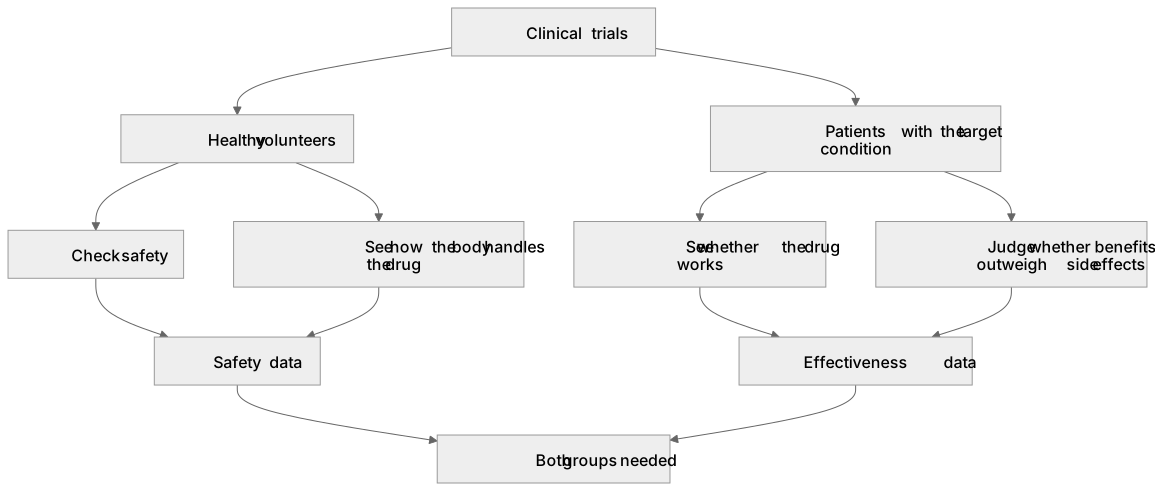
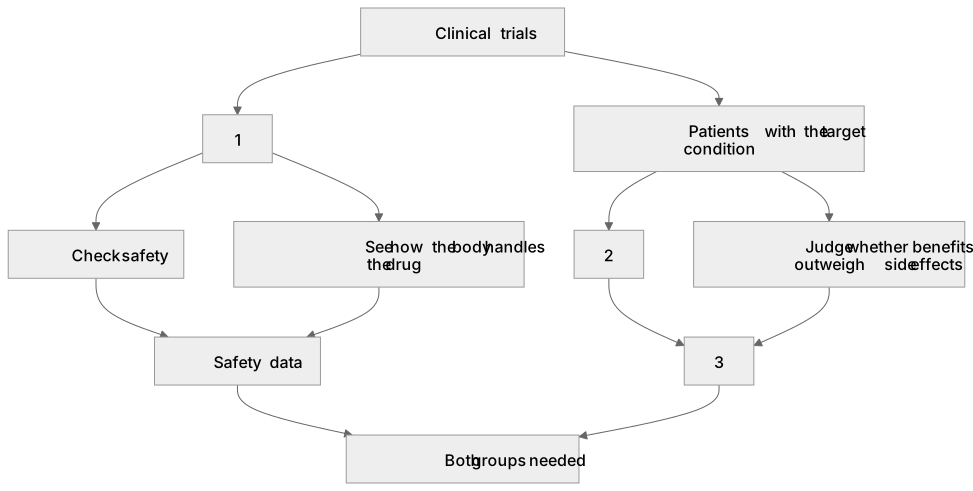
Clinical trials test a new drug in humans after laboratory and animal testing. Healthy volunteers are used first to check safety and how the body handles the drug, because they have no illness that could confuse results. Later, patients who have the target condition are used to see whether the drug actually works and whether benefits outweigh side effects. For example, a new asthma medicine might first be given to healthy adults at low dose, then to asthma patients to measure lung function. Using both groups lets researchers separate side effects caused by the drug from symptoms caused by the disease itself.
What earns the marks
- Healthy volunteers are used in early clinical trials to assess safety, tolerability and how the drug moves through the body.
- Patients with the target condition are used in later trials to test whether the drug treats that condition effectively.
- Using healthy volunteers first reduces the risk of a patient's illness masking or worsening drug side effects.
- Patients allow researchers to compare treated and untreated groups and judge whether the drug produces a real clinical benefit.
Common mistakes and how to put them right
Thinking clinical trials use only patients.
Put it right by stating that healthy volunteers are used first for safety testing.
Confusing clinical trials with laboratory or animal testing.
Put it right by placing clinical trials after preclinical testing and involving human participants.
Assuming healthy volunteers prove the drug works.
Put it right by explaining that effectiveness is tested in patients with the condition.
Exam tips
- Link each group to its purpose: healthy volunteers for safety, patients for effectiveness.
- Use the phrase 'target condition' when explaining why patients are chosen.
- If asked to compare, give one clear reason for each group rather than listing participants only.
Try the lesson
The start of the Discovery and development of drugs: Clinical trials use healthy volunteers and patients. lesson, made from checked teaching notes for this specification point.
Have a go first
In a clinical trial, which group of people is used to test whether a new medicine is safe before it is tested on people who are ill?
Listen
Clinical trials test a new drug in humans after laboratory and animal testing. Healthy volunteers are used first to check safety and how the body handles the drug, because they have no illness that could confuse results. Later, patients who have the target condition are used to see whether the drug actually works and whether benefits outweigh side effects. For example, a new asthma medicine might first be given to healthy adults at low dose, then to asthma patients to measure lung function. Using both groups lets researchers separate side effects caused by the drug from symptoms caused by the disease itself. A strong answer earns marks for these points. Healthy volunteers are used in early clinical trials to assess safety, tolerability and how the drug moves through the body. Patients with the target condition are used in later trials to test whether the drug treats that condition effectively. Using healthy volunteers first reduces the risk of a patient's illness masking or worsening drug side effects. Patients allow researchers to compare treated and untreated groups and judge whether the drug produces a real clinical benefit. A common slip: Thinking clinical trials use only patients. Instead, stating that healthy volunteers are used first for safety testing. Exam tip: Link each group to its purpose: healthy volunteers for safety, patients for effectiveness.
See it
Key words
Say what each word means before you turn the card.
Clinical trials
Try answering aloud or in your head before turning the card.
Healthy volunteers
Try answering aloud or in your head before turning the card.
Patients
Try answering aloud or in your head before turning the card.
Target condition
Try answering aloud or in your head before turning the card.
See every definition
- Clinical trials
- Tests of a new drug in humans, using healthy volunteers and patients, carried out after laboratory and animal testing.
- Healthy volunteers
- People with no illness that could confuse results, used first to check safety and how the body handles the drug.
- Patients
- People who have the target condition, used later to see whether the drug actually works and whether benefits outweigh side effects.
- Target condition
- The condition a drug is intended to treat, which the patients used in later trials have.
Label the diagram
Some boxes have lost their names. Pick the right name for each number.
1Box 1
2Box 2
3Box 3
There is more to this lesson
The full lesson goes on to check your understanding and help you earn the marks. Create a free account to carry on, with your progress saved.
A week of Premium from your first lesson · Then the free plan continues · No card, no charge
Test your understanding of Discovery and development of drugs: Clinical trials use healthy volunteers and patients.
Active recall beats re-reading. Take an instant quiz now to test what you’ve learned and lock it into long-term memory.
A week of Premium from your first lesson · Then the free plan continues · No card, no charge