AQA · GCSE · Biology
Course version: 8461 · Version from Sept 2018
The theory of evolution by natural selection states that all species of…
Full specification wording
Evolution: The theory of evolution by natural selection states that all species of living things have evolved from simple life forms that first developed more than three billion years ago.
Evolution by natural selection explains how the variety of life arose from simple beginnings.
Checked against the AQA 8461 specification (opens in a new tab) on .
- Point 2 of 4
- 3 key terms
Study notes
From the checked teaching notes for this specification point.
The idea
Evolution by natural selection explains how the variety of life arose from simple beginnings. The theory states that all species of living things have evolved from simple life forms that first developed more than three billion years ago. Over immense time, random genetic variation plus selection by the environment produced complex organisms from simpler ancestors. Evidence includes fossils showing gradual change, similarities in DNA and biochemistry between organisms, and observed evolution such as antibiotic resistance in bacteria. A useful method is to trace a lineage: simple cells appear in the oldest rocks, then increasingly complex body forms appear later. This does not mean one modern species turns into another today; it means shared ancestry over geological time.
What earns the marks
- States that all species of living things have evolved from simple life forms.
- States that these simple life forms first developed more than three billion years ago.
- Explains that variation arises randomly and selection by the environment acts on it over many generations.
- Uses evidence such as fossils, DNA similarities or observed evolution to support the theory.
- Recognises that evolution occurs over very long time scales, not within a human lifetime.
Common mistakes and how to put them right
Thinking evolution means an individual organism changes during its life.
Put it right by explaining that populations change across generations.
Believing the first life forms appeared only millions of years ago.
Put it right by stating more than three billion years.
Assuming humans evolved from modern apes.
Put it right by explaining that humans and apes share a common ancestor.
Exam tips
- Quote the three-billion-year timescale accurately when describing the origin of simple life forms.
- Link each evidence point back to the theory rather than listing evidence without explanation.
- Use the phrase natural selection when describing how simple life forms gave rise to complex ones.
Try the lesson
The start of the Evolution: The theory of evolution by natural selection states that all species of living things have evolved from simple life forms that first developed more than three billion years ago. lesson, made from checked teaching notes for this specification point.
Have a go first
According to the theory of evolution by natural selection, how long ago did the first simple life forms develop?
Listen
Evolution by natural selection explains how the variety of life arose from simple beginnings. The theory states that all species of living things have evolved from simple life forms that first developed more than three billion years ago. Over immense time, random genetic variation plus selection by the environment produced complex organisms from simpler ancestors. Evidence includes fossils showing gradual change, similarities in DNA and biochemistry between organisms, and observed evolution such as antibiotic resistance in bacteria. A useful method is to trace a lineage: simple cells appear in the oldest rocks, then increasingly complex body forms appear later. This does not mean one modern species turns into another today; it means shared ancestry over geological time. A strong answer earns marks for these points. States that all species of living things have evolved from simple life forms. States that these simple life forms first developed more than three billion years ago. Explains that variation arises randomly and selection by the environment acts on it over many generations. Uses evidence such as fossils, DNA similarities or observed evolution to support the theory. A common slip: Thinking evolution means an individual organism changes during its life. Instead, explaining that populations change across generations. Exam tip: Quote the three-billion-year timescale accurately when describing the origin of simple life forms.
See it
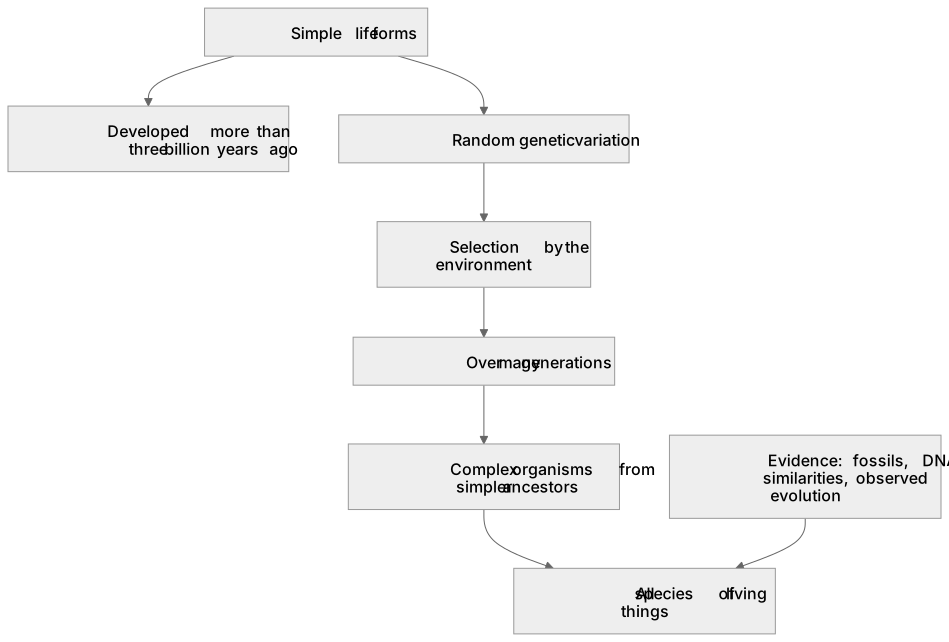
Key words
Say what each word means before you turn the card.
Natural selection
Try answering aloud or in your head before turning the card.
Common ancestry
Try answering aloud or in your head before turning the card.
Evidence for evolution
Try answering aloud or in your head before turning the card.
See every definition
- Natural selection
- Variation arises randomly and selection by the environment acts on it over many generations.
- Common ancestry
- Shared ancestry over geological time, rather than one modern species turning into another today.
- Evidence for evolution
- Fossils showing gradual change, similarities in DNA and biochemistry between organisms, and observed evolution such as antibiotic resistance in bacteria.
Label the diagram
Some boxes have lost their names. Pick the right name for each number.
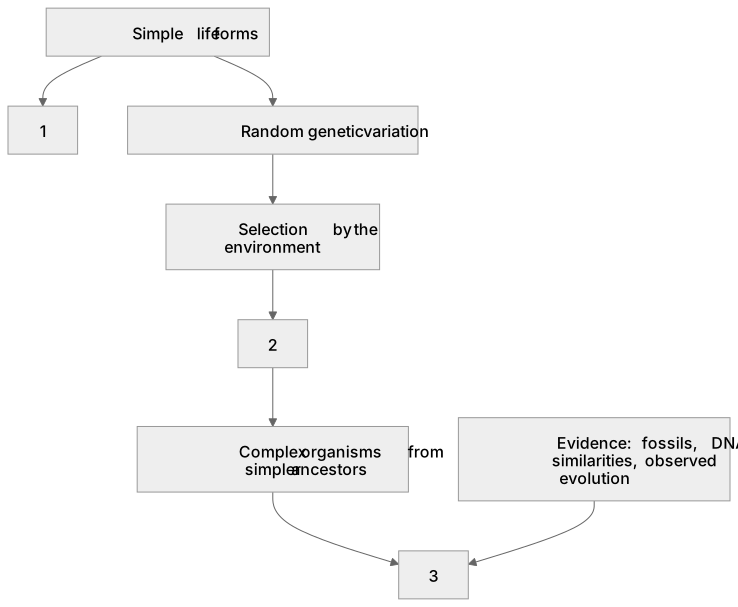
1Box 1
2Box 2
3Box 3
There is more to this lesson
The full lesson goes on to check your understanding and help you earn the marks. Create a free account to carry on, with your progress saved.
A week of Premium from your first lesson · Then the free plan continues · No card, no charge
Test your understanding of Evolution: The theory of evolution by natural selection states that all species of living things have evolved from simple life forms that first developed more than three billion years ago.
Active recall beats re-reading. Take an instant quiz now to test what you’ve learned and lock it into long-term memory.
A week of Premium from your first lesson · Then the free plan continues · No card, no charge