AQA · GCSE · Biology
Course version: 8461 · Version from Sept 2018
The efficiency of food production can be improved by restricting energy…
Full specification wording
Farming techniques: The efficiency of food production can be improved by restricting energy transfer from food animals to the environment.
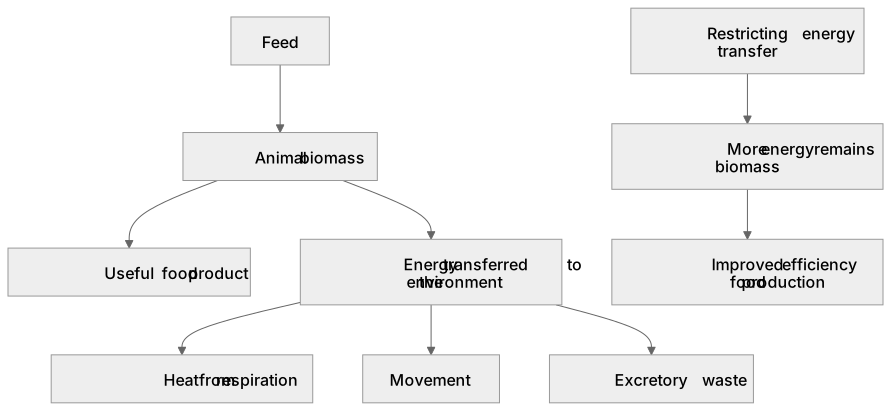
Farm animals transfer energy from their food into biomass, but much energy is lost to the environment.
Checked against the AQA 8461 specification (opens in a new tab) on .
- Point 1 of 3
- 2 key terms
Study notes
From the checked teaching notes for this specification point.
The idea
Farm animals transfer energy from their food into biomass, but much energy is lost to the environment. Energy is transferred to the surroundings by respiration as heat, and through movement and excretion. If less energy is lost, more remains in the animal's biomass, so the same amount of feed produces more meat, milk or eggs. This raises the efficiency of food production. Restricting these losses means more food energy is available to people, which can reduce costs and demand on land and water.
What earns the marks
- State that food animals transfer energy to the environment as heat from respiration, through movement and in excretory waste.
- Explain that reducing these energy losses leaves more energy stored in the animal's biomass.
- Link greater biomass per unit of feed to improved efficiency of food production.
- Use the idea that more efficient production can supply more food from the same resources.
- Describe a named farming method, such as housing animals, that reduces energy transfer to the environment.
Common mistakes and how to put them right
Saying energy is lost as food passes along the food chain without naming heat from respiration.
Put it right: Respiration transfers energy as heat to the surroundings.
Confusing energy with biomass and claiming energy is destroyed.
Put it right: Energy is conserved but transferred to less useful stores in the environment.
Thinking efficiency means the animal eats less.
Put it right: Efficiency is the proportion of feed energy converted into useful biomass.
Exam tips
- Name the process, respiration, and the energy store, heat, when explaining energy loss.
- Use the phrase more energy transferred to biomass per unit of feed to express improved efficiency.
- Compare housed and free-range systems in terms of energy loss, then state which is more efficient and why.
Try the lesson
The start of the Farming techniques: The efficiency of food production can be improved by restricting energy transfer from food animals to the environment. lesson, made from checked teaching notes for this specification point.
Have a go first
In food production, what is meant by restricting energy transfer from food animals to the environment?
Listen
Farm animals transfer energy from their food into biomass, but much energy is lost to the environment. Energy is transferred to the surroundings by respiration as heat, and through movement and excretion. If less energy is lost, more remains in the animal's biomass, so the same amount of feed produces more meat, milk or eggs. This raises the efficiency of food production. Restricting these losses means more food energy is available to people, which can reduce costs and demand on land and water. A strong answer earns marks for these points. State that food animals transfer energy to the environment as heat from respiration, through movement and in excretory waste. Explain that reducing these energy losses leaves more energy stored in the animal's biomass. Link greater biomass per unit of feed to improved efficiency of food production. Use the idea that more efficient production can supply more food from the same resources. A common slip: Saying energy is lost as food passes along the food chain without naming heat from respiration. Instead, respiration transfers energy as heat to the surroundings. Exam tip: Name the process, respiration, and the energy store, heat, when explaining energy loss.
See it
Key words
Say what each word means before you turn the card.
Efficiency of food production
Try answering aloud or in your head before turning the card.
Energy transfer in food chains
Try answering aloud or in your head before turning the card.
See every definition
- Efficiency of food production
- The proportion of feed energy converted into useful biomass, which is raised when less energy is transferred to the environment.
- Energy transfer in food chains
- The pathway from feed to animal biomass to useful food product, with losses to the environment at each stage.
Label the diagram
Some boxes have lost their names. Pick the right name for each number.
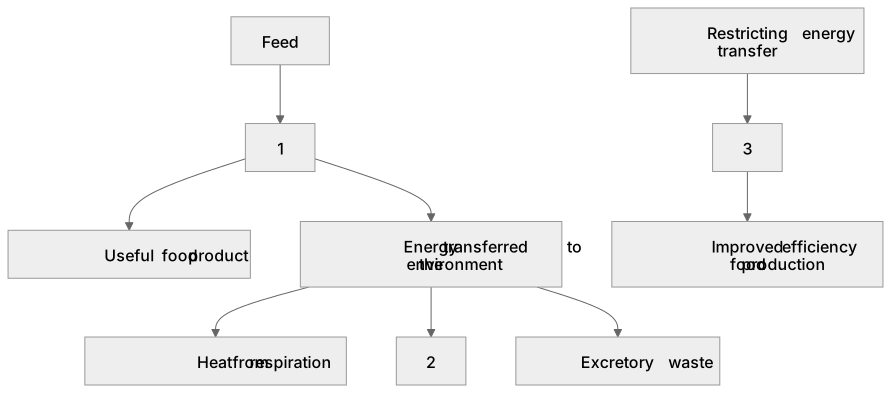
1Box 1
2Box 2
3Box 3
There is more to this lesson
The full lesson goes on to check your understanding and help you earn the marks. Create a free account to carry on, with your progress saved.
A week of Premium from your first lesson · Then the free plan continues · No card, no charge
Test your understanding of Farming techniques: The efficiency of food production can be improved by restricting energy transfer from food animals to the environment.
Active recall beats re-reading. Take an instant quiz now to test what you’ve learned and lock it into long-term memory.
A week of Premium from your first lesson · Then the free plan continues · No card, no charge