AQA · GCSE · Biology
Course version: 8461 · Version from Sept 2018
This can be done by limiting their movement and by controlling the…
Full specification wording
Farming techniques: This can be done by limiting their movement and by controlling the temperature of their surroundings.
Farmers can reduce energy losses from food animals in two main ways.
Checked against the AQA 8461 specification (opens in a new tab) on .
- Point 2 of 3
- 4 key terms
Study notes
From the checked teaching notes for this specification point.
The idea
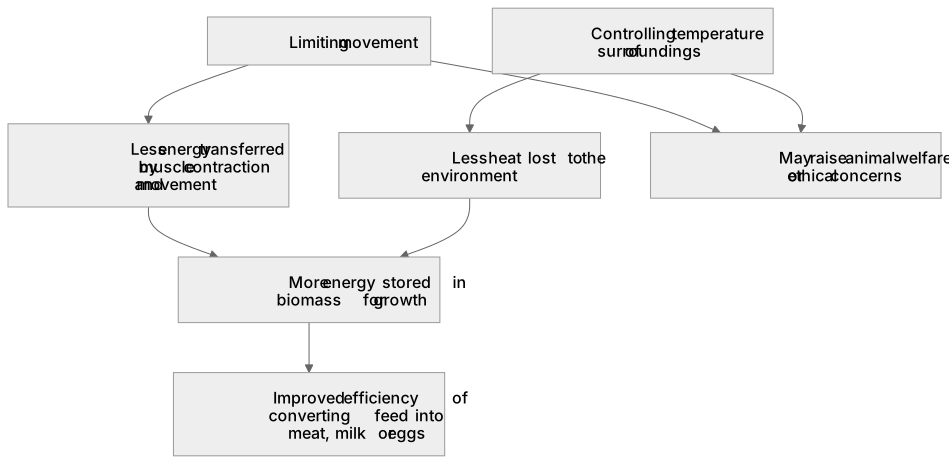
Farmers can reduce energy losses from food animals in two main ways. Limiting movement, for example by housing animals in pens, means less energy is transferred by muscle contraction and movement, so more remains in biomass. Controlling the temperature of their surroundings, for example by keeping sheds warm, means the animals lose less heat to the environment and do not need to respire extra food to stay warm. Both methods increase the proportion of feed energy converted into meat, milk or eggs.
What earns the marks
- State that limiting movement reduces energy transferred by muscle contraction and movement.
- State that controlling temperature reduces heat loss from the animal to the surroundings.
- Explain that less energy lost means more energy stored in biomass for growth.
- Link both methods to improved efficiency of converting feed into useful food products.
- Recognise that these methods may raise animal welfare or ethical concerns that can be evaluated.
Common mistakes and how to put them right
Claiming that limiting movement stops respiration.
Put it right: Respiration continues but less energy is transferred through movement.
Saying warm surroundings stop heat loss completely.
Put it right: Heat loss is reduced, not eliminated.
Describing temperature control as making animals grow faster without linking it to reduced heat loss and respiration.
Put it right: Explain the energy transfer pathway.
Exam tips
- For each method, state the energy transfer it reduces and the effect on biomass.
- Use comparative language such as less energy is transferred to the environment, so more is available for growth.
- If asked to evaluate, add a welfare point such as restricted movement may cause distress, then reach a balanced conclusion.
Try the lesson
The start of the Farming techniques: This can be done by limiting their movement and by controlling the temperature of their surroundings. lesson, made from checked teaching notes for this specification point.
Have a go first
In intensive farming, why are farm animals often kept in pens that stop them moving around freely?
Listen
Farmers can reduce energy losses from food animals in two main ways. Limiting movement, for example by housing animals in pens, means less energy is transferred by muscle contraction and movement, so more remains in biomass. Controlling the temperature of their surroundings, for example by keeping sheds warm, means the animals lose less heat to the environment and do not need to respire extra food to stay warm. Both methods increase the proportion of feed energy converted into meat, milk or eggs. A strong answer earns marks for these points. State that limiting movement reduces energy transferred by muscle contraction and movement. State that controlling temperature reduces heat loss from the animal to the surroundings. Explain that less energy lost means more energy stored in biomass for growth. Link both methods to improved efficiency of converting feed into useful food products. A common slip: Claiming that limiting movement stops respiration. Instead, respiration continues but less energy is transferred through movement. Exam tip: For each method, state the energy transfer it reduces and the effect on biomass.
See it
Key words
Say what each word means before you turn the card.
Limiting movement
Try answering aloud or in your head before turning the card.
Controlling temperature
Try answering aloud or in your head before turning the card.
Efficiency of food production
Try answering aloud or in your head before turning the card.
Animal welfare
Try answering aloud or in your head before turning the card.
See every definition
- Limiting movement
- Reduces energy transferred by muscle contraction and movement, so more energy remains in biomass.
- Controlling temperature
- Reduces heat loss from the animal to the surroundings, so less food is respired to stay warm.
- Efficiency of food production
- The proportion of feed energy converted into meat, milk or eggs, which both methods increase.
- Animal welfare
- A concern that these methods may raise, since restricted movement may cause distress.
Label the diagram
Some boxes have lost their names. Pick the right name for each number.
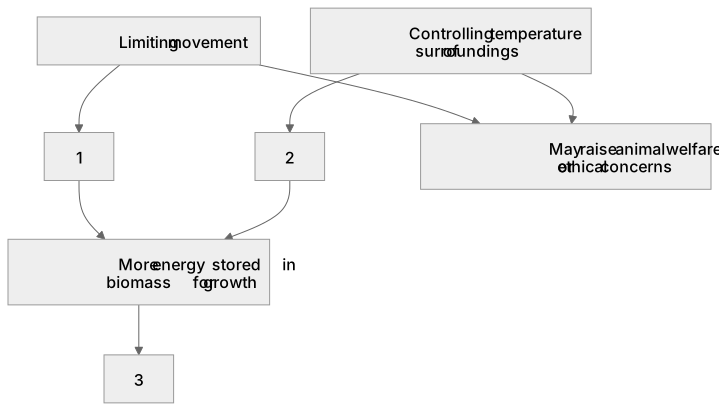
1Box 1
2Box 2
3Box 3
There is more to this lesson
The full lesson goes on to check your understanding and help you earn the marks. Create a free account to carry on, with your progress saved.
A week of Premium from your first lesson · Then the free plan continues · No card, no charge
Test your understanding of Farming techniques: This can be done by limiting their movement and by controlling the temperature of their surroundings.
Active recall beats re-reading. Take an instant quiz now to test what you’ve learned and lock it into long-term memory.
A week of Premium from your first lesson · Then the free plan continues · No card, no charge