AQA · GCSE · Biology
Course version: 8461 · Version from Sept 2018
Fossils are the ‘remains’ of organisms from millions of years ago, which…
Full specification wording
Fossils: Fossils are the ‘remains’ of organisms from millions of years ago, which are found in rocks.
A fossil is any preserved evidence of an organism that lived millions of years ago, typically discovered within sedimentary rock.
Checked against the AQA 8461 specification (opens in a new tab) on .
- Point 1 of 7
Study notes
From the checked teaching notes for this specification point.
The idea
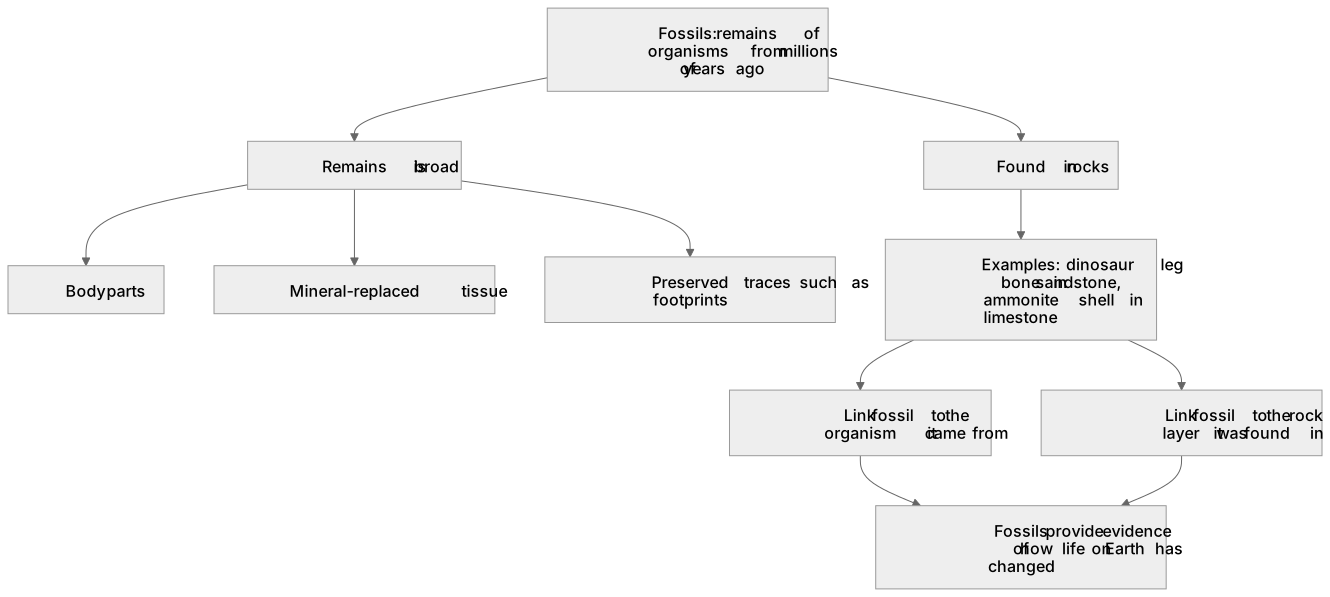
A fossil is any preserved evidence of an organism that lived millions of years ago, typically discovered within sedimentary rock. The word ‘remains’ is deliberately broad: it covers actual body parts, mineral-replaced tissue and traces such as footprints. Fossils matter because they provide the direct evidence used to reconstruct how life on Earth has changed over geological time.
For example: A dinosaur leg bone embedded in layered sandstone, or a fossilised ammonite shell in limestone, counts as a fossil because it is ancient biological material or its impression locked in rock.
What earns the marks
- States that fossils are evidence of organisms that lived millions of years ago.
- States that fossils are found in rocks, commonly sedimentary rock.
- Recognises that ‘remains’ includes body parts, mineral-replaced material and preserved traces.
- Gives a valid example, such as a fossilised bone, shell, footprint or leaf impression.
- Links a fossil to the organism that produced it and to the rock layer containing it.
Common mistakes and how to put them right
Thinking a fossil must always be the actual unchanged body of an organism.
Put it right by explaining that mineral replacement and traces also count.
Confusing fossils with modern bones or shells lying on the ground.
Put it right by stressing the millions-of-years timescale and burial in rock.
Assuming all fossils are dinosaurs.
Put it right by giving plant, shell and trace examples.
Exam tips
- Define the term using both key ideas: ancient organism and found in rock.
- Use a named example to make the definition concrete.
- If asked to identify a fossil, justify your choice by referring to its age and its location in rock.
Try the lesson
The start of the Fossils: Fossils are the ‘remains’ of organisms from millions of years ago, which are found in rocks. lesson, made from checked teaching notes for this specification point.
Have a go first
Which statement best describes a fossil?
Listen
A fossil is any preserved evidence of an organism that lived millions of years ago, typically discovered within sedimentary rock. The word ‘remains’ is deliberately broad: it covers actual body parts, mineral-replaced tissue and traces such as footprints. Fossils matter because they provide the direct evidence used to reconstruct how life on Earth has changed over geological time. For example, a dinosaur leg bone embedded in layered sandstone, or a fossilised ammonite shell in limestone, counts as a fossil because it is ancient biological material or its impression locked in rock. A strong answer earns marks for these points. States that fossils are evidence of organisms that lived millions of years ago. States that fossils are found in rocks, commonly sedimentary rock. Recognises that ‘remains’ includes body parts, mineral-replaced material and preserved traces. Gives a valid example, such as a fossilised bone, shell, footprint or leaf impression. A common slip: Thinking a fossil must always be the actual unchanged body of an organism. Instead, explaining that mineral replacement and traces also count. Exam tip: Define the term using both key ideas: ancient organism and found in rock.
See it
Label the diagram
Some boxes have lost their names. Pick the right name for each number.
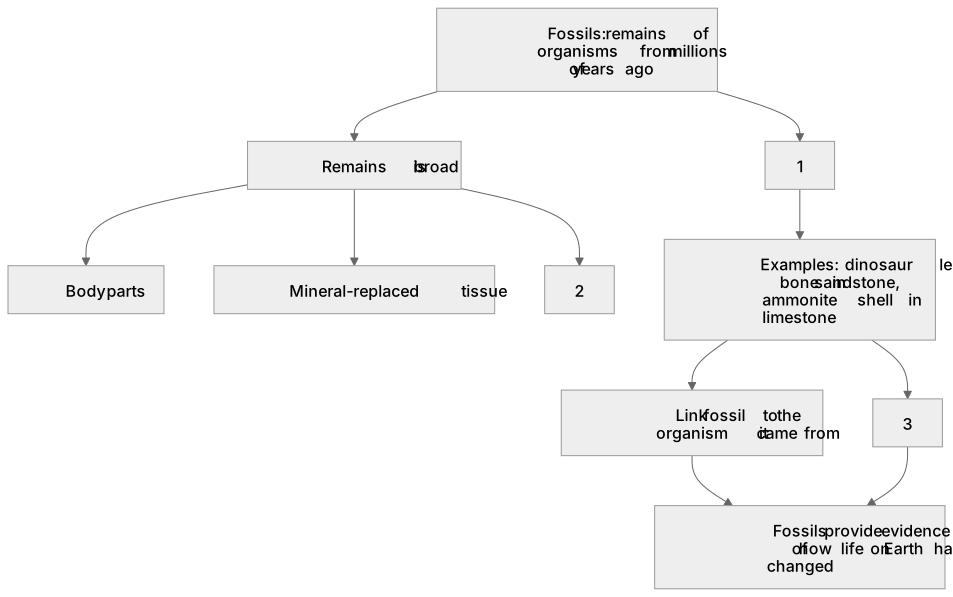
1Box 1
2Box 2
3Box 3
There is more to this lesson
The full lesson goes on to check your understanding and help you earn the marks. Create a free account to carry on, with your progress saved.
A week of Premium from your first lesson · Then the free plan continues · No card, no charge
Test your understanding of Fossils: Fossils are the ‘remains’ of organisms from millions of years ago, which are found in rocks.
Active recall beats re-reading. Take an instant quiz now to test what you’ve learned and lock it into long-term memory.
A week of Premium from your first lesson · Then the free plan continues · No card, no charge