AQA · GCSE · Biology
Course version: 8461 · Version from Sept 2018
Fossils may be formed: • from parts of organisms that have not decayed…
Full specification wording
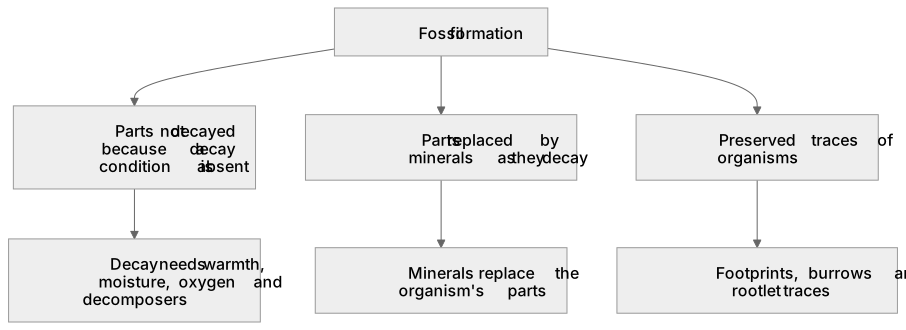
Fossils: Fossils may be formed: • from parts of organisms that have not decayed because one or more of the conditions needed for decay are absent • when parts of the organism are replaced by minerals as they decay • as preserved traces of organisms, such as footprints, burrows and rootlet traces.
Decay normally needs warmth, moisture, oxygen and decomposers.
Checked against the AQA 8461 specification (opens in a new tab) on .
- Point 2 of 7
- 3 key terms
Study notes
From the checked teaching notes for this specification point.
The idea
Decay normally needs warmth, moisture, oxygen and decomposers. If one or more of these is missing, body parts may survive and become fossils. This happens in cold or frozen ground, in acidic or waterlogged conditions with little oxygen, or when an organism is quickly buried. In a second route, as soft tissue decays, dissolved minerals seep into the remaining hard parts and replace the original material, producing a mineral cast that keeps the shape of the bone or shell. A third route preserves traces rather than body parts: footprints, burrows and rootlet traces can be filled or coated by sediment that later becomes rock. Each route explains a different kind of fossil evidence.
What earns the marks
- States that decay requires conditions such as warmth, moisture, oxygen and decomposers.
- Explains that if one or more decay conditions are absent, parts of an organism may not decay and can fossilise.
- Describes mineral replacement, where minerals replace parts of the organism as it decays.
- Describes preserved traces such as footprints, burrows or rootlet traces.
- Links each formation route to a suitable environment, such as frozen ground, waterlogged peat or rapid burial in sediment.
Common mistakes and how to put them right
Believing decay always destroys every organism.
Put it right by explaining that missing decay conditions allow preservation.
Confusing mineral replacement with the original material staying unchanged.
Put it right by stating that minerals replace the organism’s parts.
Treating footprints and burrows as body fossils.
Put it right by calling them preserved traces.
Exam tips
- Name the missing decay condition when explaining why something did not decay.
- Use the phrase ‘replaced by minerals’ precisely when describing casts.
- For trace fossils, state what made the trace and what preserved it.
Try the lesson
The start of the Fossils: Fossils may be formed: • from parts of organisms that have not decayed because one or more of the conditions needed for decay are absent • when parts of the organism are replaced by minerals as they decay • as preserved traces of organisms, such as footprints, burrows and rootlet traces. lesson, made from checked teaching notes for this specification point.
Have a go first
Which of the following is an example of a fossil formed as a preserved trace of an organism?
Listen
Decay normally needs warmth, moisture, oxygen and decomposers. If one or more of these is missing, body parts may survive and become fossils. This happens in cold or frozen ground, in acidic or waterlogged conditions with little oxygen, or when an organism is quickly buried. In a second route, as soft tissue decays, dissolved minerals seep into the remaining hard parts and replace the original material, producing a mineral cast that keeps the shape of the bone or shell. A third route preserves traces rather than body parts: footprints, burrows and rootlet traces can be filled or coated by sediment that later becomes rock. Each route explains a different kind of fossil evidence. A strong answer earns marks for these points. States that decay requires conditions such as warmth, moisture, oxygen and decomposers. Explains that if one or more decay conditions are absent, parts of an organism may not decay and can fossilise. Describes mineral replacement, where minerals replace parts of the organism as it decays. Describes preserved traces such as footprints, burrows or rootlet traces. A common slip: Believing decay always destroys every organism. Instead, explaining that missing decay conditions allow preservation. Exam tip: Name the missing decay condition when explaining why something did not decay.
See it
Key words
Say what each word means before you turn the card.
Conditions for decay
Try answering aloud or in your head before turning the card.
Mineralisation
Try answering aloud or in your head before turning the card.
Trace fossils
Try answering aloud or in your head before turning the card.
See every definition
- Conditions for decay
- Decay normally needs warmth, moisture, oxygen and decomposers, and if one or more of these is missing, body parts may survive and become fossils.
- Mineralisation
- As soft tissue decays, dissolved minerals seep into the remaining hard parts and replace the original material, producing a mineral cast that keeps the shape of the bone or shell.
- Trace fossils
- Footprints, burrows and rootlet traces can be filled or coated by sediment that later becomes rock, preserving traces rather than body parts.
Label the diagram
Some boxes have lost their names. Pick the right name for each number.
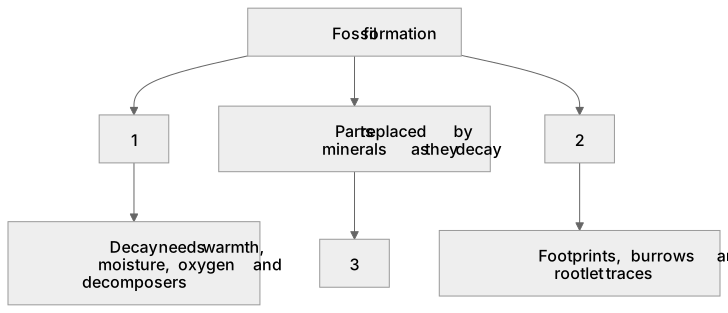
1Box 1
2Box 2
3Box 3
There is more to this lesson
The full lesson goes on to check your understanding and help you earn the marks. Create a free account to carry on, with your progress saved.
A week of Premium from your first lesson · Then the free plan continues · No card, no charge
Test your understanding of Fossils: Fossils may be formed: • from parts of organisms that have not decayed because one or more of the conditions needed for decay are absent • when parts of the organism are replaced by minerals as they decay • as preserved traces of organisms, such as footprints, burrows and rootlet traces.
Active recall beats re-reading. Take an instant quiz now to test what you’ve learned and lock it into long-term memory.
A week of Premium from your first lesson · Then the free plan continues · No card, no charge