AQA · GCSE · Biology
Course version: 8461 · Version from Sept 2018
We can learn from fossils how much or how little different organisms have…
Full specification wording
Fossils: We can learn from fossils how much or how little different organisms have changed as life developed on Earth.
Fossils preserve parts or traces of organisms in rock, ice, amber or peat, and comparing them with living species shows change over time.
Checked against the AQA 8461 specification (opens in a new tab) on .
- Point 6 of 7
- 4 key terms
Study notes
From the checked teaching notes for this specification point.
The idea
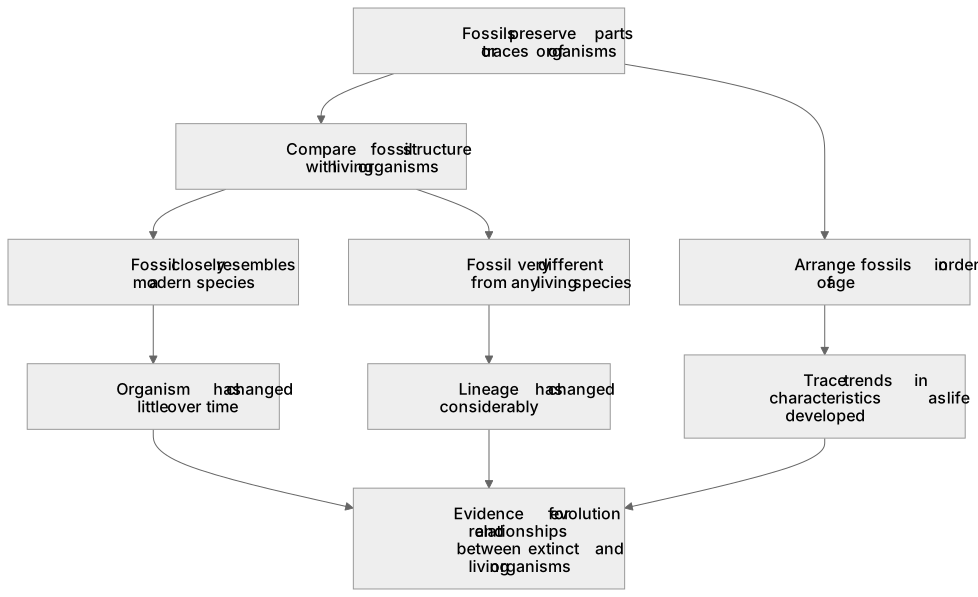
Fossils preserve parts or traces of organisms in rock, ice, amber or peat, and comparing them with living species shows change over time. A fossil similar to a modern organism, such as a horse-like ancestor with similar teeth, suggests little change. A fossil very different from any living form, such as a dinosaur with feathers or an early whale with hind limbs, shows greater change. By arranging fossils in order of age, scientists build sequences and evolutionary trees that trace how characteristics appeared or disappeared. The amount of change is judged from similarities and differences in structure, not from the age of the fossil alone. This evidence supports the idea that life has evolved and that species are related through common ancestors.
What earns the marks
- Fossils show the structure of past organisms, and comparing these structures with those of living organisms reveals similarities and differences.
- A fossil closely resembling a modern species indicates that the organism has changed little over time.
- A fossil very different from any living species indicates that the organism or its lineage has changed considerably.
- Sequencing fossils by relative age or dating allows trends in characteristics to be traced as life developed.
- Fossil comparisons provide evidence for evolution and for relationships between extinct and living organisms.
Common mistakes and how to put them right
Judging change only from how old a fossil is; correct this by comparing the fossil's structure with that of a living organism.
Assuming a fossil that looks similar to a living species proves no evolution occurred.
Put it right by saying it shows little change in the preserved features.
Confusing individual change during a lifetime with evolutionary change in a species over many generations.
Put it right by keeping the timescale of populations in mind.
Exam tips
- Name the specific feature you are comparing, such as tooth shape or limb structure, and state whether it is similar or different.
- Use comparative language such as more similar, less changed or greater difference to make the degree of change clear.
- When describing an evolutionary tree, refer to common ancestors and branching rather than reading the diagram from left to right only.
Try the lesson
The start of the Fossils: We can learn from fossils how much or how little different organisms have changed as life developed on Earth. lesson, made from checked teaching notes for this specification point.
Have a go first
Scientists often compare fossils of ancient organisms with species that are alive today. What is the main purpose of making these comparisons?
Listen
Fossils preserve parts or traces of organisms in rock, ice, amber or peat, and comparing them with living species shows change over time. A fossil similar to a modern organism, such as a horse-like ancestor with similar teeth, suggests little change. A fossil very different from any living form, such as a dinosaur with feathers or an early whale with hind limbs, shows greater change. By arranging fossils in order of age, scientists build sequences and evolutionary trees that trace how characteristics appeared or disappeared. The amount of change is judged from similarities and differences in structure, not from the age of the fossil alone. This evidence supports the idea that life has evolved and that species are related through common ancestors. A strong answer earns marks for these points. Fossils show the structure of past organisms, and comparing these structures with those of living organisms reveals similarities and differences. A fossil closely resembling a modern species indicates that the organism has changed little over time. A fossil very different from any living species indicates that the organism or its lineage has changed considerably. Sequencing fossils by relative age or dating allows trends in characteristics to be traced as life developed. A common slip: Judging change only from how old a fossil is. Instead, comparing the fossil's structure with that of a living organism. Exam tip: Name the specific feature you are comparing, such as tooth shape or limb structure, and state whether it is similar or different.
See it
Key words
Say what each word means before you turn the card.
Evidence for evolution
Try answering aloud or in your head before turning the card.
Comparing fossil and living structures
Try answering aloud or in your head before turning the card.
Change over geological time
Try answering aloud or in your head before turning the card.
Common ancestry
Try answering aloud or in your head before turning the card.
See every definition
- Evidence for evolution
- Fossil comparisons provide evidence for evolution and for relationships between extinct and living organisms.
- Comparing fossil and living structures
- Fossils show the structure of past organisms, and comparing these structures with those of living organisms reveals similarities and differences.
- Change over geological time
- A fossil closely resembling a modern species indicates that the organism has changed little over time, while a fossil very different from any living species indicates that the organism or its lineage has changed considerably.
- Common ancestry
- This evidence supports the idea that life has evolved and that species are related through common ancestors.
Label the diagram
Some boxes have lost their names. Pick the right name for each number.
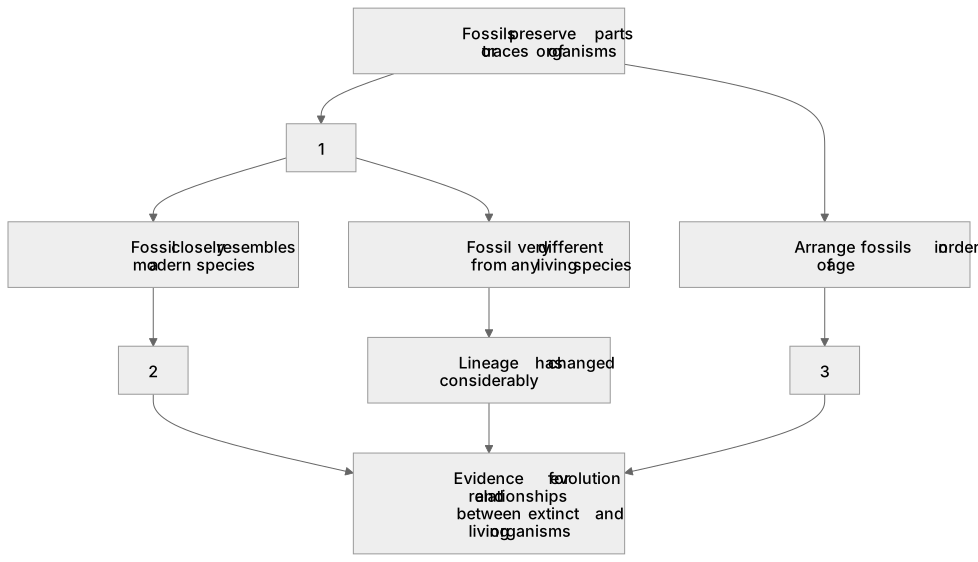
1Box 1
2Box 2
3Box 3
There is more to this lesson
The full lesson goes on to check your understanding and help you earn the marks. Create a free account to carry on, with your progress saved.
A week of Premium from your first lesson · Then the free plan continues · No card, no charge
Test your understanding of Fossils: We can learn from fossils how much or how little different organisms have changed as life developed on Earth.
Active recall beats re-reading. Take an instant quiz now to test what you’ve learned and lock it into long-term memory.
A week of Premium from your first lesson · Then the free plan continues · No card, no charge