AQA · GCSE · Biology
Course version: 8461 · Version from Sept 2018
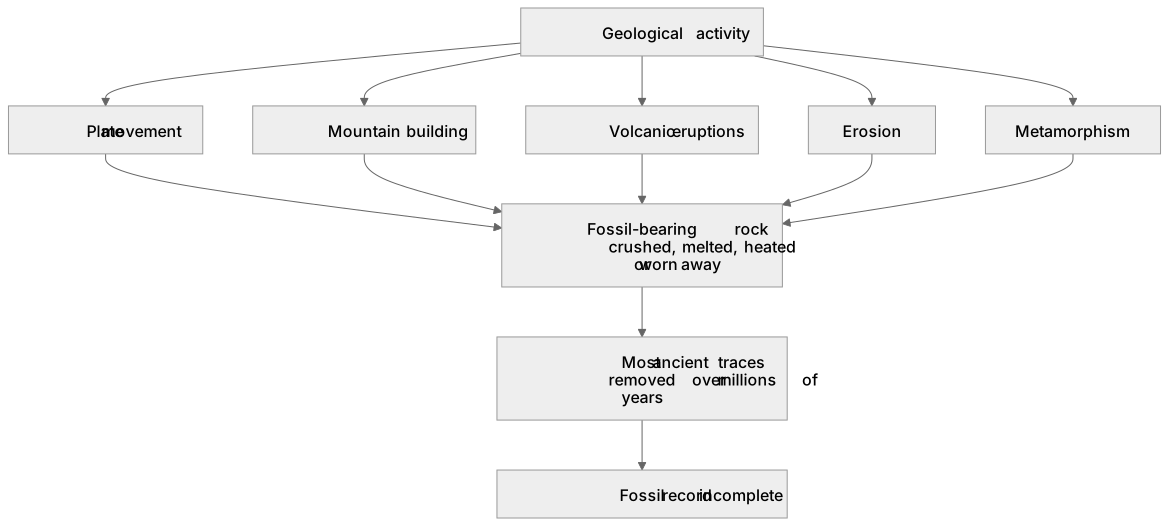
What traces there were have been mainly destroyed by geological activity.
Full specification wording
Fossils: What traces there were have been mainly destroyed by geological activity.
Even when a soft-bodied organism did leave a trace, that trace is unlikely to survive to the present day.
Checked against the AQA 8461 specification (opens in a new tab) on .
- Point 4 of 7
- 2 key terms
Study notes
From the checked teaching notes for this specification point.
The idea
Even when a soft-bodied organism did leave a trace, that trace is unlikely to survive to the present day. Geological activity such as plate movement, mountain building, volcanic eruptions, erosion and metamorphism can crush, melt, heat or wear away fossil-bearing rock. Fossils are mostly found in sedimentary rock because sedimentary layers are less likely to be destroyed than rocks subjected to intense heat and pressure. Over millions of years, repeated cycles of erosion and rock recycling remove most ancient traces. This helps explain why the fossil record is incomplete, especially for the earliest and most fragile organisms.
What earns the marks
- States that geological activity has destroyed many traces of early life.
- Names processes such as plate movement, volcanic activity, erosion or metamorphism.
- Explains that heat and pressure can destroy fossils or the rocks containing them.
- Links destruction of fossils to the incompleteness of the fossil record.
- Recognises that sedimentary rock is more likely to preserve fossils than rock altered by geological activity.
Common mistakes and how to put them right
Thinking fossils survive forever once formed.
Put it right by explaining that rock recycling and geological processes destroy them.
Confusing geological destruction with decay.
Put it right by separating biological decay from physical and chemical rock processes.
Assuming all rock types preserve fossils equally.
Put it right by noting that heat and pressure in metamorphic rock destroy fossils.
Exam tips
- Name at least one specific geological process when explaining destruction.
- Connect destroyed traces to gaps in the fossil record.
- Use the idea of rock recycling over millions of years.
Try the lesson
The start of the Fossils: What traces there were have been mainly destroyed by geological activity. lesson, made from checked teaching notes for this specification point.
Have a go first
What has mainly destroyed the traces left by early soft-bodied life?
Listen
Even when a soft-bodied organism did leave a trace, that trace is unlikely to survive to the present day. Geological activity such as plate movement, mountain building, volcanic eruptions, erosion and metamorphism can crush, melt, heat or wear away fossil-bearing rock. Fossils are mostly found in sedimentary rock because sedimentary layers are less likely to be destroyed than rocks subjected to intense heat and pressure. Over millions of years, repeated cycles of erosion and rock recycling remove most ancient traces. This helps explain why the fossil record is incomplete, especially for the earliest and most fragile organisms. A strong answer earns marks for these points. States that geological activity has destroyed many traces of early life. Names processes such as plate movement, volcanic activity, erosion or metamorphism. Explains that heat and pressure can destroy fossils or the rocks containing them. Links destruction of fossils to the incompleteness of the fossil record. A common slip: Thinking fossils survive forever once formed. Instead, explaining that rock recycling and geological processes destroy them. Exam tip: Name at least one specific geological process when explaining destruction.
See it
Key words
Say what each word means before you turn the card.
Geological processes
Try answering aloud or in your head before turning the card.
Incomplete fossil record
Try answering aloud or in your head before turning the card.
See every definition
- Geological processes
- Processes such as plate movement, mountain building, volcanic eruptions, erosion and metamorphism that can crush, melt, heat or wear away fossil-bearing rock.
- Incomplete fossil record
- The gaps in the record of past life that result from geological activity destroying many traces, especially of the earliest and most fragile organisms.
Label the diagram
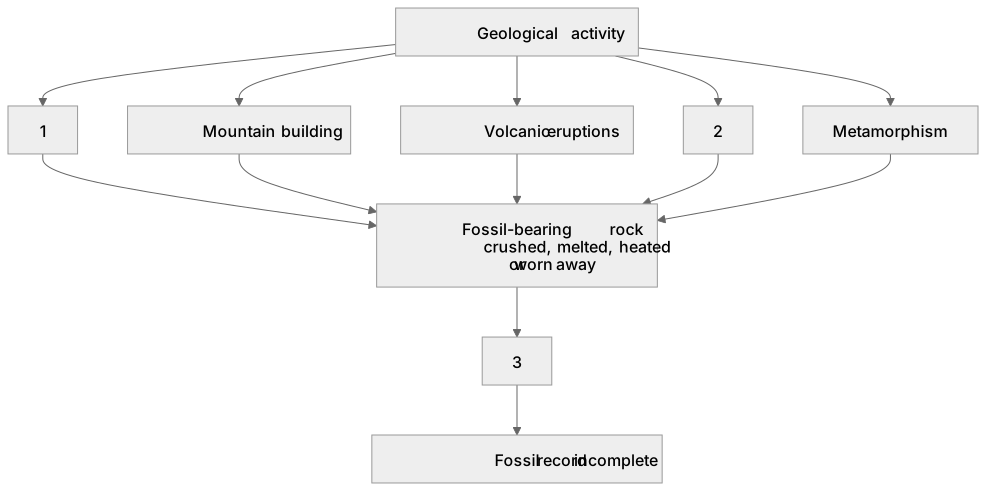
Some boxes have lost their names. Pick the right name for each number.
1Box 1
2Box 2
3Box 3
There is more to this lesson
The full lesson goes on to check your understanding and help you earn the marks. Create a free account to carry on, with your progress saved.
A week of Premium from your first lesson · Then the free plan continues · No card, no charge
Test your understanding of Fossils: What traces there were have been mainly destroyed by geological activity.
Active recall beats re-reading. Take an instant quiz now to test what you’ve learned and lock it into long-term memory.
A week of Premium from your first lesson · Then the free plan continues · No card, no charge