AQA · GCSE · Biology
Course version: 8461 · Version from Sept 2018
Many early forms of life were soft-bodied, which means that they have left…
Full specification wording
Fossils: Many early forms of life were soft-bodied, which means that they have left few traces behind.
While the earliest life forms were unicellular, many early multicellular organisms, such as simple worms and jellyfish-like animals, had soft bodies with no shells, bones or teeth.
Checked against the AQA 8461 specification (opens in a new tab) on .
- Point 3 of 7
- 4 key terms
Study notes
From the checked teaching notes for this specification point.
The idea
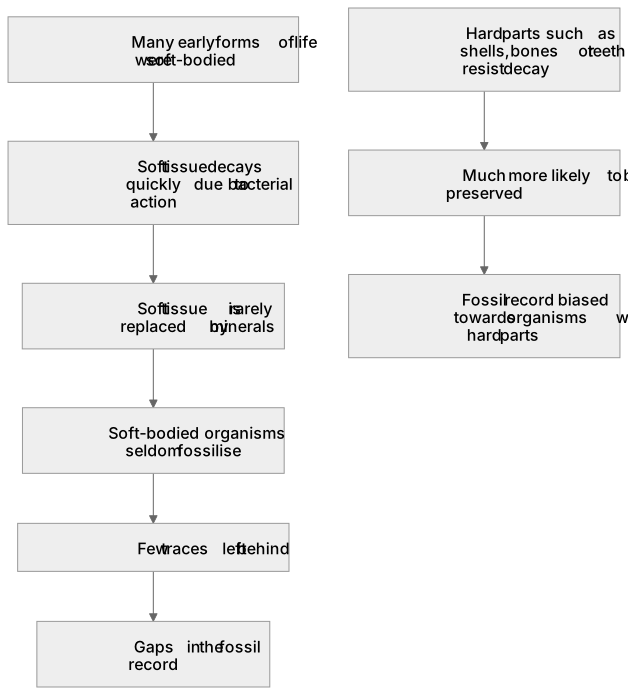
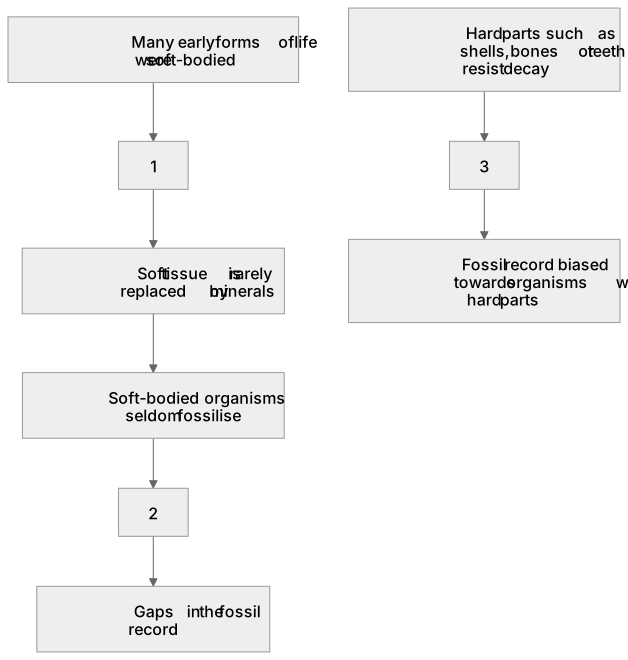
While the earliest life forms were unicellular, many early multicellular organisms, such as simple worms and jellyfish-like animals, had soft bodies with no shells, bones or teeth. Soft tissue decays quickly due to bacterial action and is rarely replaced by minerals, so it seldom fossilises. Hard parts resist decay and are much more likely to be preserved. This creates a gap in the fossil record: the further back in time we look, the fewer fossils we find, and the fossils we do find are biased towards organisms with hard parts.
For example: A soft-bodied worm is far less likely to leave a fossil than a shelled mollusc living at the same time.
What earns the marks
- States that many early multicellular life forms were soft-bodied.
- Explains that soft tissue decays quickly and is rarely preserved as fossils.
- Contrasts soft-bodied organisms with those having hard parts such as shells, bones or teeth which fossilise more easily.
- Concludes that early soft-bodied organisms left few traces, creating gaps in the fossil record.
- Uses an example, such as a soft-bodied worm compared with a shelled animal, to illustrate preservation bias.
Common mistakes and how to put them right
Claiming no early life existed because no fossils are found.
Put it right by explaining that absence of fossils is due to poor preservation, not absence of life.
Thinking soft-bodied organisms never fossilise.
Put it right by saying they rarely fossilise, usually only in exceptional conditions where decay is prevented.
Ignoring the role of hard parts.
Put it right by explaining that shells and bones fossilise more readily than soft tissue.
Exam tips
- Use the phrase ‘few traces’ rather than ‘no traces’ to stay accurate when discussing early soft-bodied life.
- Link the lack of fossils to the decay of soft tissue by microorganisms.
Try the lesson
The start of the Fossils: Many early forms of life were soft-bodied, which means that they have left few traces behind. lesson, made from checked teaching notes for this specification point.
Have a go first
Many early forms of life were soft-bodied. What does this mean about the number of traces they have left behind?
Listen
While the earliest life forms were unicellular, many early multicellular organisms, such as simple worms and jellyfish-like animals, had soft bodies with no shells, bones or teeth. Soft tissue decays quickly due to bacterial action and is rarely replaced by minerals, so it seldom fossilises. Hard parts resist decay and are much more likely to be preserved. This creates a gap in the fossil record: the further back in time we look, the fewer fossils we find, and the fossils we do find are biased towards organisms with hard parts. For example, a soft-bodied worm is far less likely to leave a fossil than a shelled mollusc living at the same time. A strong answer earns marks for these points. States that many early multicellular life forms were soft-bodied. Explains that soft tissue decays quickly and is rarely preserved as fossils. Contrasts soft-bodied organisms with those having hard parts such as shells, bones or teeth which fossilise more easily. Concludes that early soft-bodied organisms left few traces, creating gaps in the fossil record. A common slip: Claiming no early life existed because no fossils are found. Instead, explaining that absence of fossils is due to poor preservation, not absence of life. Exam tip: Use the phrase ‘few traces’ rather than ‘no traces’ to stay accurate when discussing early soft-bodied life.
See it
Key words
Say what each word means before you turn the card.
Fossil record gaps
Try answering aloud or in your head before turning the card.
Decay and preservation
Try answering aloud or in your head before turning the card.
Early life
Try answering aloud or in your head before turning the card.
Evidence and bias
Try answering aloud or in your head before turning the card.
See every definition
- Fossil record gaps
- The further back in time we look, the fewer fossils we find, creating gaps in the fossil record.
- Decay and preservation
- Soft tissue decays quickly due to bacterial action and is rarely replaced by minerals, so it seldom fossilises, while hard parts resist decay and are much more likely to be preserved.
- Early life
- Many early forms of life were soft-bodied, which means that they have left few traces behind.
- Evidence and bias
- The fossils we do find are biased towards organisms with hard parts, so a soft-bodied worm is far less likely to leave a fossil than a shelled mollusc living at the same time.
Label the diagram
Some boxes have lost their names. Pick the right name for each number.
1Box 1
2Box 2
3Box 3
There is more to this lesson
The full lesson goes on to check your understanding and help you earn the marks. Create a free account to carry on, with your progress saved.
A week of Premium from your first lesson · Then the free plan continues · No card, no charge
Test your understanding of Fossils: Many early forms of life were soft-bodied, which means that they have left few traces behind.
Active recall beats re-reading. Take an instant quiz now to test what you’ve learned and lock it into long-term memory.
A week of Premium from your first lesson · Then the free plan continues · No card, no charge