AQA · GCSE · Biology
Course version: 8461 · Version from Sept 2018
Health issues: Different types of disease may interact.
Diseases rarely occur in isolation.
Checked against the AQA 8461 specification (opens in a new tab) on .
- Point 5 of 10
- 4 key terms
Study notes
From the checked teaching notes for this specification point.
The idea
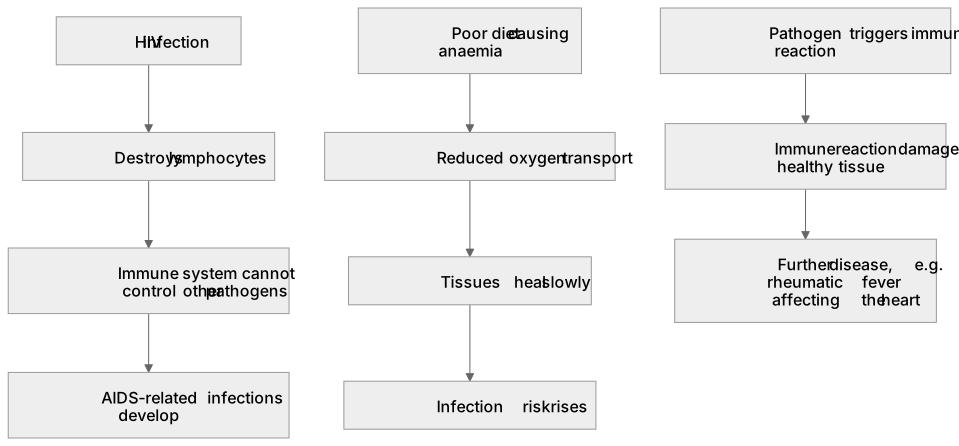
Diseases rarely occur in isolation. A communicable disease can weaken the body so a non-communicable disease develops, or a non-communicable disease can make a communicable infection more likely or more severe. For example, infection with HIV destroys lymphocytes, so the immune system cannot control other pathogens and the person may develop AIDS-related infections. Conversely, a poor diet causing anaemia reduces oxygen transport, so tissues heal slowly and infection risk rises. Another interaction is that a pathogen can trigger an immune reaction that damages healthy tissue, as in rheumatic fever affecting the heart.
What earns the marks
- States that one disease can increase the risk of another disease developing.
- Explains a causal mechanism, such as a weakened immune system allowing a secondary infection.
- Uses a named example, such as HIV destroying lymphocytes so opportunistic infections occur.
- Distinguishes between communicable and non-communicable diseases and explains how one can influence the other.
- Describes how a pathogen can trigger an immune response that damages body tissues, leading to further disease.
Common mistakes and how to put them right
Treating diseases as independent events and listing two conditions without linking them.
Put it right by explaining the causal pathway from the first disease to the second.
Confusing correlation with causation, for example saying that people with a disease always catch another.
Put it right by using words such as increases the risk or makes more likely.
Describing HIV as directly killing the person rather than destroying lymphocytes so the immune system fails.
Put it right by explaining the role of lymphocytes in defence.
Exam tips
- Use the command word to decide whether you need a simple link or a full causal chain.
- Name specific diseases and the cells or organs affected to make the interaction concrete.
- Link back to the question by stating clearly how the first disease makes the second more likely.
Try the lesson
The start of the Health issues: Different types of disease may interact. lesson, made from checked teaching notes for this specification point.
Have a go first
A person has a disease that damages the lining of their airways. Which statement best describes how this disease may interact with another type of disease?
Listen
Diseases rarely occur in isolation. A communicable disease can weaken the body so a non-communicable disease develops, or a non-communicable disease can make a communicable infection more likely or more severe. For example, infection with HIV destroys lymphocytes, so the immune system cannot control other pathogens and the person may develop AIDS-related infections. Conversely, a poor diet causing anaemia reduces oxygen transport, so tissues heal slowly and infection risk rises. Another interaction is that a pathogen can trigger an immune reaction that damages healthy tissue, as in rheumatic fever affecting the heart. A strong answer earns marks for these points. States that one disease can increase the risk of another disease developing. Explains a causal mechanism, such as a weakened immune system allowing a secondary infection. Uses a named example, such as HIV destroying lymphocytes so opportunistic infections occur. Distinguishes between communicable and non-communicable diseases and explains how one can influence the other. A common slip: Treating diseases as independent events and listing two conditions without linking them. Instead, explaining the causal pathway from the first disease to the second. Exam tip: Use the command word to decide whether you need a simple link or a full causal chain.
See it
Key words
Say what each word means before you turn the card.
Communicable and non-communicable disease interaction
Try answering aloud or in your head before turning the card.
Immune system function and failure
Try answering aloud or in your head before turning the card.
Causal mechanisms in disease
Try answering aloud or in your head before turning the card.
Risk factors and health
Try answering aloud or in your head before turning the card.
See every definition
- Communicable and non-communicable disease interaction
- A communicable disease can weaken the body so a non-communicable disease develops, or a non-communicable disease can make a communicable infection more likely or more severe.
- Immune system function and failure
- Infection with HIV destroys lymphocytes, so the immune system cannot control other pathogens and the person may develop AIDS-related infections.
- Causal mechanisms in disease
- A causal chain links the first disease to the second, such as a weakened immune system allowing a secondary infection.
- Risk factors and health
- A poor diet causing anaemia reduces oxygen transport, so tissues heal slowly and infection risk rises.
Label the diagram
Some boxes have lost their names. Pick the right name for each number.
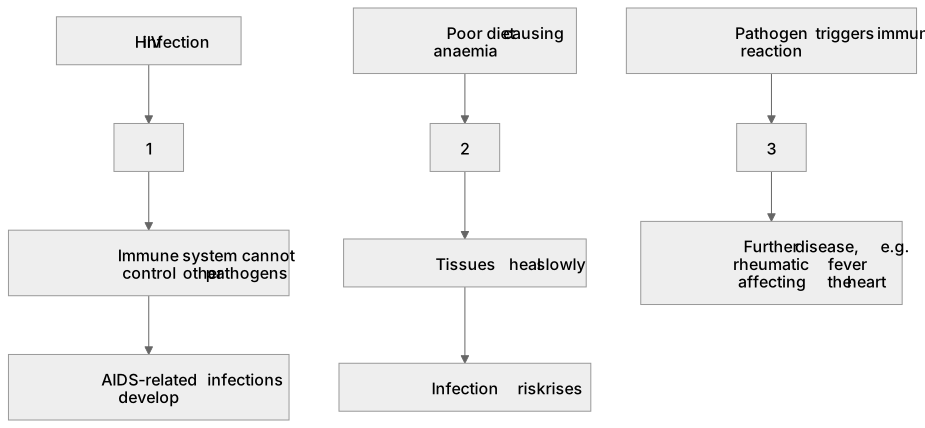
1Box 1
2Box 2
3Box 3
There is more to this lesson
The full lesson goes on to check your understanding and help you earn the marks. Create a free account to carry on, with your progress saved.
A week of Premium from your first lesson · Then the free plan continues · No card, no charge
Test your understanding of Health issues: Different types of disease may interact.
Active recall beats re-reading. Take an instant quiz now to test what you’ve learned and lock it into long-term memory.
A week of Premium from your first lesson · Then the free plan continues · No card, no charge