AQA · GCSE · Biology
Course version: 8461 · Version from Sept 2018
Severe physical ill health can lead to depression and other mental illness.
Full specification wording
Health issues: Severe physical ill health can lead to depression and other mental illness.
Health is not merely the absence of disease; it is a state of physical and mental well-being.
Checked against the AQA 8461 specification (opens in a new tab) on .
- Point 8 of 10
- 3 key terms
Study notes
From the checked teaching notes for this specification point.
The idea
Health is not merely the absence of disease; it is a state of physical and mental well-being. Severe physical ill health, such as cancer, chronic heart disease or long-term disability, can disrupt daily life, cause persistent pain, limit independence and create uncertainty about the future. These stresses can trigger depression, anxiety and other mental illnesses. The relationship can also work in reverse: mental illness may reduce self-care, exercise and healthy eating, worsening physical health. A useful model is a two-way feedback loop: a long-term physical condition increases stress and reduces activity, which lowers mood, which further reduces activity and recovery. Understanding this interdependence explains why treatment often addresses both physical and mental health together.
What earns the marks
- Health is a state of physical and mental well-being, not just the absence of disease.
- Severe or long-term physical illness can cause pain, disability, loss of independence and financial or social stress.
- The link is often two-way: mental illness can also worsen physical health by reducing self-care, exercise or healthy eating.
- Recognising the link supports holistic care, such as treating pain, offering psychological support and encouraging social contact.
Common mistakes and how to put them right
Treating physical and mental health as completely separate.
Put it right by explaining that they interact and influence each other.
Assuming that physical illness always causes mental illness.
Put it right by stating that it increases the risk rather than making it inevitable.
Describing mental illness as less serious than physical illness.
Put it right by recognising that both affect health and daily functioning.
Exam tips
- Use the definition of health to frame your answer, then explain the link with a named example such as chronic pain or cancer.
- Include the reverse direction, showing that mental illness can also affect physical health, to reach the highest level.
- Link your explanation to real consequences such as difficulty working, reduced social contact or poorer recovery.
Try the lesson
The start of the Health issues: Severe physical ill health can lead to depression and other mental illness. lesson, made from checked teaching notes for this specification point.
Have a go first
How can severe physical ill health affect a person's mental wellbeing?
Listen
Health is not merely the absence of disease; it is a state of physical and mental well-being. Severe physical ill health, such as cancer, chronic heart disease or long-term disability, can disrupt daily life, cause persistent pain, limit independence and create uncertainty about the future. These stresses can trigger depression, anxiety and other mental illnesses. The relationship can also work in reverse: mental illness may reduce self-care, exercise and healthy eating, worsening physical health. A useful model is a two-way feedback loop: a long-term physical condition increases stress and reduces activity, which lowers mood, which further reduces activity and recovery. Understanding this interdependence explains why treatment often addresses both physical and mental health together. A strong answer earns marks for these points. Health is a state of physical and mental well-being, not just the absence of disease. Severe or long-term physical illness can cause pain, disability, loss of independence and financial or social stress. The link is often two-way: mental illness can also worsen physical health by reducing self-care, exercise or healthy eating. Recognising the link supports holistic care, such as treating pain, offering psychological support and encouraging social contact. A common slip: Treating physical and mental health as completely separate. Instead, explaining that they interact and influence each other. Exam tip: Use the definition of health to frame your answer, then explain the link with a named example such as chronic pain or cancer.
See it
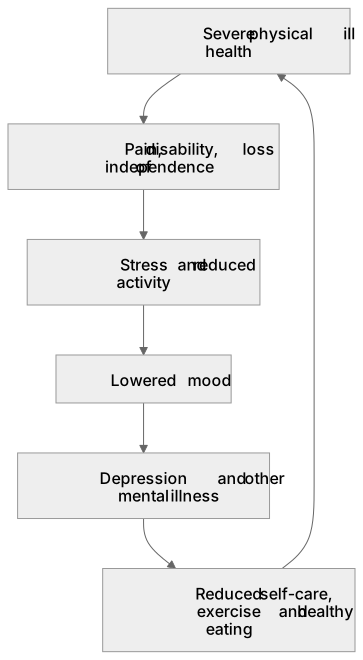
Key words
Say what each word means before you turn the card.
Health
Try answering aloud or in your head before turning the card.
Interdependence
Try answering aloud or in your head before turning the card.
Holistic care
Try answering aloud or in your head before turning the card.
See every definition
- Health
- A state of physical and mental well-being, not just the absence of disease.
- Interdependence
- A two-way feedback loop in which physical and mental health influence each other.
- Holistic care
- Treatment that addresses both physical and mental health together, such as treating pain, offering psychological support and encouraging social contact.
Label the diagram
Some boxes have lost their names. Pick the right name for each number.
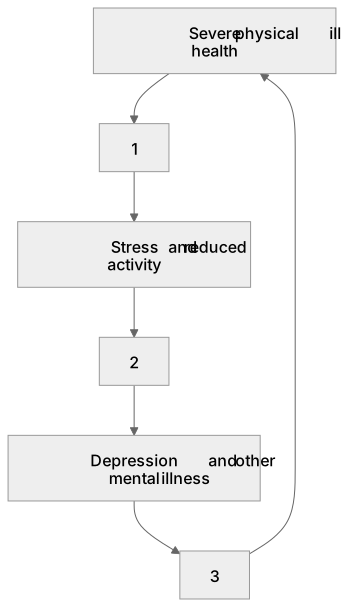
1Box 1
2Box 2
3Box 3
There is more to this lesson
The full lesson goes on to check your understanding and help you earn the marks. Create a free account to carry on, with your progress saved.
A week of Premium from your first lesson · Then the free plan continues · No card, no charge
Test your understanding of Health issues: Severe physical ill health can lead to depression and other mental illness.
Active recall beats re-reading. Take an instant quiz now to test what you’ve learned and lock it into long-term memory.
A week of Premium from your first lesson · Then the free plan continues · No card, no charge