AQA · GCSE · Biology
Course version: 8461 · Version from Sept 2018
The blood carries the hormone to a target organ where it produces an effect.
Full specification wording
Human endocrine system: The blood carries the hormone to a target organ where it produces an effect.
Once a hormone is secreted into the blood, it is transported around the body.
Checked against the AQA 8461 specification (opens in a new tab) on .
- Point 3 of 7
- 3 key terms
Study notes
From the checked teaching notes for this specification point.
The idea
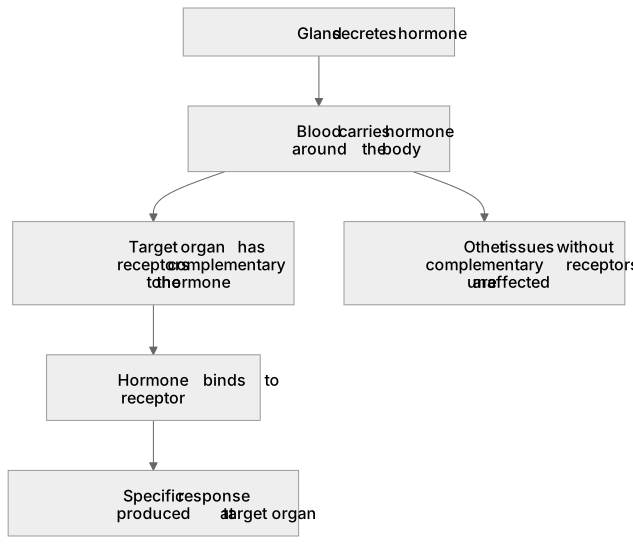
Once a hormone is secreted into the blood, it is transported around the body. A hormone only affects target organs or cells that have receptors complementary to that hormone. When the hormone binds to its receptor, it triggers a specific response. For example, insulin secreted by the pancreas is carried in the blood to the liver, where it stimulates liver cells to take up glucose and store it as glycogen, lowering blood glucose concentration. Adrenaline from the adrenal glands is carried to the heart, where it increases heart rate. This explains why hormones can act on distant organs while leaving other tissues unaffected.
What earns the marks
- State that blood transports hormones from the secreting gland to target organs.
- Explain that target cells have receptors complementary to the hormone, making the response specific.
- Give a named example, such as insulin travelling from the pancreas to the liver to reduce blood glucose.
- Describe the effect produced at the target organ, such as glycogen storage in the liver or increased heart rate from adrenaline.
- Link the hormone, its target organ and its effect in a complete cause-and-effect sequence.
Common mistakes and how to put them right
Saying the blood carries the hormone to every organ and every organ responds.
Put it right: Only target organs with complementary receptors respond.
Confusing the gland that secretes a hormone with the organ it acts on; the correction is to name both, for example the pancreas secretes insulin and the liver responds.
Stating that hormones are carried by nerves.
Put it right: Hormones are transported in the bloodstream.
Exam tips
- Write the route as gland, hormone, blood, target organ, effect to make the sequence clear.
- Name the target organ and the specific effect rather than saying 'it causes a change'.
- Use examples such as insulin acting on the liver or adrenaline acting on the heart to show understanding.
Try the lesson
The start of the Human endocrine system: The blood carries the hormone to a target organ where it produces an effect. lesson, made from checked teaching notes for this specification point.
Have a go first
What transports a hormone from the gland that made it to its target organ?
Listen
Once a hormone is secreted into the blood, it is transported around the body. A hormone only affects target organs or cells that have receptors complementary to that hormone. When the hormone binds to its receptor, it triggers a specific response. For example, insulin secreted by the pancreas is carried in the blood to the liver, where it stimulates liver cells to take up glucose and store it as glycogen, lowering blood glucose concentration. Adrenaline from the adrenal glands is carried to the heart, where it increases heart rate. This explains why hormones can act on distant organs while leaving other tissues unaffected. A strong answer earns marks for these points. State that blood transports hormones from the secreting gland to target organs. Explain that target cells have receptors complementary to the hormone, making the response specific. Give a named example, such as insulin travelling from the pancreas to the liver to reduce blood glucose. Describe the effect produced at the target organ, such as glycogen storage in the liver or increased heart rate from adrenaline. A common slip: Saying the blood carries the hormone to every organ and every organ responds. Instead, only target organs with complementary receptors respond. Exam tip: Write the route as gland, hormone, blood, target organ, effect to make the sequence clear.
See it
Key words
Say what each word means before you turn the card.
Blood transport of hormones
Try answering aloud or in your head before turning the card.
Target organ specificity
Try answering aloud or in your head before turning the card.
Receptor-hormone binding
Try answering aloud or in your head before turning the card.
See every definition
- Blood transport of hormones
- The blood carries the hormone from the secreting gland to a target organ where it produces an effect.
- Target organ specificity
- A hormone only affects target organs or cells that have receptors complementary to that hormone, leaving other tissues unaffected.
- Receptor-hormone binding
- When the hormone binds to its receptor, it triggers a specific response.
Label the diagram
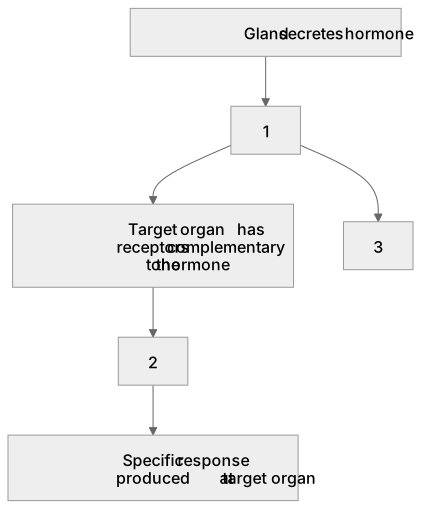
Some boxes have lost their names. Pick the right name for each number.
1Box 1
2Box 2
3Box 3
There is more to this lesson
The full lesson goes on to check your understanding and help you earn the marks. Create a free account to carry on, with your progress saved.
A week of Premium from your first lesson · Then the free plan continues · No card, no charge
Test your understanding of Human endocrine system: The blood carries the hormone to a target organ where it produces an effect.
Active recall beats re-reading. Take an instant quiz now to test what you’ve learned and lock it into long-term memory.
A week of Premium from your first lesson · Then the free plan continues · No card, no charge