AQA · GCSE · Biology
Course version: 8461 · Version from Sept 2018
Compared to the nervous system the effects are slower but act for longer.
Full specification wording
Human endocrine system: Compared to the nervous system the effects are slower but act for longer.
The nervous system and the endocrine system are the two main coordination systems in the body.
Checked against the AQA 8461 specification (opens in a new tab) on .
- Point 4 of 7
Study notes
From the checked teaching notes for this specification point.
The idea
The nervous system and the endocrine system are the two main coordination systems in the body. Nervous coordination uses electrical impulses travelling along neurones, so responses are almost immediate but short-lived. Endocrine coordination uses hormones secreted into the blood, which must be transported to target organs before they act, so responses are slower but the effects persist for longer.
For example: The hormone adrenaline is released from the adrenal glands during a stressful event; its effects on heart rate and breathing develop over seconds to minutes and last well beyond the initial stimulus, whereas a reflex withdrawal of the hand from a hot object is instantaneous but stops as soon as the impulse ceases.
What earns the marks
- Hormones are chemical messengers secreted by endocrine glands directly into the bloodstream.
- Hormones are carried in the blood to target organs, which takes time, so endocrine responses are slower than nervous responses.
- Nervous responses use electrical impulses along neurones and are rapid but short-lived.
- Endocrine effects act for longer because hormones remain in the blood and continue to stimulate target cells.
- A valid comparison must refer to both speed and duration, not just one feature.
- A suitable example, such as adrenaline increasing heart rate for a sustained period, can support the comparison.
Common mistakes and how to put them right
Stating that hormones travel along nerves.
Put it right: Hormones travel in the blood plasma to target organs.
Claiming that nervous responses last longer than endocrine responses.
Put it right: Nervous responses are rapid and short-lived, while endocrine effects are slower to start but last longer.
Writing that hormones act on any cell they contact.
Put it right: Hormones act only on target cells that have the complementary receptors.
Exam tips
- Use comparative language such as slower and longer, because the question asks you to compare the two systems.
- Link each statement to a named example, such as a reflex action for the nervous system and adrenaline for the endocrine system.
- Check that your answer covers both speed and duration, as marks are often awarded for each distinct comparison.
Try the lesson
The start of the Human endocrine system: Compared to the nervous system the effects are slower but act for longer. lesson, made from checked teaching notes for this specification point.
Have a go first
Which statement describes how the effects of the endocrine system compare with the effects of the nervous system?
Listen
The nervous system and the endocrine system are the two main coordination systems in the body. Nervous coordination uses electrical impulses travelling along neurones, so responses are almost immediate but short-lived. Endocrine coordination uses hormones secreted into the blood, which must be transported to target organs before they act, so responses are slower but the effects persist for longer. For example, the hormone adrenaline is released from the adrenal glands during a stressful event; its effects on heart rate and breathing develop over seconds to minutes and last well beyond the initial stimulus, whereas a reflex withdrawal of the hand from a hot object is instantaneous but stops as soon as the impulse ceases. A strong answer earns marks for these points. Hormones are chemical messengers secreted by endocrine glands directly into the bloodstream. Hormones are carried in the blood to target organs, which takes time, so endocrine responses are slower than nervous responses. Nervous responses use electrical impulses along neurones and are rapid but short-lived. Endocrine effects act for longer because hormones remain in the blood and continue to stimulate target cells. A common slip: Stating that hormones travel along nerves. Instead, hormones travel in the blood plasma to target organs. Exam tip: Use comparative language such as slower and longer, because the question asks you to compare the two systems.
See it
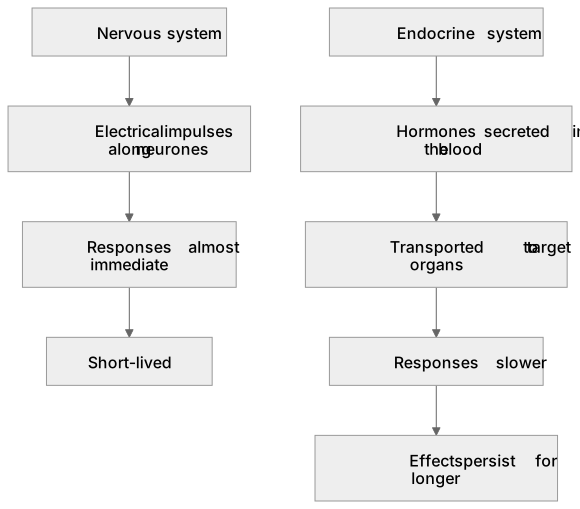
Label the diagram
Some boxes have lost their names. Pick the right name for each number.
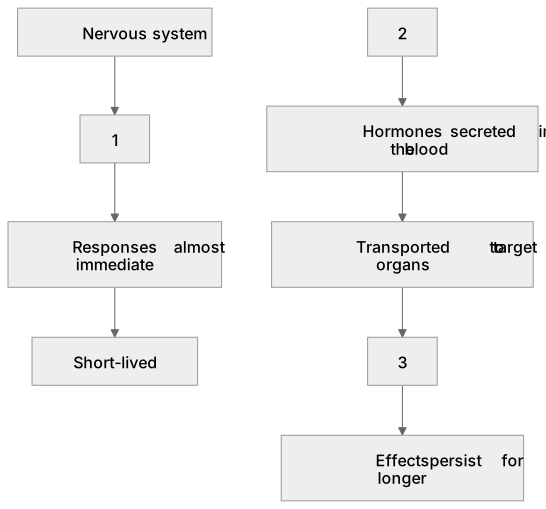
1Box 1
2Box 2
3Box 3
There is more to this lesson
The full lesson goes on to check your understanding and help you earn the marks. Create a free account to carry on, with your progress saved.
A week of Premium from your first lesson · Then the free plan continues · No card, no charge
Test your understanding of Human endocrine system: Compared to the nervous system the effects are slower but act for longer.
Active recall beats re-reading. Take an instant quiz now to test what you’ve learned and lock it into long-term memory.
A week of Premium from your first lesson · Then the free plan continues · No card, no charge