AQA · GCSE · Biology
Course version: 8461 · Version from Sept 2018
Students should be able to evaluate the impact of environmental changes on…
Full specification wording
Impact of environmental change (biology only) (HT only): Students should be able to evaluate the impact of environmental changes on the distribution of species in an ecosystem given appropriate information.
Distribution describes where organisms of a species are found within an ecosystem.
Checked against the AQA 8461 specification (opens in a new tab) on .
- Point 1 of 3
- 2 key terms
Study notes
From the checked teaching notes for this specification point.
The idea
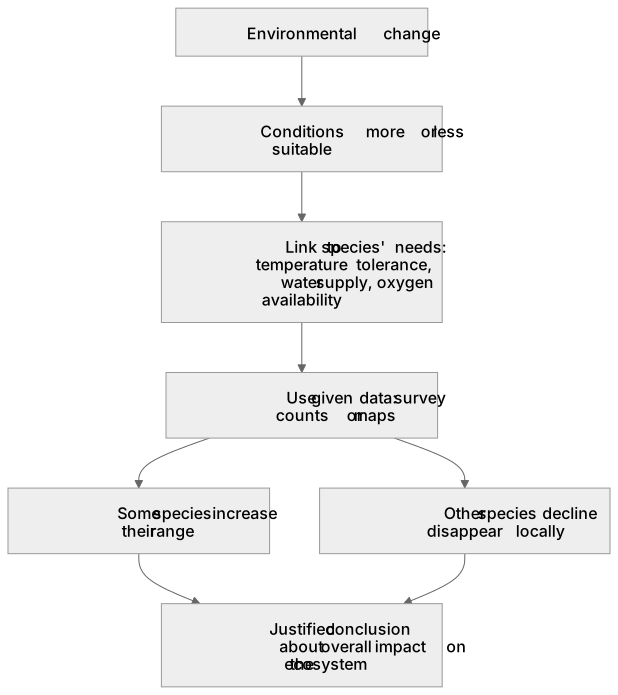
Distribution describes where organisms of a species are found within an ecosystem. Environmental changes can make conditions more or less suitable, so species may spread into new areas, become restricted to smaller areas, or disappear locally. To evaluate an impact you use the information provided, such as survey data, maps or graphs, and reason about how a change affects the needs of the species. For example, if a river becomes warmer, a cold-water fish may move upstream while a warm-water species extends its range. Evaluation means weighing the evidence, identifying which species benefit or suffer, and explaining the likely effect on distribution using biological ideas such as temperature tolerance, water availability and gas exchange.
What earns the marks
- Define distribution as where a species is found within an ecosystem.
- Identify the environmental change described in the information and state whether it makes conditions more or less suitable.
- Link the change to the species' needs, such as temperature tolerance, water supply or oxygen availability.
- Use the given data, such as survey counts or maps, to support a judgement about how distribution changes.
- Explain that some species may increase their range while others decline or disappear locally.
- Reach a justified conclusion about the overall impact on the ecosystem.
Common mistakes and how to put them right
Describing the environmental change without linking it to species distribution.
Put it right by explaining how the change affects where the species can survive.
Ignoring the provided data and giving a general answer.
Put it right by quoting specific figures or patterns from the information.
Assuming all species respond in the same way.
Put it right by recognising that different species have different tolerances and may benefit or suffer.
Exam tips
- Always refer to the data or information given in the question rather than relying on memory alone.
- Use comparative language such as increased, decreased, restricted or extended when describing distribution changes.
- Structure your evaluation as change, effect on species, evidence, and overall judgement.
Try the lesson
The start of the Impact of environmental change (biology only) (HT only): Students should be able to evaluate the impact of environmental changes on the distribution of species in an ecosystem given appropriate information. lesson, made from checked teaching notes for this specification point.
Have a go first
Scientists recorded the distribution of two plant species on a mountain. Over 50 years, the average temperature increased by 1.5 °C. Originally, Species A grew between 500 m and 1000 m, and Species B grew between 1000 m and 1500 m. Now, Species A grows between 500 m and 1200 m, and Species B grows between 1200 m and 1500 m. Which evaluation of this environmental change is most valid?
Listen
Distribution describes where organisms of a species are found within an ecosystem. Environmental changes can make conditions more or less suitable, so species may spread into new areas, become restricted to smaller areas, or disappear locally. To evaluate an impact you use the information provided, such as survey data, maps or graphs, and reason about how a change affects the needs of the species. For example, if a river becomes warmer, a cold-water fish may move upstream while a warm-water species extends its range. Evaluation means weighing the evidence, identifying which species benefit or suffer, and explaining the likely effect on distribution using biological ideas such as temperature tolerance, water availability and gas exchange. A strong answer earns marks for these points. Define distribution as where a species is found within an ecosystem. Identify the environmental change described in the information and state whether it makes conditions more or less suitable. Link the change to the species' needs, such as temperature tolerance, water supply or oxygen availability. Use the given data, such as survey counts or maps, to support a judgement about how distribution changes. A common slip: Describing the environmental change without linking it to species distribution. Instead, explaining how the change affects where the species can survive. Exam tip: Always refer to the data or information given in the question rather than relying on memory alone.
See it
Key words
Say what each word means before you turn the card.
Distribution of species
Try answering aloud or in your head before turning the card.
Environmental change
Try answering aloud or in your head before turning the card.
See every definition
- Distribution of species
- Where organisms of a species are found within an ecosystem.
- Environmental change
- A change that can make conditions in an ecosystem more or less suitable, so species may spread into new areas, become restricted to smaller areas, or disappear locally.
Label the diagram
Some boxes have lost their names. Pick the right name for each number.
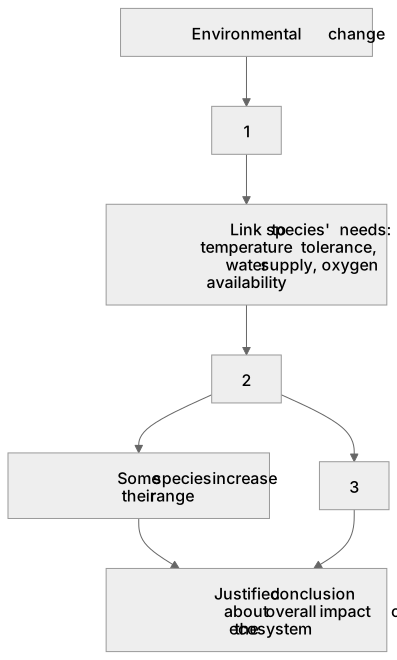
1Box 1
2Box 2
3Box 3
There is more to this lesson
The full lesson goes on to check your understanding and help you earn the marks. Create a free account to carry on, with your progress saved.
A week of Premium from your first lesson · Then the free plan continues · No card, no charge
Test your understanding of Impact of environmental change (biology only) (HT only): Students should be able to evaluate the impact of environmental changes on the distribution of species in an ecosystem given appropriate information.
Active recall beats re-reading. Take an instant quiz now to test what you’ve learned and lock it into long-term memory.
A week of Premium from your first lesson · Then the free plan continues · No card, no charge