AQA · GCSE · Biology
Course version: 8461 · Version from Sept 2018
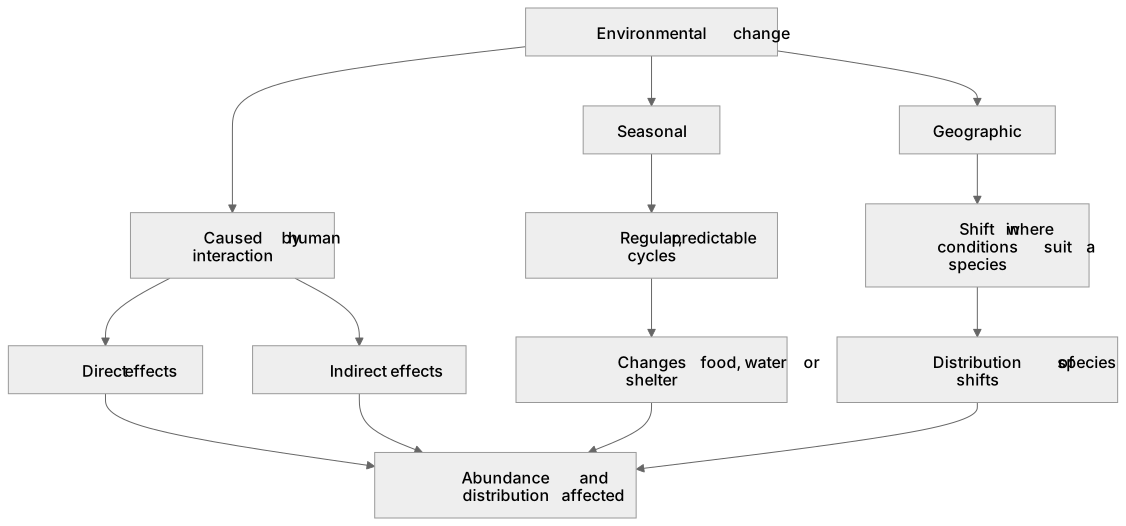
The changes may be seasonal, geographic or caused by human interaction.
Full specification wording
Impact of environmental change (biology only) (HT only): The changes may be seasonal, geographic or caused by human interaction.
Environmental conditions are not fixed, so the distribution and abundance of organisms shift over time.
Checked against the AQA 8461 specification (opens in a new tab) on .
- Point 3 of 3
- 3 key terms
Study notes
From the checked teaching notes for this specification point.
The idea
Environmental conditions are not fixed, so the distribution and abundance of organisms shift over time. Seasonal changes follow regular cycles: day length and temperature alter in temperate regions, so many birds migrate and deciduous trees lose leaves, changing food and shelter. Geographic changes are longer-term shifts in where conditions suit a species, such as altered rainfall or a warming climate moving suitable habitat uphill or towards the poles. Human interaction covers direct and indirect effects: clearing hedgerows removes shelter, draining a wetland destroys breeding sites, while planting a wildflower strip can increase pollinator numbers. These categories overlap, and a change in one factor often alters competition and predator-prey relationships.
What earns the marks
- Seasonal changes are regular, predictable cycles such as changing day length, temperature or rainfall across the year.
- Seasonal change alters the availability of food, water or shelter, so organisms may migrate, hibernate or become dormant.
- Geographic changes are shifts in the distribution of suitable conditions, for example a species' range moving towards the poles or to higher altitude as the climate warms.
- Human interaction includes direct effects such as deforestation, drainage, pollution and building, and indirect effects such as introducing species or changing land use.
- A change in an environmental factor can alter the abundance and distribution of a species by affecting competition, predation or breeding success.
- Different causes can act together, so a seasonal drought may be made worse by abstraction of water for human use.
Common mistakes and how to put them right
Treating seasonal change as random weather.
Put it right: Seasonal change is a regular, repeating pattern linked to the time of year, whereas weather events are short-term and unpredictable.
Assuming geographic change always means the whole planet changes at once.
Put it right: It refers to a shift in the area where conditions suit a species, which may be local or regional.
Describing human interaction only as habitat destruction.
Put it right: Human activity can also create or improve habitats, for example by planting trees or creating ponds.
Exam tips
- Read the question carefully to identify whether the change described is seasonal, geographic or caused by human interaction, then justify your choice using evidence from the information given.
- When asked to explain an effect, link the change to a named factor such as food, shelter or breeding sites, then state the consequence for the population.
- Use comparative language such as 'increases', 'decreases' or 'shifts' rather than vague words like 'affects', and refer to distribution or abundance explicitly.
Try the lesson
The start of the Impact of environmental change (biology only) (HT only): The changes may be seasonal, geographic or caused by human interaction. lesson, made from checked teaching notes for this specification point.
Have a go first
Researchers monitored a population of migratory birds in a UK woodland over 10 years. The birds were present from April to September but absent from October to March. Over the 10-year period, the total number of breeding pairs declined by 40%, which correlated with the construction of a large nearby housing estate. Which combination of environmental changes best explains these observations?
Listen
Environmental conditions are not fixed, so the distribution and abundance of organisms shift over time. Seasonal changes follow regular cycles: day length and temperature alter in temperate regions, so many birds migrate and deciduous trees lose leaves, changing food and shelter. Geographic changes are longer-term shifts in where conditions suit a species, such as altered rainfall or a warming climate moving suitable habitat uphill or towards the poles. Human interaction covers direct and indirect effects: clearing hedgerows removes shelter, draining a wetland destroys breeding sites, while planting a wildflower strip can increase pollinator numbers. These categories overlap, and a change in one factor often alters competition and predator-prey relationships. A strong answer earns marks for these points. Seasonal changes are regular, predictable cycles such as changing day length, temperature or rainfall across the year. Seasonal change alters the availability of food, water or shelter, so organisms may migrate, hibernate or become dormant. Geographic changes are shifts in the distribution of suitable conditions, for example a species' range moving towards the poles or to higher altitude as the climate warms. Human interaction includes direct effects such as deforestation, drainage, pollution and building, and indirect effects such as introducing species or changing land use. Exam tip: Read the question carefully to identify whether the change described is seasonal, geographic or caused by human interaction, then justify your choice using evidence from the information given.
See it
Key words
Say what each word means before you turn the card.
Seasonal change
Try answering aloud or in your head before turning the card.
Geographic change
Try answering aloud or in your head before turning the card.
Human interaction
Try answering aloud or in your head before turning the card.
See every definition
- Seasonal change
- Regular, predictable cycles such as changing day length, temperature or rainfall across the year.
- Geographic change
- A shift in the distribution of suitable conditions, for example a species' range moving towards the poles or to higher altitude as the climate warms.
- Human interaction
- Direct effects such as deforestation, drainage, pollution and building, and indirect effects such as introducing species or changing land use.
Label the diagram
Some boxes have lost their names. Pick the right name for each number.
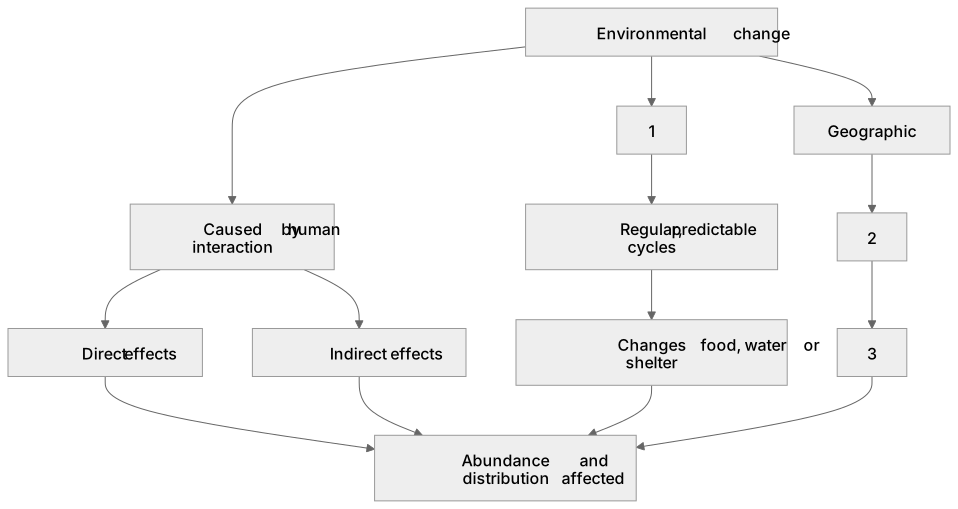
1Box 1
2Box 2
3Box 3
There is more to this lesson
The full lesson goes on to check your understanding and help you earn the marks. Create a free account to carry on, with your progress saved.
A week of Premium from your first lesson · Then the free plan continues · No card, no charge
Test your understanding of Impact of environmental change (biology only) (HT only): The changes may be seasonal, geographic or caused by human interaction.
Active recall beats re-reading. Take an instant quiz now to test what you’ve learned and lock it into long-term memory.
A week of Premium from your first lesson · Then the free plan continues · No card, no charge