AQA · GCSE · Biology
Course version: 8461 · Version from Sept 2018
Cystic fibrosis (a disorder of cell membranes) is caused by a recessive…
Full specification wording
Inherited disorders: Cystic fibrosis (a disorder of cell membranes) is caused by a recessive allele.
Cystic fibrosis is a disorder that affects cell membranes, particularly in the lungs and digestive system, causing thick mucus.
Checked against the AQA 8461 specification (opens in a new tab) on .
- Point 3 of 4
Study notes
From the checked teaching notes for this specification point.
The idea
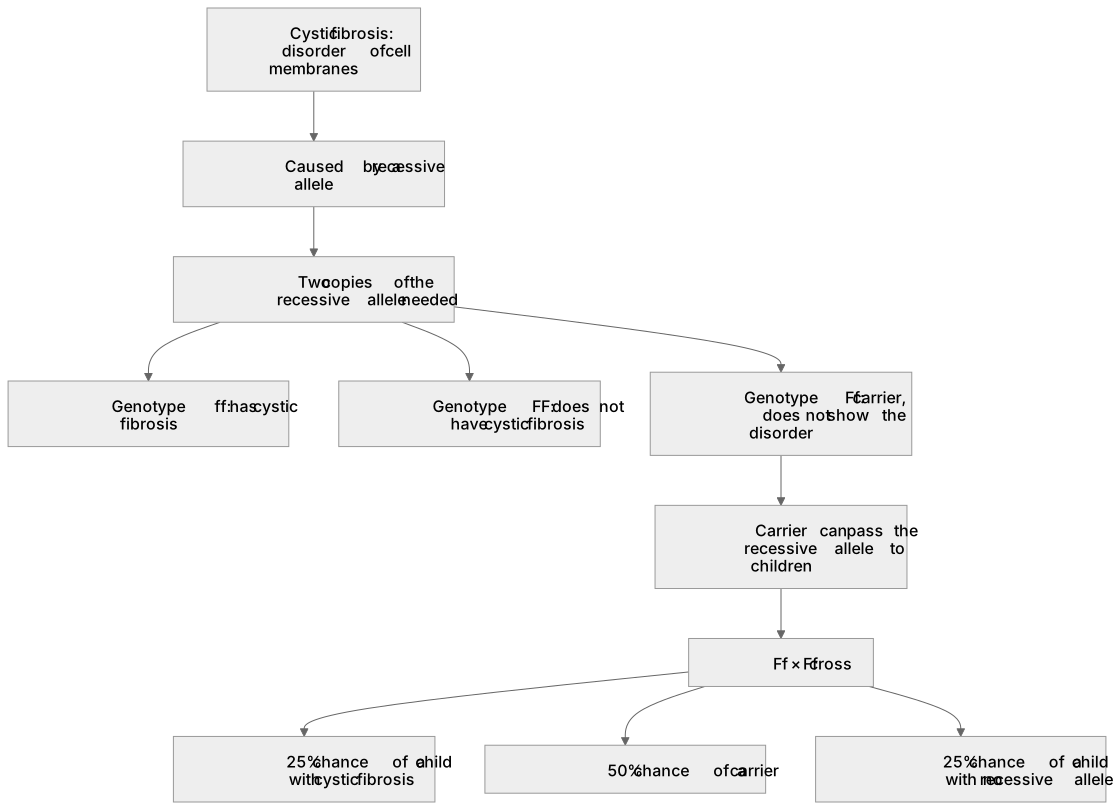
Cystic fibrosis is a disorder that affects cell membranes, particularly in the lungs and digestive system, causing thick mucus. It is caused by a recessive allele, so two copies of the recessive allele are needed for a person to have the disorder. We can write the dominant allele as F and the recessive allele as f. A person with genotype ff has cystic fibrosis, while FF and Ff do not. People with Ff are carriers: they have one recessive allele but do not show the disorder, and they can pass the allele to their children.
For example: If two carriers Ff × Ff have children, there is a 25% chance of a child with cystic fibrosis, a 50% chance of a carrier and a 25% chance of a child with no recessive allele.
What earns the marks
- States that cystic fibrosis is caused by a recessive allele, so two copies of the allele are needed for the disorder to be expressed.
- Uses correct genetic symbols, such as F for the dominant allele and f for the recessive allele, and identifies ff as the genotype of a person with cystic fibrosis.
- Identifies FF and Ff as genotypes of people who do not have cystic fibrosis.
- Explains that a person with genotype Ff is a carrier who does not show the disorder but can pass on the recessive allele.
- Completes a monohybrid cross, such as Ff × Ff, and states the expected ratio or percentage of offspring with cystic fibrosis, carriers and unaffected non-carriers.
- Links the disorder to cell membranes, for example by stating that cystic fibrosis affects the movement of substances across cell membranes and causes thick mucus.
Common mistakes and how to put them right
Thinking that one copy of the recessive allele causes cystic fibrosis.
Put it right: Two copies are needed, so only ff shows the disorder.
Assuming that a carrier must show symptoms.
Put it right: A carrier has one recessive allele and one dominant allele, so they do not have the disorder but can pass it on.
Forgetting that both parents must pass on a recessive allele for a child to be affected.
Put it right: Show in a genetic cross that each parent contributes one allele to the offspring.
Exam tips
- Use a key to define dominant and recessive alleles before drawing a genetic cross, and keep the same letters throughout your answer.
- When calculating probability, count the number of squares in the Punnett square that match the required genotype and express this as a fraction, percentage or ratio.
- Read the question carefully to check whether it asks about the chance of a child being affected, being a carrier or being completely unaffected.
Try the lesson
The start of the Inherited disorders: Cystic fibrosis (a disorder of cell membranes) is caused by a recessive allele. lesson, made from checked teaching notes for this specification point.
Have a go first
Cystic fibrosis is caused by a recessive allele. What must be true for a person to have cystic fibrosis?
Listen
Cystic fibrosis is a disorder that affects cell membranes, particularly in the lungs and digestive system, causing thick mucus. It is caused by a recessive allele, so two copies of the recessive allele are needed for a person to have the disorder. We can write the dominant allele as F and the recessive allele as f. A person with genotype ff has cystic fibrosis, while FF and Ff do not. People with Ff are carriers: they have one recessive allele but do not show the disorder, and they can pass the allele to their children. For example, if two carriers Ff × Ff have children, there is a 25% chance of a child with cystic fibrosis, a 50% chance of a carrier and a 25% chance of a child with no recessive allele. A strong answer earns marks for these points. States that cystic fibrosis is caused by a recessive allele, so two copies of the allele are needed for the disorder to be expressed. Uses correct genetic symbols, such as F for the dominant allele and f for the recessive allele, and identifies ff as the genotype of a person with cystic fibrosis. Identifies FF and Ff as genotypes of people who do not have cystic fibrosis. Explains that a person with genotype Ff is a carrier who does not show the disorder but can pass on the recessive allele. A common slip: Thinking that one copy of the recessive allele causes cystic fibrosis. Instead, two copies are needed, so only ff shows the disorder. Exam tip: Use a key to define dominant and recessive alleles before drawing a genetic cross, and keep the same letters throughout your answer.
See it
Label the diagram
Some boxes have lost their names. Pick the right name for each number.
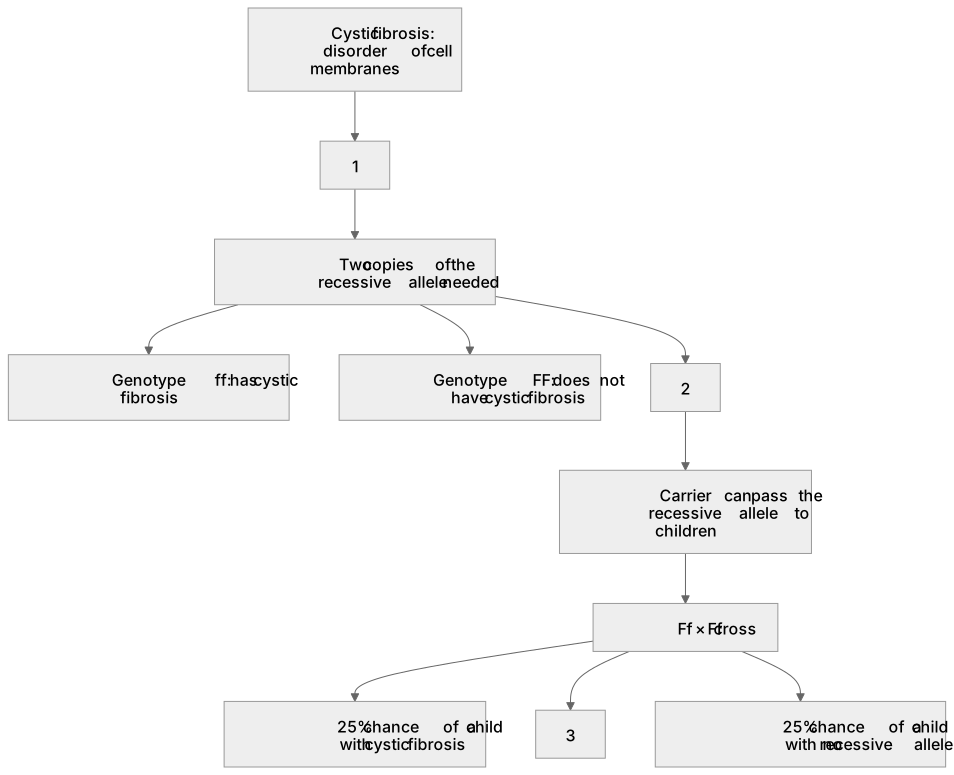
1Box 1
2Box 2
3Box 3
There is more to this lesson
The full lesson goes on to check your understanding and help you earn the marks. Create a free account to carry on, with your progress saved.
A week of Premium from your first lesson · Then the free plan continues · No card, no charge
Test your understanding of Inherited disorders: Cystic fibrosis (a disorder of cell membranes) is caused by a recessive allele.
Active recall beats re-reading. Take an instant quiz now to test what you’ve learned and lock it into long-term memory.
A week of Premium from your first lesson · Then the free plan continues · No card, no charge