AQA · GCSE · Biology
Course version: 8461 · Version from Sept 2018
Polydactyly (having extra fingers or toes) is caused by a dominant allele.
Full specification wording
Inherited disorders: Polydactyly (having extra fingers or toes) is caused by a dominant allele.
Polydactyly means a person is born with extra fingers or toes.
Checked against the AQA 8461 specification (opens in a new tab) on .
- Point 2 of 4
- 3 key terms
Study notes
From the checked teaching notes for this specification point.
The idea
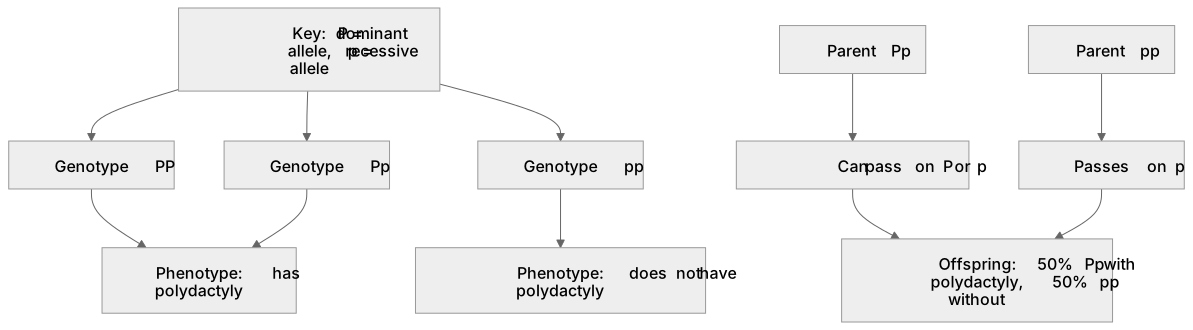
Polydactyly means a person is born with extra fingers or toes. It is caused by a dominant allele, so only one copy of that allele is needed for the feature to appear. We can write the dominant allele as P and the recessive allele as p. A person with genotype PP or Pp has polydactyly, while pp does not. Because the allele is dominant, an affected parent can pass it on even if the other parent has two recessive alleles. For example, a Pp parent crossed with a pp parent gives a 50% chance of Pp offspring with polydactyly and a 50% chance of pp offspring without it. This explains why the condition can appear in every generation of a family.
What earns the marks
- States that polydactyly is caused by a dominant allele, so only one copy of the allele is needed for the condition to be expressed.
- Uses correct genetic symbols, such as P for the dominant allele and p for the recessive allele, and identifies PP and Pp as genotypes showing polydactyly.
- Identifies pp as the genotype of a person who does not have polydactyly.
- Completes a monohybrid cross, such as Pp × pp, and states the expected ratio or percentage of offspring with and without polydactyly.
- Explains that an affected parent with genotype Pp can pass on either P or p, so some offspring may inherit the condition and some may not.
- Distinguishes dominant inheritance from recessive inheritance by noting that a dominant disorder can be passed on by a parent who has the condition.
Common mistakes and how to put them right
Thinking that two copies of the dominant allele are needed.
Put it right: One copy of a dominant allele is enough for polydactyly to be expressed.
Writing genotypes without a clear key.
Put it right: Define the symbols first, for example P for the dominant allele and p for the recessive allele.
Confusing genotype with phenotype.
Put it right: State that PP and Pp are genotypes that produce the phenotype of having extra fingers or toes, while pp produces the phenotype without polydactyly.
Exam tips
- Always write a key before using letters in a genetic cross, so the examiner can follow your reasoning.
- When asked to complete a Punnett square, fill in the parental gametes along the top and side, then combine them carefully to avoid copying errors.
- Link the ratio or probability to the question wording, for example stating the chance that a child will have polydactyly rather than only giving the genotypes.
Try the lesson
The start of the Inherited disorders: Polydactyly (having extra fingers or toes) is caused by a dominant allele. lesson, made from checked teaching notes for this specification point.
Have a go first
Polydactyly is caused by a dominant allele. What does this mean for a person who has one dominant allele for polydactyly?
Listen
Polydactyly means a person is born with extra fingers or toes. It is caused by a dominant allele, so only one copy of that allele is needed for the feature to appear. We can write the dominant allele as P and the recessive allele as p. A person with genotype PP or Pp has polydactyly, while pp does not. Because the allele is dominant, an affected parent can pass it on even if the other parent has two recessive alleles. For example, a Pp parent crossed with a pp parent gives a 50% chance of Pp offspring with polydactyly and a 50% chance of pp offspring without it. This explains why the condition can appear in every generation of a family. A strong answer earns marks for these points. States that polydactyly is caused by a dominant allele, so only one copy of the allele is needed for the condition to be expressed. Uses correct genetic symbols, such as P for the dominant allele and p for the recessive allele, and identifies PP and Pp as genotypes showing polydactyly. Identifies pp as the genotype of a person who does not have polydactyly. Completes a monohybrid cross, such as Pp × pp, and states the expected ratio or percentage of offspring with and without polydactyly. A common slip: Thinking that two copies of the dominant allele are needed. Instead, one copy of a dominant allele is enough for polydactyly to be expressed. Exam tip: Always write a key before using letters in a genetic cross, so the examiner can follow your reasoning.
See it
Key words
Say what each word means before you turn the card.
Dominant allele
Try answering aloud or in your head before turning the card.
Genotype
Try answering aloud or in your head before turning the card.
Phenotype
Try answering aloud or in your head before turning the card.
See every definition
- Dominant allele
- An allele of which only one copy is needed for the feature to appear, and which causes polydactyly.
- Genotype
- The alleles a person has, written as PP or Pp for polydactyly and pp for no polydactyly.
- Phenotype
- The feature produced by the genotype, such as having extra fingers or toes with PP or Pp, or not with pp.
Label the diagram
Some boxes have lost their names. Pick the right name for each number.
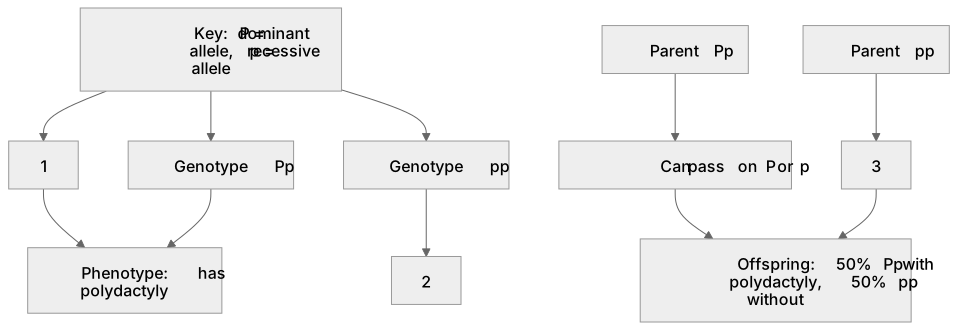
1Box 1
2Box 2
3Box 3
There is more to this lesson
The full lesson goes on to check your understanding and help you earn the marks. Create a free account to carry on, with your progress saved.
A week of Premium from your first lesson · Then the free plan continues · No card, no charge
Test your understanding of Inherited disorders: Polydactyly (having extra fingers or toes) is caused by a dominant allele.
Active recall beats re-reading. Take an instant quiz now to test what you’ve learned and lock it into long-term memory.
A week of Premium from your first lesson · Then the free plan continues · No card, no charge