AQA · GCSE · Biology
Course version: 8461 · Version from Sept 2018
Humans reduce the amount of land available for other animals and plants by…
Full specification wording
Land use: Humans reduce the amount of land available for other animals and plants by building, quarrying, farming and dumping waste.
The land surface is finite, so land used for human purposes is unavailable as habitat for other organisms.
Checked against the AQA 8461 specification (opens in a new tab) on .
- Point 1 of 3
Study notes
From the checked teaching notes for this specification point.
The idea
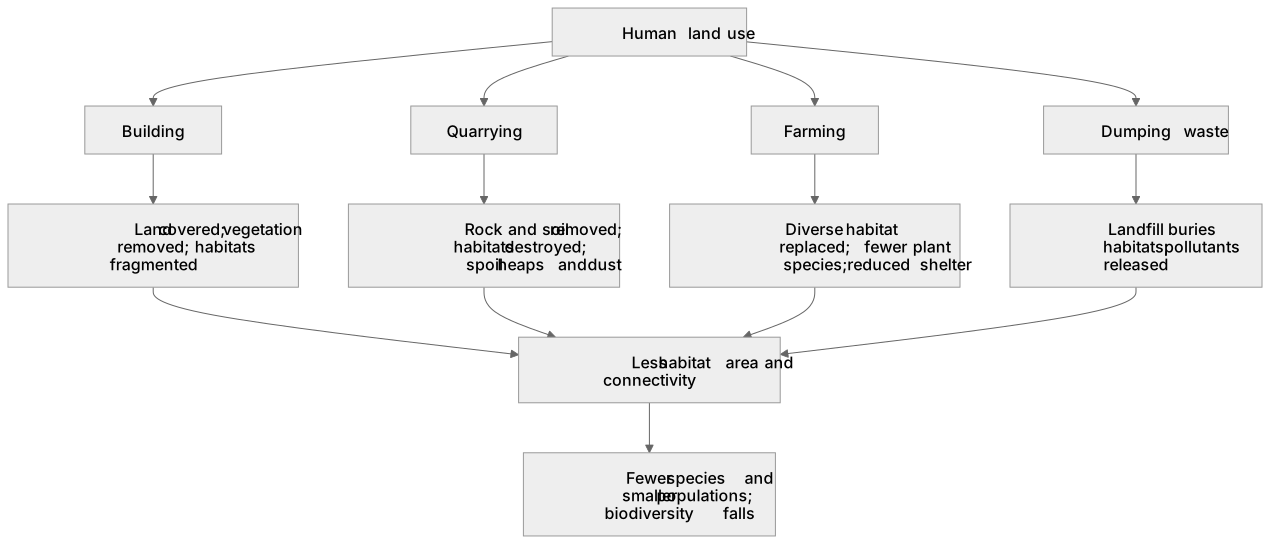
The land surface is finite, so land used for human purposes is unavailable as habitat for other organisms. Building covers land with houses, roads, factories and airports, removing vegetation and fragmenting what remains. Quarrying removes rock and soil, destroying habitats directly and leaving spoil heaps and dust. Farming uses large areas for crops, pasture and livestock, and may replace diverse ecosystems with single-species fields, while hedgerow removal and drainage reduce shelter and breeding sites. Dumping waste creates landfill sites that bury habitats and can release pollutants. Each activity reduces the area, quality or connectivity of habitats. Smaller, isolated habitats support fewer species and smaller populations, which are more vulnerable to extinction. The overall effect is a reduction in biodiversity, although some species may benefit from human-made environments.
What earns the marks
- Land is a finite resource, so land used by humans is not available as habitat for other organisms.
- Building covers land with structures and surfaces, removing vegetation and fragmenting habitats.
- Quarrying removes rock and soil, destroying habitats and creating spoil heaps and dust.
- Farming replaces diverse habitats with managed land, often with few plant species and reduced shelter.
- Dumping waste creates landfill and polluted ground, burying or damaging habitats.
- Reduced habitat area and connectivity lower species richness and population sizes, so biodiversity falls.
Common mistakes and how to put them right
Thinking only building reduces land.
Put it right: Quarrying, farming and waste dumping also remove or degrade habitat.
Confusing land use with pollution.
Put it right: Land use is about the area and quality of habitat lost, while pollution is about harmful substances released.
Assuming farming always increases biodiversity because plants are present.
Put it right: Monoculture fields usually support fewer species than the diverse habitat they replace.
Exam tips
- Use all four named activities from the statement and give a habitat effect for each.
- Link each activity to a consequence such as habitat loss, fragmentation or reduced species richness.
- Use comparative language such as fewer species and smaller populations to show the effect on biodiversity.
Try the lesson
The start of the Land use: Humans reduce the amount of land available for other animals and plants by building, quarrying, farming and dumping waste. lesson, made from checked teaching notes for this specification point.
Have a go first
A new housing estate is built on a field where wild flowers and insects used to live. What effect does this building have on the land available for other organisms?
Listen
The land surface is finite, so land used for human purposes is unavailable as habitat for other organisms. Building covers land with houses, roads, factories and airports, removing vegetation and fragmenting what remains. Quarrying removes rock and soil, destroying habitats directly and leaving spoil heaps and dust. Farming uses large areas for crops, pasture and livestock, and may replace diverse ecosystems with single-species fields, while hedgerow removal and drainage reduce shelter and breeding sites. Dumping waste creates landfill sites that bury habitats and can release pollutants. Each activity reduces the area, quality or connectivity of habitats. Smaller, isolated habitats support fewer species and smaller populations, which are more vulnerable to extinction. The overall effect is a reduction in biodiversity, although some species may benefit from human-made environments. A strong answer earns marks for these points. Land is a finite resource, so land used by humans is not available as habitat for other organisms. Building covers land with structures and surfaces, removing vegetation and fragmenting habitats. Quarrying removes rock and soil, destroying habitats and creating spoil heaps and dust. Farming replaces diverse habitats with managed land, often with few plant species and reduced shelter. A common slip: Thinking only building reduces land. Instead, quarrying, farming and waste dumping also remove or degrade habitat. Exam tip: Use all four named activities from the statement and give a habitat effect for each.
See it
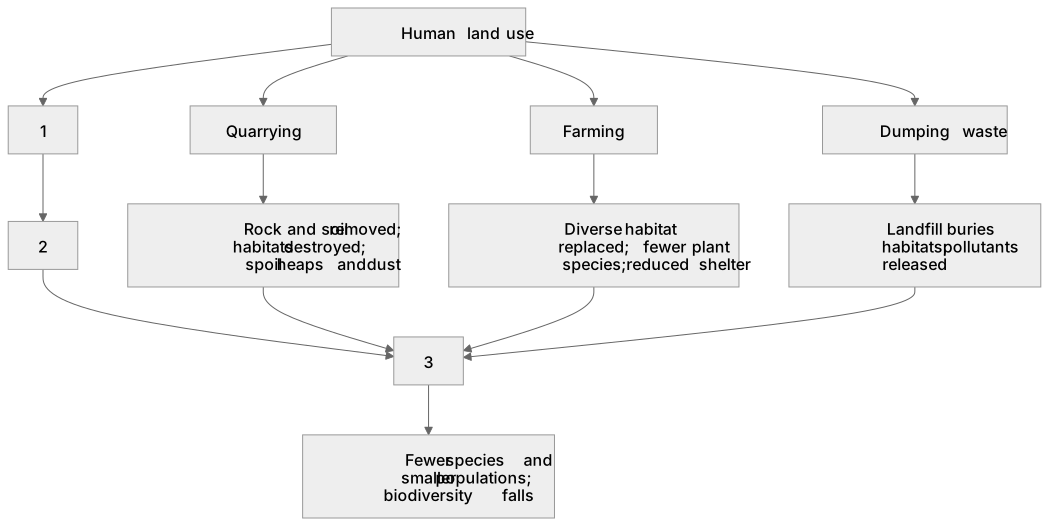
Label the diagram
Some boxes have lost their names. Pick the right name for each number.
1Box 1
2Box 2
3Box 3
There is more to this lesson
The full lesson goes on to check your understanding and help you earn the marks. Create a free account to carry on, with your progress saved.
A week of Premium from your first lesson · Then the free plan continues · No card, no charge
Test your understanding of Land use: Humans reduce the amount of land available for other animals and plants by building, quarrying, farming and dumping waste.
Active recall beats re-reading. Take an instant quiz now to test what you’ve learned and lock it into long-term memory.
A week of Premium from your first lesson · Then the free plan continues · No card, no charge