AQA · GCSE · Biology
Course version: 8461 · Version from Sept 2018
The destruction of peat bogs, and other areas of peat to produce garden…
Full specification wording
Land use: The destruction of peat bogs, and other areas of peat to produce garden compost, reduces the area of this habitat and thus the variety of different plant, animal and microorganism species that live there (biodiversity).
Peat bogs are waterlogged, acidic, low-oxygen habitats where dead plant material accumulates over thousands of years because decomposition is very slow.
Checked against the AQA 8461 specification (opens in a new tab) on .
- Point 2 of 3
Study notes
From the checked teaching notes for this specification point.
The idea
Peat bogs are waterlogged, acidic, low-oxygen habitats where dead plant material accumulates over thousands of years because decomposition is very slow. This waterlogged peat supports specialised plants such as sphagnum mosses, plus insects, birds and microorganisms adapted to the wet, acidic conditions. Peat is extracted and sold as garden compost or soil improver. Extraction drains the bog, removes the peat layer and destroys the habitat. The area of peat bog decreases, so the range of plant, animal and microorganism species living there falls. Species that cannot survive elsewhere may become locally extinct. Even after extraction stops, a bog may take a very long time to recover because peat forms slowly. The loss is therefore a reduction in biodiversity caused by destroying a specific habitat for a human product.
What earns the marks
- Peat bogs are waterlogged, acidic, low-oxygen habitats where decomposition is slow and peat accumulates.
- Peat is extracted and used to produce garden compost or soil improver.
- Extraction drains and removes the peat, destroying the bog habitat.
- The area of peat bog habitat is reduced.
- Specialised plants, animals and microorganisms lose their habitat, so the variety of species living there decreases.
- The reduction in the variety of species is a reduction in biodiversity, and recovery is very slow because peat forms over thousands of years.
Common mistakes and how to put them right
Saying peat is a renewable resource on a human timescale.
Put it right: Peat accumulates very slowly, so extraction is effectively non-renewable.
Thinking only plants are affected.
Put it right: The statement includes plants, animals and microorganisms, all of which lose habitat.
Confusing peat destruction with pollution.
Put it right: The primary issue is habitat destruction and loss of area, although burning or decay of peat also releases carbon dioxide.
Exam tips
- State that peat bogs are a specific habitat and that peat is used in garden compost.
- Use the phrase variety of different plant, animal and microorganism species when explaining the biodiversity loss.
- Link destruction of the bog to reduced habitat area and then to reduced species variety, in that order.
Try the lesson
The start of the Land use: The destruction of peat bogs, and other areas of peat to produce garden compost, reduces the area of this habitat and thus the variety of different plant, animal and microorganism species that live there (biodiversity). lesson, made from checked teaching notes for this specification point.
Have a go first
Peat bogs are being dug up so that the peat can be sold as garden compost. What effect does this have on the biodiversity of the peat bog?
Listen
Peat bogs are waterlogged, acidic, low-oxygen habitats where dead plant material accumulates over thousands of years because decomposition is very slow. This waterlogged peat supports specialised plants such as sphagnum mosses, plus insects, birds and microorganisms adapted to the wet, acidic conditions. Peat is extracted and sold as garden compost or soil improver. Extraction drains the bog, removes the peat layer and destroys the habitat. The area of peat bog decreases, so the range of plant, animal and microorganism species living there falls. Species that cannot survive elsewhere may become locally extinct. Even after extraction stops, a bog may take a very long time to recover because peat forms slowly. The loss is therefore a reduction in biodiversity caused by destroying a specific habitat for a human product. A strong answer earns marks for these points. Peat bogs are waterlogged, acidic, low-oxygen habitats where decomposition is slow and peat accumulates. Peat is extracted and used to produce garden compost or soil improver. Extraction drains and removes the peat, destroying the bog habitat. The area of peat bog habitat is reduced. A common slip: Saying peat is a renewable resource on a human timescale. Instead, peat accumulates very slowly, so extraction is effectively non-renewable. Exam tip: State that peat bogs are a specific habitat and that peat is used in garden compost.
See it
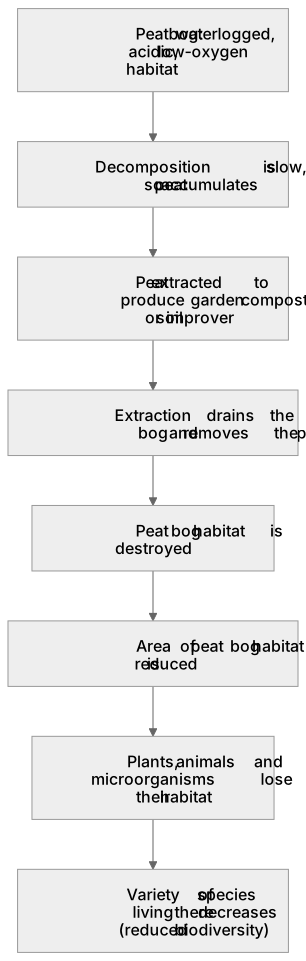
Put it in order
Put these steps in the order they happen.
- 1. Peat bog habitat is destroyed
- 2. Variety of species living there decreases (reduced biodiversity)
- 3. Area of peat bog habitat is reduced
- 4. Peat bog: waterlogged, acidic, low-oxygen habitat
- 5. Decomposition is slow, so peat accumulates
- 6. Plants, animals and microorganisms lose their habitat
- 7. Peat extracted to produce garden compost or soil improver
- 8. Extraction drains the bog and removes the peat
Label the diagram
Some boxes have lost their names. Pick the right name for each number.
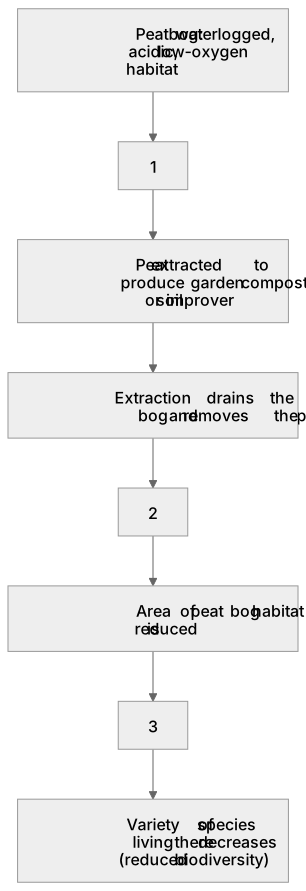
1Box 1
2Box 2
3Box 3
There is more to this lesson
The full lesson goes on to check your understanding and help you earn the marks. Create a free account to carry on, with your progress saved.
A week of Premium from your first lesson · Then the free plan continues · No card, no charge
Test your understanding of Land use: The destruction of peat bogs, and other areas of peat to produce garden compost, reduces the area of this habitat and thus the variety of different plant, animal and microorganism species that live there (biodiversity).
Active recall beats re-reading. Take an instant quiz now to test what you’ve learned and lock it into long-term memory.
A week of Premium from your first lesson · Then the free plan continues · No card, no charge