AQA · GCSE · Biology
Course version: 8461 · Version from Sept 2018
The decay or burning of the peat releases carbon dioxide into the…
Full specification wording
Land use: The decay or burning of the peat releases carbon dioxide into the atmosphere.
Peat stores carbon because dead plant material has not fully decomposed.
Checked against the AQA 8461 specification (opens in a new tab) on .
- Point 3 of 3
- 4 key terms
Study notes
From the checked teaching notes for this specification point.
The idea
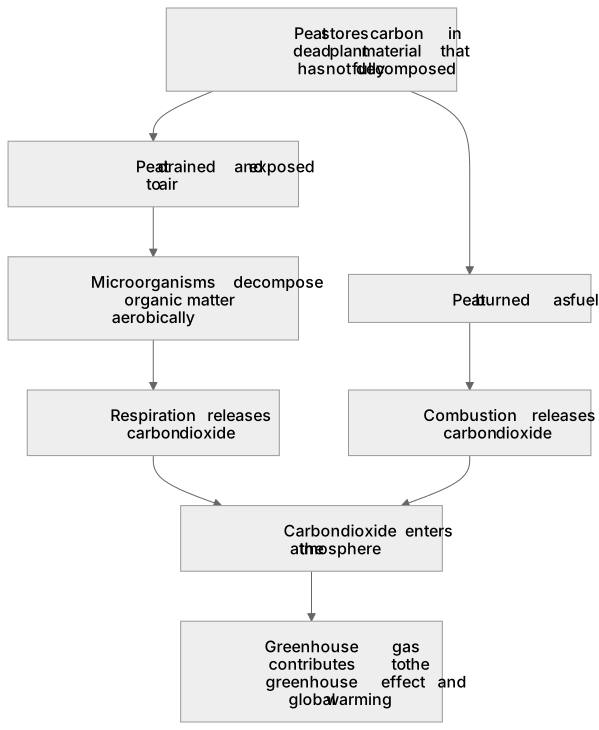
Peat stores carbon because dead plant material has not fully decomposed. When peat is drained and exposed to air, microorganisms decompose the organic matter aerobically, and respiration releases carbon dioxide. When peat is burned as a fuel, combustion also releases carbon dioxide. In both cases, carbon that was locked in the peat for thousands of years enters the atmosphere as carbon dioxide, a greenhouse gas. This adds to the greenhouse effect and contributes to global warming. The release can happen during extraction, when drained peat is exposed, and when peat-based compost is used or peat is burned. The key biological process in decay is respiration by decomposers; the key chemical process in burning is combustion. Both pathways return stored carbon to the atmosphere.
What earns the marks
- Peat stores carbon in dead plant material that has not fully decomposed.
- Decay of peat involves microorganisms breaking down organic matter, and respiration releases carbon dioxide.
- Burning peat is combustion, which also releases carbon dioxide.
- In both decay and burning, carbon stored in peat is returned to the atmosphere as carbon dioxide.
- Carbon dioxide is a greenhouse gas, so its release contributes to the greenhouse effect and global warming.
- The release occurs when peat is drained and exposed, used as compost, or burned as fuel.
Common mistakes and how to put them right
Saying decay releases oxygen.
Put it right: Aerobic decay uses oxygen and releases carbon dioxide.
Confusing burning with respiration.
Put it right: Burning is combustion, while decay involves respiration by microorganisms, but both release carbon dioxide.
Thinking carbon dioxide is stored in peat as a gas.
Put it right: Carbon is stored in the organic matter of peat and is released as carbon dioxide when decay or burning occurs.
Exam tips
- Name both processes, decay and burning, and state that each releases carbon dioxide.
- Identify microorganisms as the decomposers responsible for decay.
- Link the released carbon dioxide to the greenhouse effect rather than leaving it as a gas with no consequence.
Try the lesson
The start of the Land use: The decay or burning of the peat releases carbon dioxide into the atmosphere. lesson, made from checked teaching notes for this specification point.
Have a go first
When peat is burned or allowed to decay, which gas is released into the atmosphere?
Listen
Peat stores carbon because dead plant material has not fully decomposed. When peat is drained and exposed to air, microorganisms decompose the organic matter aerobically, and respiration releases carbon dioxide. When peat is burned as a fuel, combustion also releases carbon dioxide. In both cases, carbon that was locked in the peat for thousands of years enters the atmosphere as carbon dioxide, a greenhouse gas. This adds to the greenhouse effect and contributes to global warming. The release can happen during extraction, when drained peat is exposed, and when peat-based compost is used or peat is burned. The key biological process in decay is respiration by decomposers; the key chemical process in burning is combustion. Both pathways return stored carbon to the atmosphere. A strong answer earns marks for these points. Peat stores carbon in dead plant material that has not fully decomposed. Decay of peat involves microorganisms breaking down organic matter, and respiration releases carbon dioxide. Burning peat is combustion, which also releases carbon dioxide. In both decay and burning, carbon stored in peat is returned to the atmosphere as carbon dioxide. A common slip: Saying decay releases oxygen. Instead, aerobic decay uses oxygen and releases carbon dioxide. Exam tip: Name both processes, decay and burning, and state that each releases carbon dioxide.
See it
Key words
Say what each word means before you turn the card.
Decomposition and respiration
Try answering aloud or in your head before turning the card.
Combustion and energy transfer
Try answering aloud or in your head before turning the card.
Greenhouse gases and global warming
Try answering aloud or in your head before turning the card.
Carbon cycle
Try answering aloud or in your head before turning the card.
See every definition
- Decomposition and respiration
- Microorganisms break down organic matter in peat, and respiration releases carbon dioxide.
- Combustion and energy transfer
- Burning peat as a fuel is combustion, which also releases carbon dioxide.
- Greenhouse gases and global warming
- Carbon dioxide is a greenhouse gas, so its release contributes to the greenhouse effect and global warming.
- Carbon cycle
- Carbon stored in the organic matter of peat is returned to the atmosphere as carbon dioxide when decay or burning occurs.
Label the diagram
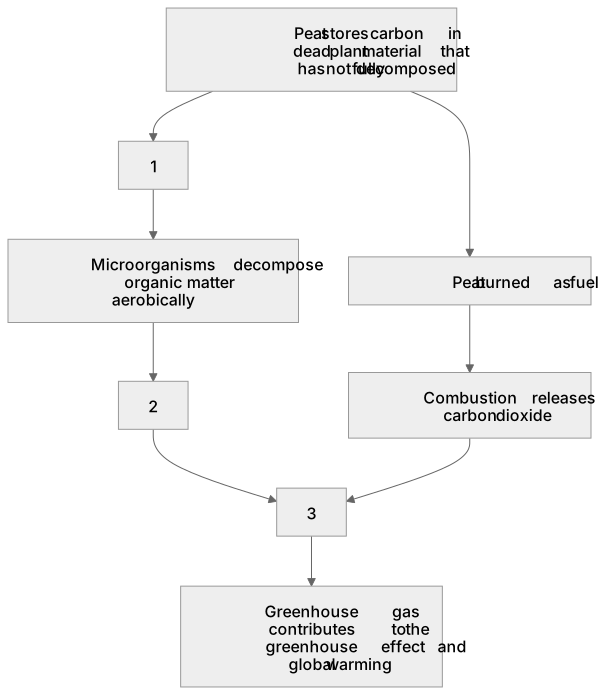
Some boxes have lost their names. Pick the right name for each number.
1Box 1
2Box 2
3Box 3
There is more to this lesson
The full lesson goes on to check your understanding and help you earn the marks. Create a free account to carry on, with your progress saved.
A week of Premium from your first lesson · Then the free plan continues · No card, no charge
Test your understanding of Land use: The decay or burning of the peat releases carbon dioxide into the atmosphere.
Active recall beats re-reading. Take an instant quiz now to test what you’ve learned and lock it into long-term memory.
A week of Premium from your first lesson · Then the free plan continues · No card, no charge