AQA · GCSE · Biology
Course version: 8461 · Version from Sept 2018
Consumers that kill and eat other animals are predators, and those eaten…
Full specification wording
Levels of organisation: Consumers that kill and eat other animals are predators, and those eaten are prey.
Consumers cannot make their own food, so they obtain energy by eating other organisms.
Checked against the AQA 8461 specification (opens in a new tab) on .
- Point 8 of 12
- 2 key terms
Study notes
From the checked teaching notes for this specification point.
The idea
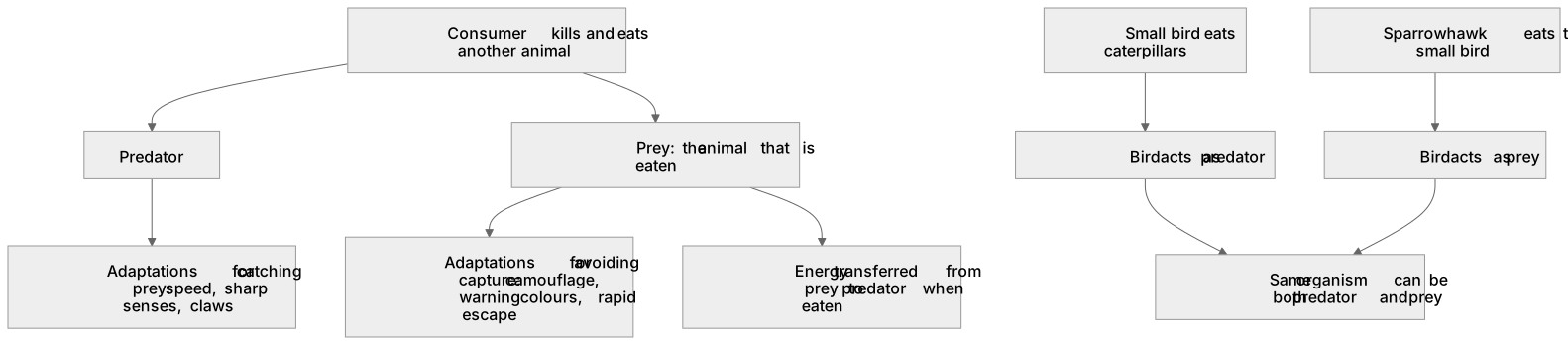
Consumers cannot make their own food, so they obtain energy by eating other organisms. Within a food web, a predator is a consumer that hunts, kills and eats other animals, while the animal it eats is its prey. The same organism can be both: a small bird eats caterpillars but is eaten by a sparrowhawk, so it acts as predator and prey in different links. Predator and prey are therefore roles defined by the feeding relationship, not fixed species labels. A predator has adaptations for catching prey, such as speed, sharp senses or claws, while prey have adaptations for avoiding capture, such as camouflage, warning colours or rapid escape. Energy passes along the chain when the predator consumes the prey, but most energy is lost, so fewer predators than prey can usually be supported.
What earns the marks
- A predator is a consumer that kills and eats other animals; the eaten animal is the prey.
- Predator and prey are feeding roles, so one organism can be both in different food-chain links.
- Predators often show adaptations for capture, such as speed, sharp senses, claws or venom.
- Prey often show adaptations that reduce capture, such as camouflage, warning coloration or rapid escape.
- Energy is transferred from prey to predator when the prey is eaten, and much energy is lost at each transfer.
Common mistakes and how to put them right
Thinking a predator must be a large mammal.
Put it right by noting that any animal that kills and eats another animal, including a ladybird eating aphids, is a predator.
Assuming a species is always only a predator or only prey.
Put it right by tracking its position in a food web, where it may be both.
Confusing prey with a decomposer.
Put it right by stating that prey are living animals eaten by predators, whereas decomposers break down dead material.
Exam tips
- Define both terms in one sentence, then give a named example such as a fox eating a rabbit.
- When asked to identify a predator or prey in a food web, follow the arrow direction: the arrow points from the eaten organism to the eater.
- Use the words predator and prey precisely in explanations of energy transfer rather than writing 'eater' and 'eaten'.
Try the lesson
The start of the Levels of organisation: Consumers that kill and eat other animals are predators, and those eaten are prey. lesson, made from checked teaching notes for this specification point.
Have a go first
In a woodland food chain, a fox hunts and eats a rabbit. Which term describes the rabbit?
Listen
Consumers cannot make their own food, so they obtain energy by eating other organisms. Within a food web, a predator is a consumer that hunts, kills and eats other animals, while the animal it eats is its prey. The same organism can be both: a small bird eats caterpillars but is eaten by a sparrowhawk, so it acts as predator and prey in different links. Predator and prey are therefore roles defined by the feeding relationship, not fixed species labels. A predator has adaptations for catching prey, such as speed, sharp senses or claws, while prey have adaptations for avoiding capture, such as camouflage, warning colours or rapid escape. Energy passes along the chain when the predator consumes the prey, but most energy is lost, so fewer predators than prey can usually be supported. A strong answer earns marks for these points. A predator is a consumer that kills and eats other animals; the eaten animal is the prey. Predator and prey are feeding roles, so one organism can be both in different food-chain links. Predators often show adaptations for capture, such as speed, sharp senses, claws or venom. Prey often show adaptations that reduce capture, such as camouflage, warning coloration or rapid escape. A common slip: Thinking a predator must be a large mammal. Instead, noting that any animal that kills and eats another animal, including a ladybird eating aphids, is a predator. Exam tip: Define both terms in one sentence, then give a named example such as a fox eating a rabbit.
See it
Key words
Say what each word means before you turn the card.
Predator
Try answering aloud or in your head before turning the card.
Prey
Try answering aloud or in your head before turning the card.
See every definition
- Predator
- A consumer that hunts, kills and eats other animals.
- Prey
- The animal that is eaten by a predator.
Label the diagram
Some boxes have lost their names. Pick the right name for each number.
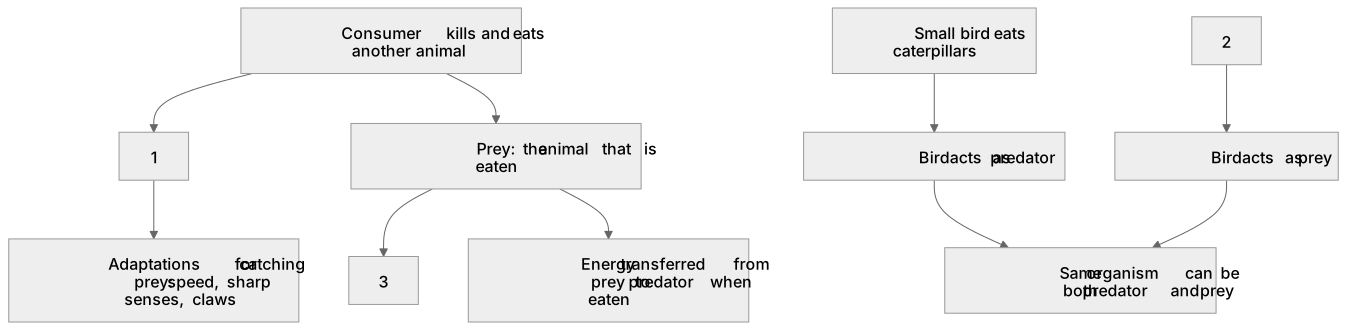
1Box 1
2Box 2
3Box 3
There is more to this lesson
The full lesson goes on to check your understanding and help you earn the marks. Create a free account to carry on, with your progress saved.
A week of Premium from your first lesson · Then the free plan continues · No card, no charge
Test your understanding of Levels of organisation: Consumers that kill and eat other animals are predators, and those eaten are prey.
Active recall beats re-reading. Take an instant quiz now to test what you’ve learned and lock it into long-term memory.
A week of Premium from your first lesson · Then the free plan continues · No card, no charge