AQA · GCSE · Biology
Course version: 8461 · Version from Sept 2018
In a stable community the numbers of predators and prey rise and fall in…
Full specification wording
Levels of organisation: In a stable community the numbers of predators and prey rise and fall in cycles.
A stable community is one where all the species and environmental factors are in balance, so population sizes stay roughly constant over long periods.
Checked against the AQA 8461 specification (opens in a new tab) on .
- Point 9 of 12
- 4 key terms
Study notes
From the checked teaching notes for this specification point.
The idea
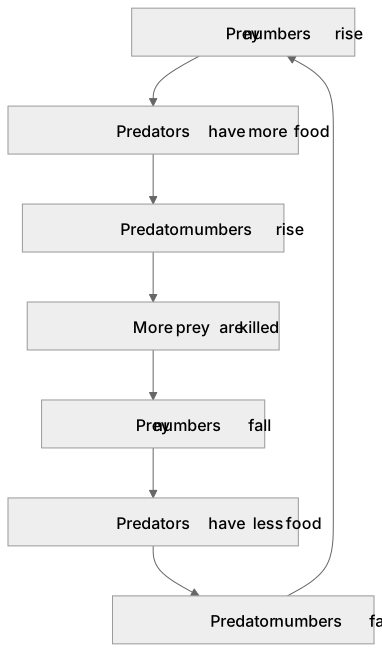
A stable community is one where all the species and environmental factors are in balance, so population sizes stay roughly constant over long periods. Within such a community, predator and prey populations are linked by negative feedback. If prey become more numerous, predators find more food, survive and reproduce more successfully, so predator numbers rise. More predators then kill more prey, so prey numbers fall. With less food, predator numbers fall, which allows prey numbers to rise again. This produces repeating cycles in which predator numbers rise and fall after prey numbers, and the peaks and troughs of the two populations are out of step. The cycles continue around a steady average, which is what makes the community stable.
What earns the marks
- A stable community has populations that fluctuate around a steady average rather than changing permanently.
- An increase in prey numbers gives predators more food, so predator numbers rise.
- A rise in predator numbers increases predation, so prey numbers fall.
- A fall in prey numbers reduces food for predators, so predator numbers fall, allowing prey to recover.
- The result is repeating cycles in which predator changes lag behind prey changes.
Common mistakes and how to put them right
Saying predator and prey numbers rise and fall at exactly the same time.
Put it right by explaining that predator numbers lag behind prey numbers because reproduction takes time.
Treating the cycles as random.
Put it right by linking each change to negative feedback through food supply and predation.
Believing a stable community has no change at all.
Put it right by stating that numbers fluctuate around a steady average.
Exam tips
- Describe the cycle as a sequence of cause-and-effect steps rather than listing numbers.
- Use the phrase 'negative feedback' to show why the populations do not grow without limit.
- When reading a graph, compare the timing of peaks to show that the predator peak follows the prey peak.
Try the lesson
The start of the Levels of organisation: In a stable community the numbers of predators and prey rise and fall in cycles. lesson, made from checked teaching notes for this specification point.
Have a go first
In a stable community, what happens to the numbers of predators and prey over time?
Listen
A stable community is one where all the species and environmental factors are in balance, so population sizes stay roughly constant over long periods. Within such a community, predator and prey populations are linked by negative feedback. If prey become more numerous, predators find more food, survive and reproduce more successfully, so predator numbers rise. More predators then kill more prey, so prey numbers fall. With less food, predator numbers fall, which allows prey numbers to rise again. This produces repeating cycles in which predator numbers rise and fall after prey numbers, and the peaks and troughs of the two populations are out of step. The cycles continue around a steady average, which is what makes the community stable. A strong answer earns marks for these points. A stable community has populations that fluctuate around a steady average rather than changing permanently. An increase in prey numbers gives predators more food, so predator numbers rise. A rise in predator numbers increases predation, so prey numbers fall. A fall in prey numbers reduces food for predators, so predator numbers fall, allowing prey to recover. A common slip: Saying predator and prey numbers rise and fall at exactly the same time. Instead, explaining that predator numbers lag behind prey numbers because reproduction takes time. Exam tip: Describe the cycle as a sequence of cause-and-effect steps rather than listing numbers.
See it
Key words
Say what each word means before you turn the card.
Negative feedback
Try answering aloud or in your head before turning the card.
Stable community
Try answering aloud or in your head before turning the card.
Predator-prey population dynamics
Try answering aloud or in your head before turning the card.
Interdependence and food supply
Try answering aloud or in your head before turning the card.
See every definition
- Negative feedback
- The process by which predator and prey populations are linked, so that a rise in one leads to a change that brings it back down.
- Stable community
- A community where all the species and environmental factors are in balance, so population sizes stay roughly constant over long periods.
- Predator-prey population dynamics
- Repeating cycles in which predator numbers rise and fall after prey numbers, with the peaks and troughs of the two populations out of step.
- Interdependence and food supply
- The link by which prey give predators more food, and a fall in prey reduces food for predators, so predator numbers fall.
Label the diagram
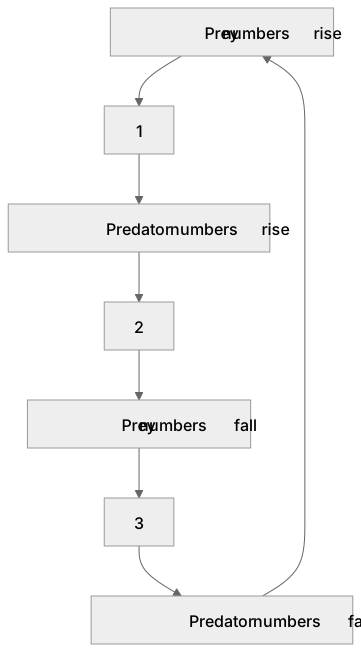
Some boxes have lost their names. Pick the right name for each number.
1Box 1
2Box 2
3Box 3
There is more to this lesson
The full lesson goes on to check your understanding and help you earn the marks. Create a free account to carry on, with your progress saved.
A week of Premium from your first lesson · Then the free plan continues · No card, no charge
Test your understanding of Levels of organisation: In a stable community the numbers of predators and prey rise and fall in cycles.
Active recall beats re-reading. Take an instant quiz now to test what you’ve learned and lock it into long-term memory.
A week of Premium from your first lesson · Then the free plan continues · No card, no charge