AQA · GCSE · Biology
Course version: 8461 · Version from Sept 2018
Excess water, ions and urea are removed via the kidneys in the urine.
Full specification wording
Maintaining water and nitrogen balance in the body (biology only): Excess water, ions and urea are removed via the kidneys in the urine.
The kidneys filter the blood and remove excess water, ions and urea, which leave the body in urine.
Checked against the AQA 8461 specification (opens in a new tab) on .
- Point 5 of 17
- 4 key terms
Study notes
From the checked teaching notes for this specification point.
The idea
The kidneys filter the blood and remove excess water, ions and urea, which leave the body in urine. Blood enters the kidney, where small molecules including water, ions, glucose and urea are filtered. Useful substances such as glucose and some water and ions are reabsorbed back into the blood, while excess water, ions and urea remain in the forming urine. Urine travels down the ureter to the bladder and is excreted through the urethra. The amount and concentration of urine change with the body's needs: if you are dehydrated, less water is lost in urine; if you drink a lot, more dilute urine is produced. This makes the kidneys the main organ for controlling water, ion and urea balance.
What earns the marks
- The kidneys filter the blood, removing water, ions and urea from it.
- Excess water, ions and urea are excreted in urine, which passes down the ureter to the bladder.
- Reabsorption returns useful substances such as glucose and some water and ions to the blood.
- The volume and concentration of urine are adjusted by the kidneys to help maintain balance.
- Urea is a waste product from the breakdown of excess amino acids and is removed in urine.
Common mistakes and how to put them right
Confusing the ureter with the urethra.
Put it right: Urine leaves each kidney through a ureter and leaves the body through the urethra.
Thinking all filtered water and ions are excreted.
Put it right: Some are reabsorbed back into the blood.
Believing the kidneys remove only urea.
Put it right: They also remove excess water and ions in urine.
Exam tips
- Use the sequence kidney → ureter → bladder → urethra when describing the route of urine.
- State that the kidneys adjust both the volume and the concentration of urine to control water and ion balance.
- Link urea to the breakdown of excess amino acids so the source of urea is clear.
Try the lesson
The start of the Maintaining water and nitrogen balance in the body (biology only): Excess water, ions and urea are removed via the kidneys in the urine. lesson, made from checked teaching notes for this specification point.
Have a go first
Which organs are responsible for filtering the blood to remove excess water, ions and urea?
Listen
The kidneys filter the blood and remove excess water, ions and urea, which leave the body in urine. Blood enters the kidney, where small molecules including water, ions, glucose and urea are filtered. Useful substances such as glucose and some water and ions are reabsorbed back into the blood, while excess water, ions and urea remain in the forming urine. Urine travels down the ureter to the bladder and is excreted through the urethra. The amount and concentration of urine change with the body's needs: if you are dehydrated, less water is lost in urine; if you drink a lot, more dilute urine is produced. This makes the kidneys the main organ for controlling water, ion and urea balance. A strong answer earns marks for these points. The kidneys filter the blood, removing water, ions and urea from it. Excess water, ions and urea are excreted in urine, which passes down the ureter to the bladder. Reabsorption returns useful substances such as glucose and some water and ions to the blood. The volume and concentration of urine are adjusted by the kidneys to help maintain balance. A common slip: Confusing the ureter with the urethra. Instead, urine leaves each kidney through a ureter and leaves the body through the urethra. Exam tip: Use the sequence kidney → ureter → bladder → urethra when describing the route of urine.
See it
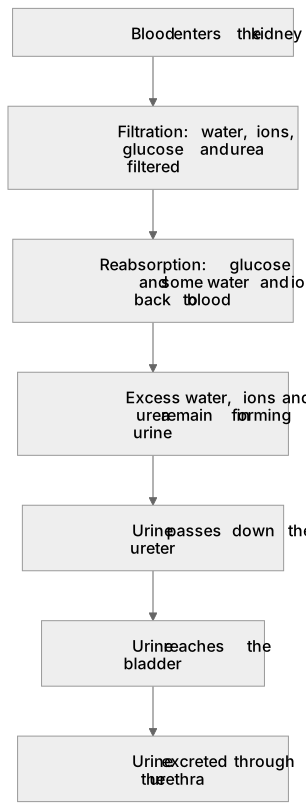
Put it in order
Put these steps in the order they happen.
- 1. Urine excreted through the urethra
- 2. Urine reaches the bladder
- 3. Reabsorption: glucose and some water and ions back to blood
- 4. Urine passes down the ureter
- 5. Blood enters the kidney
- 6. Filtration: water, ions, glucose and urea filtered
- 7. Excess water, ions and urea remain in forming urine
Key words
Say what each word means before you turn the card.
Excretion and homeostasis
Try answering aloud or in your head before turning the card.
Kidney function and urine formation
Try answering aloud or in your head before turning the card.
Selective reabsorption
Try answering aloud or in your head before turning the card.
Water and ion balance
Try answering aloud or in your head before turning the card.
See every definition
- Excretion and homeostasis
- The kidneys are the main organ for controlling water, ion and urea balance, adjusting the volume and concentration of urine to help maintain balance.
- Kidney function and urine formation
- The kidneys filter the blood, removing water, ions and urea from it, and these leave the body in urine.
- Selective reabsorption
- Reabsorption returns useful substances such as glucose and some water and ions to the blood, while excess water, ions and urea remain in the forming urine.
- Water and ion balance
- If you are dehydrated, less water is lost in urine; if you drink a lot, more dilute urine is produced.
Label the diagram
Some boxes have lost their names. Pick the right name for each number.
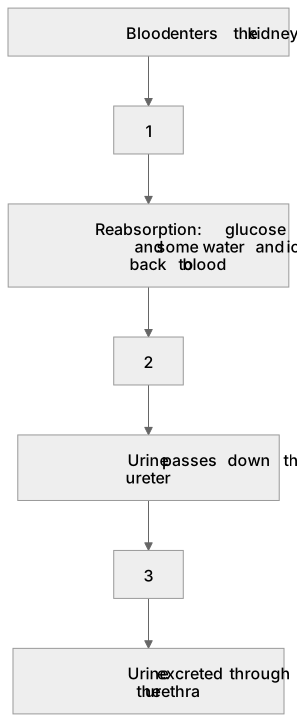
1Box 1
2Box 2
3Box 3
There is more to this lesson
The full lesson goes on to check your understanding and help you earn the marks. Create a free account to carry on, with your progress saved.
A week of Premium from your first lesson · Then the free plan continues · No card, no charge
Test your understanding of Maintaining water and nitrogen balance in the body (biology only): Excess water, ions and urea are removed via the kidneys in the urine.
Active recall beats re-reading. Take an instant quiz now to test what you’ve learned and lock it into long-term memory.
A week of Premium from your first lesson · Then the free plan continues · No card, no charge