AQA · GCSE · Biology
Course version: 8461 · Version from Sept 2018
There is no control over water, ion or urea loss by the lungs or skin.
Full specification wording
Maintaining water and nitrogen balance in the body (biology only): There is no control over water, ion or urea loss by the lungs or skin.
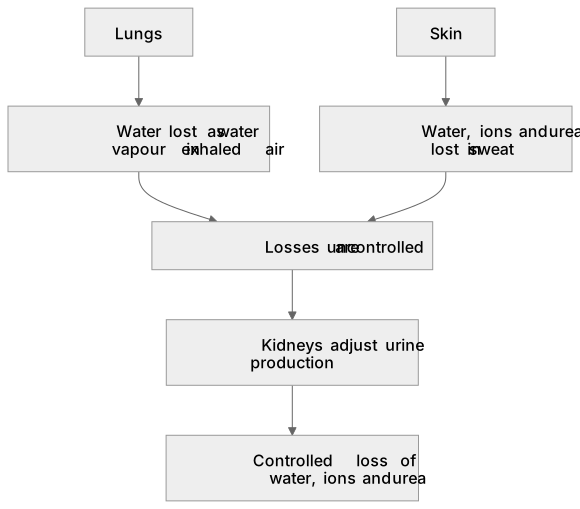
Water leaves the body via the lungs during exhalation, while water, ions, and urea are lost through the skin in sweat.
Checked against the AQA 8461 specification (opens in a new tab) on .
- Point 4 of 17
- 3 key terms
Study notes
From the checked teaching notes for this specification point.
The idea
Water leaves the body via the lungs during exhalation, while water, ions, and urea are lost through the skin in sweat. Crucially, there is no control over these losses. For example, when you exercise on a hot day, you sweat heavily to cool down, losing water, ions, and urea as a passive consequence of temperature regulation, not to maintain internal balance. Similarly, breathing rate dictates water loss from the lungs, independent of the body's hydration status. Because the lungs and skin cannot regulate these losses, the kidneys must actively adjust the volume and concentration of urine to maintain the body's water, ion, and nitrogen balance.
What earns the marks
- Water is lost from the lungs as water vapour in exhaled air.
- Water, ions, and urea are lost from the skin in sweat.
- The loss of water, ions, and urea from the lungs and skin is uncontrolled and not adjusted to maintain internal balance.
- The kidneys are responsible for the controlled loss of water, ions, and urea by adjusting urine production.
Common mistakes and how to put them right
Thinking the skin controls water or ion balance by sweating.
Put it right: Sweating is for temperature regulation, and the resulting water and ion loss is uncontrolled.
Believing urea is breathed out from the lungs.
Put it right: Urea is lost in sweat from the skin and in urine from the kidneys, while the lungs only lose water and carbon dioxide.
Assuming all water loss is regulated.
Put it right: Only the kidneys actively control water loss, whereas lung and skin losses are unregulated.
Exam tips
- Clearly distinguish between the routes: state that lungs lose water, while skin loses water, ions, and urea.
- Use the term 'uncontrolled' for losses via the lungs and skin, contrasting this with the 'controlled' regulation by the kidneys.
Try the lesson
The start of the Maintaining water and nitrogen balance in the body (biology only): There is no control over water, ion or urea loss by the lungs or skin. lesson, made from checked teaching notes for this specification point.
Have a go first
How does the body regulate the loss of water, ions, and urea from the lungs and skin?
Listen
Water leaves the body via the lungs during exhalation, while water, ions, and urea are lost through the skin in sweat. Crucially, there is no control over these losses. For example, when you exercise on a hot day, you sweat heavily to cool down, losing water, ions, and urea as a passive consequence of temperature regulation, not to maintain internal balance. Similarly, breathing rate dictates water loss from the lungs, independent of the body's hydration status. Because the lungs and skin cannot regulate these losses, the kidneys must actively adjust the volume and concentration of urine to maintain the body's water, ion, and nitrogen balance. A strong answer earns marks for these points. Water is lost from the lungs as water vapour in exhaled air. Water, ions, and urea are lost from the skin in sweat. The loss of water, ions, and urea from the lungs and skin is uncontrolled and not adjusted to maintain internal balance. The kidneys are responsible for the controlled loss of water, ions, and urea by adjusting urine production. A common slip: Thinking the skin controls water or ion balance by sweating. Instead, sweating is for temperature regulation, and the resulting water and ion loss is uncontrolled. Exam tip: Clearly distinguish between the routes: state that lungs lose water, while skin loses water, ions, and urea.
See it
Key words
Say what each word means before you turn the card.
Excretion of water, ions and urea
Try answering aloud or in your head before turning the card.
Passive versus controlled loss
Try answering aloud or in your head before turning the card.
Homeostasis and control
Try answering aloud or in your head before turning the card.
See every definition
- Excretion of water, ions and urea
- Water leaves the body via the lungs during exhalation, while water, ions, and urea are lost through the skin in sweat.
- Passive versus controlled loss
- Losses from the lungs and skin are uncontrolled, whereas the kidneys are responsible for the controlled loss of water, ions, and urea by adjusting urine production.
- Homeostasis and control
- Because the lungs and skin cannot regulate these losses, the kidneys must actively adjust the volume and concentration of urine to maintain the body's water, ion, and nitrogen balance.
Label the diagram
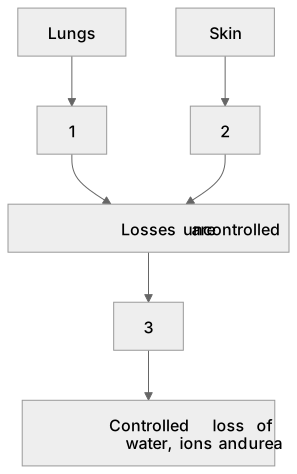
Some boxes have lost their names. Pick the right name for each number.
1Box 1
2Box 2
3Box 3
There is more to this lesson
The full lesson goes on to check your understanding and help you earn the marks. Create a free account to carry on, with your progress saved.
A week of Premium from your first lesson · Then the free plan continues · No card, no charge
Test your understanding of Maintaining water and nitrogen balance in the body (biology only): There is no control over water, ion or urea loss by the lungs or skin.
Active recall beats re-reading. Take an instant quiz now to test what you’ve learned and lock it into long-term memory.
A week of Premium from your first lesson · Then the free plan continues · No card, no charge