AQA · GCSE · Biology
Course version: 8461 · Version from Sept 2018
Students should be able to explain the effect on cells of osmotic changes…
Full specification wording
Maintaining water and nitrogen balance in the body (biology only): Students should be able to explain the effect on cells of osmotic changes in body fluids.
Body fluids are aqueous solutions whose solute concentration can change with water intake, salt intake and water loss.
Checked against the AQA 8461 specification (opens in a new tab) on .
- Point 1 of 17
Study notes
From the checked teaching notes for this specification point.
The idea
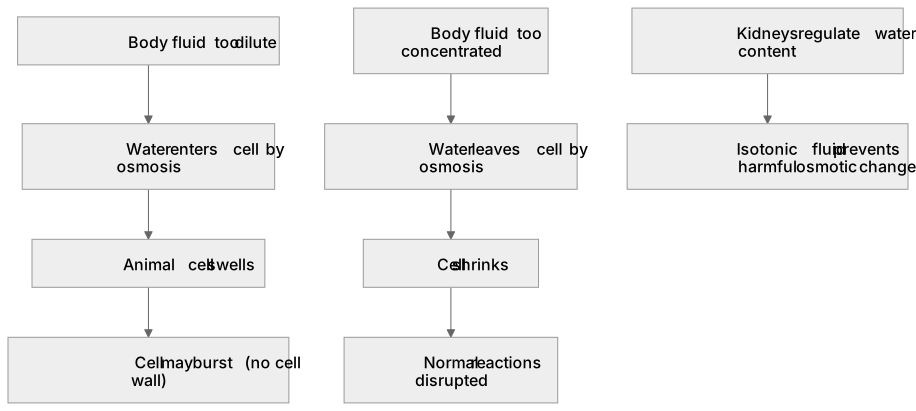
Body fluids are aqueous solutions whose solute concentration can change with water intake, salt intake and water loss. Osmosis is the diffusion of water from a dilute solution to a concentrated solution through a partially permeable membrane. If body fluid becomes too dilute, water enters cells by osmosis; animal cells may swell and burst because they lack a cell wall. If body fluid becomes too concentrated, water leaves cells by osmosis; cells shrink and their normal reactions are disrupted. Cells therefore function best when the concentration of the surrounding fluid is isotonic to the cell contents, preventing harmful osmotic changes.
What earns the marks
- Osmosis is the movement of water from a dilute solution to a more concentrated solution across a partially permeable membrane.
- If body fluids are too dilute, water enters animal cells by osmosis.
- Water entering an animal cell causes it to swell and potentially burst, as it lacks a cell wall.
- If body fluids are too concentrated, water leaves the cell by osmosis.
- Water leaving an animal cell causes it to shrink, which disrupts normal cellular activity.
- The kidneys regulate the water content of body fluids to prevent these harmful osmotic changes.
Common mistakes and how to put them right
Using A-level terminology like 'water potential'.
Put it right by using standard GCSE terms such as 'dilute solution' and 'concentrated solution'.
Claiming that animal cells become turgid.
Put it right by stating that turgidity applies to plant cells with a cell wall, while animal cells swell and burst.
Forgetting to mention the partially permeable membrane.
Put it right by including it in definitions and explanations of osmosis.
Exam tips
- Define osmosis using GCSE terminology: movement of water from a dilute to a concentrated solution through a partially permeable membrane.
- Explain the direction of water movement first, then the effect on the animal cell (swelling/bursting or shrinking).
Try the lesson
The start of the Maintaining water and nitrogen balance in the body (biology only): Students should be able to explain the effect on cells of osmotic changes in body fluids. lesson, made from checked teaching notes for this specification point.
Have a go first
Body fluid surrounding some cells becomes more concentrated than the fluid inside the cells. What happens to these cells?
Listen
Body fluids are aqueous solutions whose solute concentration can change with water intake, salt intake and water loss. Osmosis is the diffusion of water from a dilute solution to a concentrated solution through a partially permeable membrane. If body fluid becomes too dilute, water enters cells by osmosis; animal cells may swell and burst because they lack a cell wall. If body fluid becomes too concentrated, water leaves cells by osmosis; cells shrink and their normal reactions are disrupted. Cells therefore function best when the concentration of the surrounding fluid is isotonic to the cell contents, preventing harmful osmotic changes. A strong answer earns marks for these points. Osmosis is the movement of water from a dilute solution to a more concentrated solution across a partially permeable membrane. If body fluids are too dilute, water enters animal cells by osmosis. Water entering an animal cell causes it to swell and potentially burst, as it lacks a cell wall. If body fluids are too concentrated, water leaves the cell by osmosis. A common slip: Using A-level terminology like 'water potential'. Instead, using standard GCSE terms such as 'dilute solution' and 'concentrated solution'. Exam tip: Define osmosis using GCSE terminology: movement of water from a dilute to a concentrated solution through a partially permeable membrane.
See it
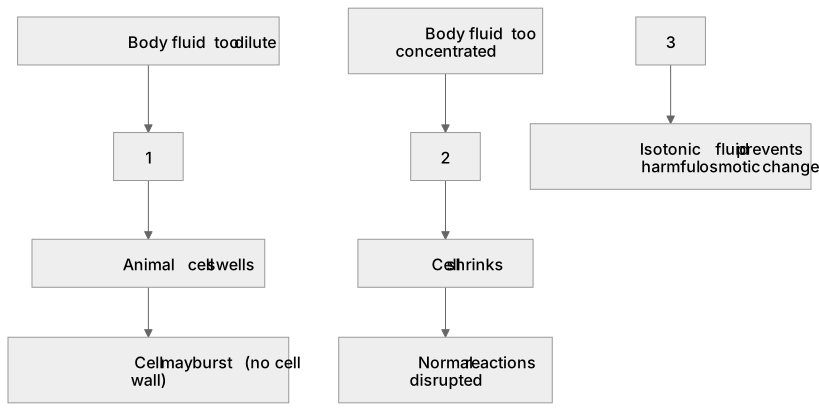
Label the diagram
Some boxes have lost their names. Pick the right name for each number.
1Box 1
2Box 2
3Box 3
There is more to this lesson
The full lesson goes on to check your understanding and help you earn the marks. Create a free account to carry on, with your progress saved.
A week of Premium from your first lesson · Then the free plan continues · No card, no charge
Test your understanding of Maintaining water and nitrogen balance in the body (biology only): Students should be able to explain the effect on cells of osmotic changes in body fluids.
Active recall beats re-reading. Take an instant quiz now to test what you’ve learned and lock it into long-term memory.
A week of Premium from your first lesson · Then the free plan continues · No card, no charge