AQA · GCSE · Biology
Course version: 8461 · Version from Sept 2018
An electron microscope has much higher magnification and resolving power…
Full specification wording
Microscopy: An electron microscope has much higher magnification and resolving power than a light microscope.
Magnification tells you how many times larger an image appears than the object; resolving power is the smallest separation at which two points can still be seen as separate.
Checked against the AQA 8461 specification (opens in a new tab) on .
- Point 2 of 4
- 4 key terms
Study notes
From the checked teaching notes for this specification point.
The idea
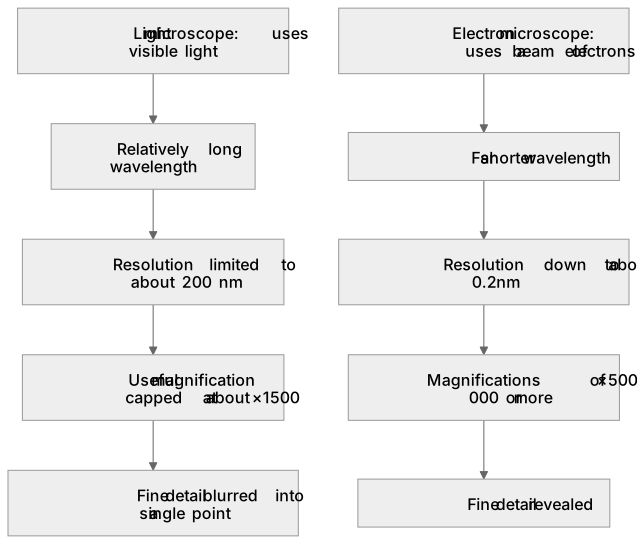
Magnification tells you how many times larger an image appears than the object; resolving power is the smallest separation at which two points can still be seen as separate. A light microscope uses visible light, whose relatively long wavelength limits resolution to roughly 200 nm, so its useful magnification is capped at about ×1500. An electron microscope uses a beam of electrons with a far shorter wavelength, giving resolution down to about 0.2 nm and magnifications of ×500 000 or more. For example, a mitochondrion about 1 µm long appears roughly 1 mm across at ×1000, but an electron micrograph can enlarge the same organelle until its internal cristae are distinguishable. Higher resolving power, not magnification alone, is what reveals fine detail.
What earns the marks
- Magnification is the number of times an image is larger than the real object; resolving power is the ability to distinguish two separate points as distinct.
- Light microscopes use visible light with a relatively long wavelength, limiting resolution to about 200 nm and useful magnification to roughly ×1500.
- Electron microscopes use a beam of electrons with a much shorter wavelength, giving resolution near 0.2 nm and far greater magnification.
- Because resolution is better, electron microscopes reveal detail that light microscopes blur into a single point, even if the light image is enlarged further.
- Calculations such as magnification = image size ÷ actual size apply to images from either microscope.
Common mistakes and how to put them right
Confusing magnification with resolving power.
Put it right: Magnification enlarges an image, whereas resolving power determines whether fine detail remains distinguishable; state both definitions separately.
Believing that simply enlarging a light microscope image reveals more detail.
Put it right: Beyond the resolution limit the image only becomes blurrier, so detail is not gained.
Thinking electron microscopes use light or lenses in the same way as light microscopes.
Put it right: They use a beam of electrons focused by electromagnets, and specimens must be dead and in a vacuum.
Exam tips
- Define both terms before comparing, then link the comparison to wavelength of light versus electrons.
- Use comparative wording such as 'much higher' or 'far greater' when the question asks for a comparison.
- If asked to calculate magnification, rearrange magnification = image size ÷ actual size carefully and give units, converting µm to mm where needed.
Try the lesson
The start of the Microscopy: An electron microscope has much higher magnification and resolving power than a light microscope. lesson, made from checked teaching notes for this specification point.
Have a go first
Which statement correctly compares an electron microscope to a light microscope?
Listen
Magnification tells you how many times larger an image appears than the object; resolving power is the smallest separation at which two points can still be seen as separate. A light microscope uses visible light, whose relatively long wavelength limits resolution to roughly 200 nm, so its useful magnification is capped at about ×1500. An electron microscope uses a beam of electrons with a far shorter wavelength, giving resolution down to about 0.2 nm and magnifications of ×500 000 or more. For example, a mitochondrion about 1 µm long appears roughly 1 mm across at ×1000, but an electron micrograph can enlarge the same organelle until its internal cristae are distinguishable. Higher resolving power, not magnification alone, is what reveals fine detail. A strong answer earns marks for these points. Magnification is the number of times an image is larger than the real object; resolving power is the ability to distinguish two separate points as distinct. Light microscopes use visible light with a relatively long wavelength, limiting resolution to about 200 nm and useful magnification to roughly ×1500. Electron microscopes use a beam of electrons with a much shorter wavelength, giving resolution near 0.2 nm and far greater magnification. Because resolution is better, electron microscopes reveal detail that light microscopes blur into a single point, even if the light image is enlarged further. Exam tip: Define both terms before comparing, then link the comparison to wavelength of light versus electrons.
See it
Key words
Say what each word means before you turn the card.
Magnification
Try answering aloud or in your head before turning the card.
Resolving power
Try answering aloud or in your head before turning the card.
Light microscope
Try answering aloud or in your head before turning the card.
Electron microscope
Try answering aloud or in your head before turning the card.
See every definition
- Magnification
- The number of times an image is larger than the real object.
- Resolving power
- The smallest separation at which two points can still be seen as separate.
- Light microscope
- Uses visible light, whose relatively long wavelength limits resolution to roughly 200 nm and useful magnification to about ×1500.
- Electron microscope
- Uses a beam of electrons with a far shorter wavelength, giving resolution down to about 0.2 nm and much higher magnification.
Label the diagram
Some boxes have lost their names. Pick the right name for each number.
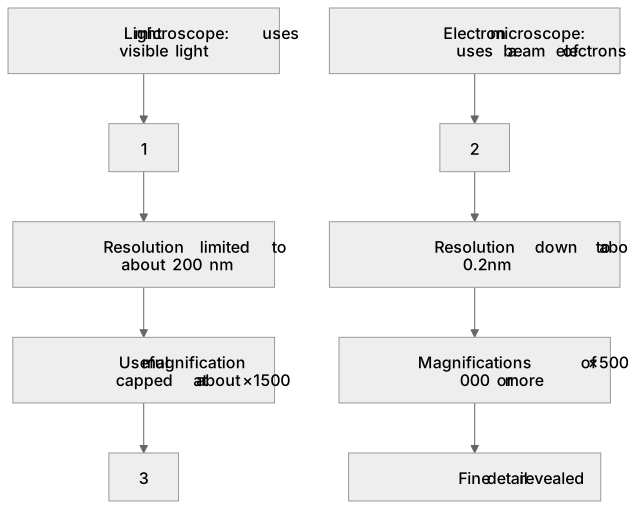
1Box 1
2Box 2
3Box 3
There is more to this lesson
The full lesson goes on to check your understanding and help you earn the marks. Create a free account to carry on, with your progress saved.
A week of Premium from your first lesson · Then the free plan continues · No card, no charge
Test your understanding of Microscopy: An electron microscope has much higher magnification and resolving power than a light microscope.
Active recall beats re-reading. Take an instant quiz now to test what you’ve learned and lock it into long-term memory.
A week of Premium from your first lesson · Then the free plan continues · No card, no charge