AQA · GCSE · Biology
Course version: 8461 · Version from Sept 2018
Students should be able to recognise and describe situations in given…
Full specification wording
Mitosis and the cell cycle: Students should be able to recognise and describe situations in given contexts where mitosis is occurring.
You need to apply your knowledge of mitosis to unfamiliar contexts.
Checked against the AQA 8461 specification (opens in a new tab) on .
- Point 9 of 9
- 4 key terms
Study notes
From the checked teaching notes for this specification point.
The idea
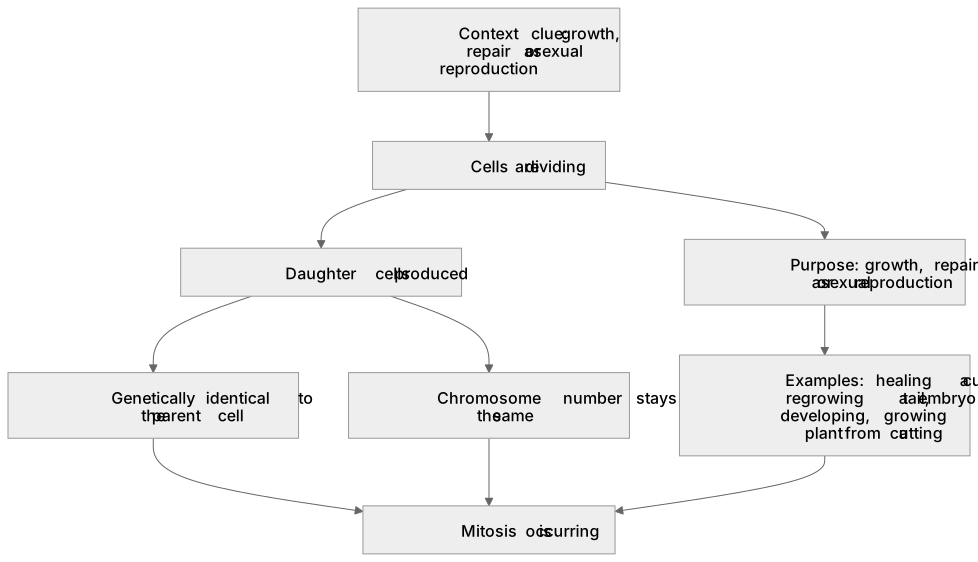
You need to apply your knowledge of mitosis to unfamiliar contexts. Look for clues such as growth, repair or asexual reproduction. For example, a gardener taking cuttings produces new plants genetically identical to the parent, so mitosis is occurring. A lizard regrowing its tail, a cut healing, or an embryo developing all involve mitosis. In each case, the key features are: cells are dividing to produce genetically identical copies, the chromosome number stays the same, and the purpose is growth, repair or asexual reproduction. When describing the situation, state what is happening and link it to mitosis, rather than just naming the process.
What earns the marks
- Identify a context involving growth, repair or asexual reproduction as a site of mitosis.
- State that the new cells produced are genetically identical to the parent cell.
- Describe the purpose of the division in that context, such as healing a wound or growing a new plant from a cutting.
- Recognise that the chromosome number remains constant in the daughter cells.
- Use correct terminology such as 'daughter cells' and 'genetically identical'.
- Explain why mitosis, rather than meiosis, is the relevant process in the given context.
Common mistakes and how to put them right
Confusing mitosis with meiosis in contexts such as gamete production.
Put it right: Mitosis occurs in growth and repair, meiosis in gamete formation.
Assuming any cell division is mitosis.
Put it right: Check whether the daughter cells are genetically identical and whether the purpose is growth, repair or asexual reproduction.
Describing the context without linking it to mitosis.
Put it right: Explicitly state that mitosis is occurring and why.
Exam tips
- Underline the key clue in the question, such as 'healing' or 'cutting', before answering.
- Always link your description back to mitosis and genetic identity.
- If asked to explain, state the purpose of the division in that context.
Try the lesson
The start of the Mitosis and the cell cycle: Students should be able to recognise and describe situations in given contexts where mitosis is occurring. lesson, made from checked teaching notes for this specification point.
Have a go first
Which situation is an example of mitosis occurring?
Listen
You need to apply your knowledge of mitosis to unfamiliar contexts. Look for clues such as growth, repair or asexual reproduction. For example, a gardener taking cuttings produces new plants genetically identical to the parent, so mitosis is occurring. A lizard regrowing its tail, a cut healing, or an embryo developing all involve mitosis. In each case, the key features are: cells are dividing to produce genetically identical copies, the chromosome number stays the same, and the purpose is growth, repair or asexual reproduction. When describing the situation, state what is happening and link it to mitosis, rather than just naming the process. A strong answer earns marks for these points. Identify a context involving growth, repair or asexual reproduction as a site of mitosis. State that the new cells produced are genetically identical to the parent cell. Describe the purpose of the division in that context, such as healing a wound or growing a new plant from a cutting. Recognise that the chromosome number remains constant in the daughter cells. A common slip: Confusing mitosis with meiosis in contexts such as gamete production. Instead, mitosis occurs in growth and repair, meiosis in gamete formation. Exam tip: Underline the key clue in the question, such as 'healing' or 'cutting', before answering.
See it
Key words
Say what each word means before you turn the card.
Asexual reproduction
Try answering aloud or in your head before turning the card.
Growth and repair
Try answering aloud or in your head before turning the card.
Genetic identity
Try answering aloud or in your head before turning the card.
Application of knowledge
Try answering aloud or in your head before turning the card.
See every definition
- Asexual reproduction
- A context such as a gardener taking cuttings, where new plants are produced that are genetically identical to the parent, so mitosis is occurring.
- Growth and repair
- Contexts such as a lizard regrowing its tail, a cut healing or an embryo developing, in which cells divide by mitosis.
- Genetic identity
- The key feature that cells dividing by mitosis produce genetically identical copies, with the chromosome number staying the same.
- Application of knowledge
- Using knowledge of mitosis in unfamiliar contexts by looking for clues such as growth, repair or asexual reproduction and linking the situation to mitosis.
Label the diagram
Some boxes have lost their names. Pick the right name for each number.
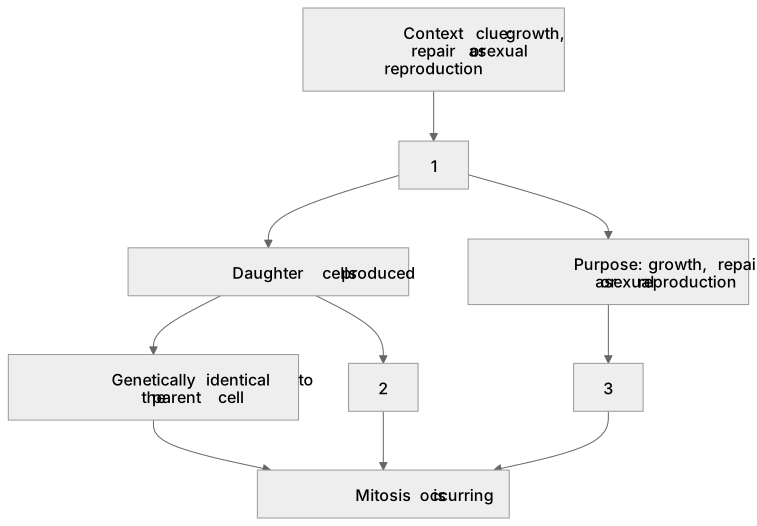
1Box 1
2Box 2
3Box 3
There is more to this lesson
The full lesson goes on to check your understanding and help you earn the marks. Create a free account to carry on, with your progress saved.
A week of Premium from your first lesson · Then the free plan continues · No card, no charge
Test your understanding of Mitosis and the cell cycle: Students should be able to recognise and describe situations in given contexts where mitosis is occurring.
Active recall beats re-reading. Take an instant quiz now to test what you’ve learned and lock it into long-term memory.
A week of Premium from your first lesson · Then the free plan continues · No card, no charge