AQA · GCSE · Biology
Course version: 8461 · Version from Sept 2018
Osmosis: AT skills covered by this practical activity: AT 1, 3 and 5.
This practical develops three working scientifically skills.
Checked against the AQA 8461 specification (opens in a new tab) on .
- Point 6 of 6
Study notes
From the checked teaching notes for this specification point.
The idea
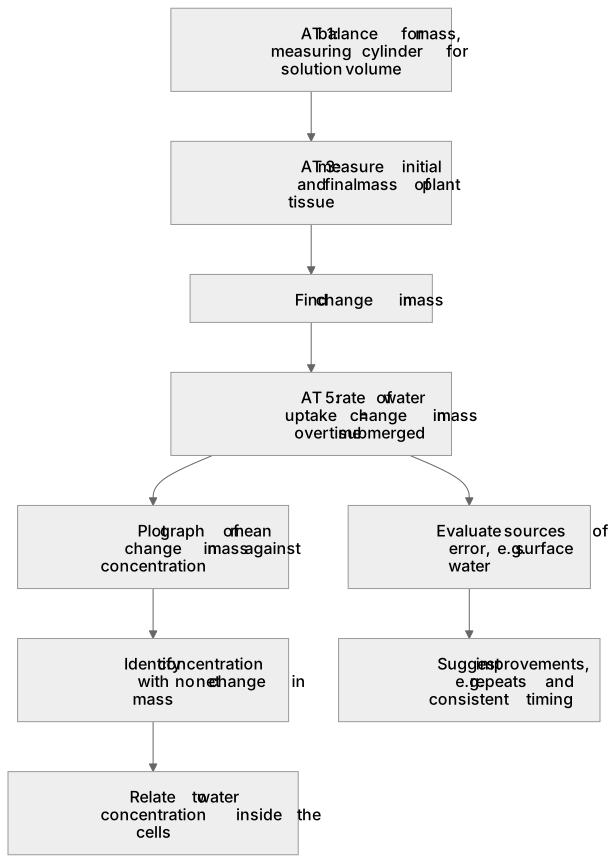
This practical develops three working scientifically skills. AT 1 is the use of appropriate apparatus to make measurements, here a balance for mass and a measuring cylinder for solution volume. AT 3 involves using appropriate apparatus and techniques to observe and measure biological changes, such as the change in mass of plant tissue due to osmosis. AT 5 is the measurement of rates of water uptake, which can be determined by calculating the change in mass over the specific time the tissue was submerged. You should also evaluate sources of error, for example incomplete blotting or evaporation, and suggest improvements such as repeats and consistent timing to ensure valid measurements of these biological processes.
What earns the marks
- AT 1: Selects and uses appropriate apparatus, such as a balance for mass and a measuring cylinder for solution volume, to collect valid measurements.
- AT 3: Uses techniques to measure biological changes, such as accurately determining the initial and final mass of plant tissue to find the change in mass.
- AT 5: Measures the rate of water uptake by calculating the change in mass of the tissue over the duration of the experiment.
- Plots a graph of mean change in mass against concentration, using suitable scales and labels, and describes the trend.
- Interprets the graph to identify the concentration at which there is no net change in mass and relates this to the water concentration inside the cells.
- Evaluates the method by identifying sources of error, such as surface water, and suggests improvements.
Common mistakes and how to put them right
Recording masses without units.
Put it right by including grams (g) in column headings and throughout calculations.
Plotting individual results without calculating a mean.
Put it right by repeating measurements and using the mean to reduce random error.
Ignoring anomalous results; correct this by identifying outliers and considering whether to repeat or exclude them with justification.
Exam tips
- When asked about AT 1, name the apparatus (e.g., balance) and explain why it is suitable for the measurement being taken.
- For AT 3, describe the techniques used to measure biological changes, such as carefully blotting the potato cylinders before weighing.
- For AT 5, explain how to calculate the rate of water uptake by dividing the change in mass by the time the tissue was submerged.
Try the lesson
The start of the Osmosis: AT skills covered by this practical activity: AT 1, 3 and 5. lesson, made from checked teaching notes for this specification point.
Have a go first
A student is preparing potato cylinders for an osmosis investigation. Which technique ensures that the results are valid and comparable?
Listen
This practical develops three working scientifically skills. AT 1 is the use of appropriate apparatus to make measurements, here a balance for mass and a measuring cylinder for solution volume. AT 3 involves using appropriate apparatus and techniques to observe and measure biological changes, such as the change in mass of plant tissue due to osmosis. AT 5 is the measurement of rates of water uptake, which can be determined by calculating the change in mass over the specific time the tissue was submerged. You should also evaluate sources of error, for example incomplete blotting or evaporation, and suggest improvements such as repeats and consistent timing to ensure valid measurements of these biological processes. A strong answer earns marks for these points. AT 1: Selects and uses appropriate apparatus, such as a balance for mass and a measuring cylinder for solution volume, to collect valid measurements. AT 3: Uses techniques to measure biological changes, such as accurately determining the initial and final mass of plant tissue to find the change in mass. AT 5: Measures the rate of water uptake by calculating the change in mass of the tissue over the duration of the experiment. Plots a graph of mean change in mass against concentration, using suitable scales and labels, and describes the trend. A common slip: Recording masses without units. Instead, including grams (g) in column headings and throughout calculations. Exam tip: When asked about AT 1, name the apparatus (e.g., balance) and explain why it is suitable for the measurement being taken.
See it
Label the diagram
Some boxes have lost their names. Pick the right name for each number.
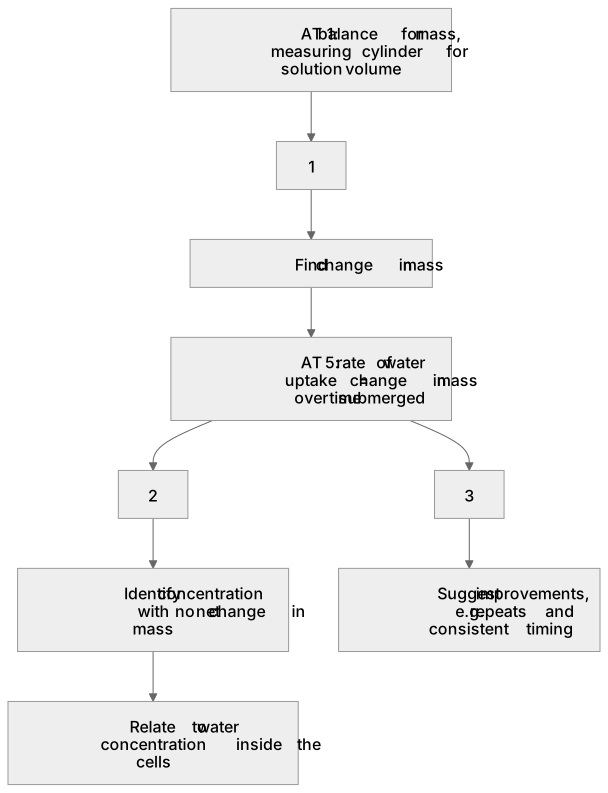
1Box 1
2Box 2
3Box 3
There is more to this lesson
The full lesson goes on to check your understanding and help you earn the marks. Create a free account to carry on, with your progress saved.
A week of Premium from your first lesson · Then the free plan continues · No card, no charge
Test your understanding of Osmosis: AT skills covered by this practical activity: AT 1, 3 and 5.
Active recall beats re-reading. Take an instant quiz now to test what you’ve learned and lock it into long-term memory.
A week of Premium from your first lesson · Then the free plan continues · No card, no charge