AQA · GCSE · Biology
Course version: 8461 · Version from Sept 2018
Required practical activity 3: investigate the effect of a range of…
Full specification wording
Osmosis: Required practical activity 3: investigate the effect of a range of concentrations of salt or sugar solutions on the mass of plant tissue.
This required practical tests osmosis in plant tissue by measuring mass change after immersion in a range of salt or sugar concentrations.
Checked against the AQA 8461 specification (opens in a new tab) on .
- Point 5 of 6
- 4 key terms
Study notes
From the checked teaching notes for this specification point.
The idea
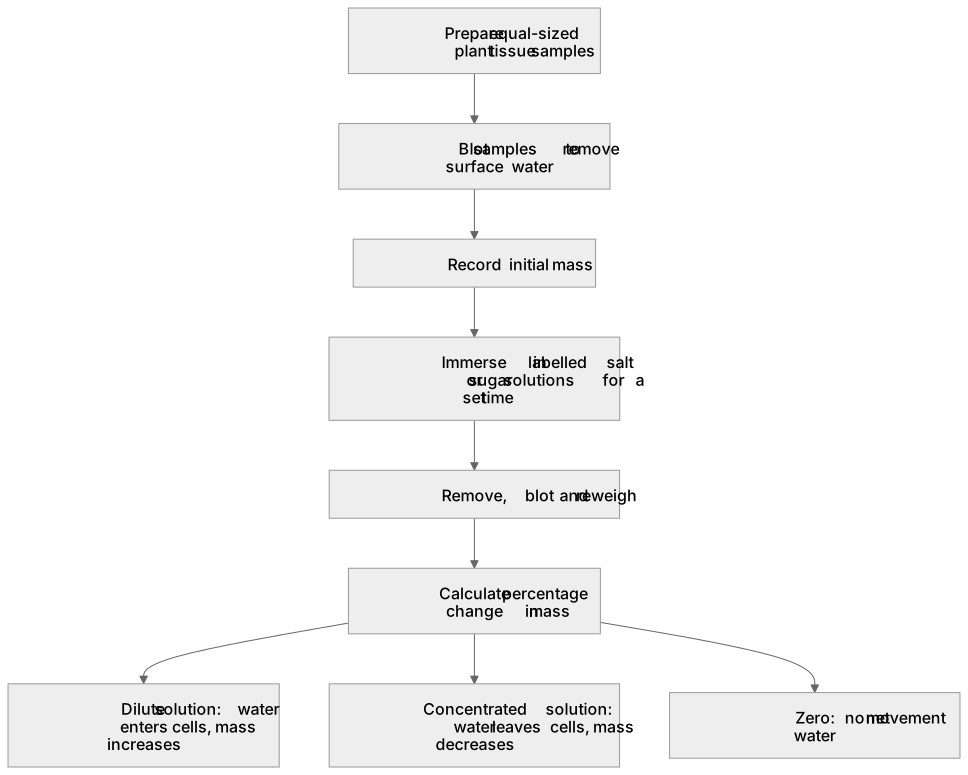
This required practical tests osmosis in plant tissue by measuring mass change after immersion in a range of salt or sugar concentrations. Osmosis is the diffusion of water from a dilute solution to a concentrated solution through a partially permeable membrane. You prepare equal-sized tissue samples, blot them, record initial masses, immerse them in labelled solutions for a set time, then blot and reweigh. Calculate the percentage change in mass. In a dilute solution, water enters cells by osmosis, so mass increases; in a concentrated solution, water leaves, so mass decreases. Plotting the results helps identify the concentration where there is no net movement of water.
What earns the marks
- State that osmosis is the diffusion of water from a dilute solution to a concentrated solution through a partially permeable membrane.
- Describe preparing equal-sized samples of plant tissue, blotting them to remove surface water, and recording initial mass.
- Explain that samples are immersed in a range of salt or sugar concentrations for a controlled time, then removed, blotted and reweighed.
- Calculate percentage change in mass for each sample to allow valid comparisons between pieces of different starting masses.
- Interpret a graph of mass change: positive values show water uptake, negative values show water loss, and zero indicates no net movement.
- Identify and control key variables such as temperature, immersion time and blotting method to make the investigation valid.
Common mistakes and how to put them right
Confusing osmosis with diffusion of solute particles.
Put it right by stating that osmosis specifically involves water movement from a dilute to a concentrated solution.
Forgetting to blot samples before weighing.
Put it right by blotting gently and consistently to remove surface water that would otherwise affect mass readings.
Using A-level terminology like water potential.
Put it right by using GCSE terms such as dilute and concentrated solutions.
Exam tips
- When describing the method, include how you control variables such as temperature and time, because these affect water movement.
- When interpreting results, refer to the concentration of the solutions rather than water potential, and link mass increase to water entering cells by osmosis.
Try the lesson
The start of the Osmosis: Required practical activity 3: investigate the effect of a range of concentrations of salt or sugar solutions on the mass of plant tissue. lesson, made from checked teaching notes for this specification point.
Have a go first
In a practical investigating osmosis, potato cylinders are blotted dry with a paper towel before their final mass is measured. Why is this step necessary?
Listen
This required practical tests osmosis in plant tissue by measuring mass change after immersion in a range of salt or sugar concentrations. Osmosis is the diffusion of water from a dilute solution to a concentrated solution through a partially permeable membrane. You prepare equal-sized tissue samples, blot them, record initial masses, immerse them in labelled solutions for a set time, then blot and reweigh. Calculate the percentage change in mass. In a dilute solution, water enters cells by osmosis, so mass increases; in a concentrated solution, water leaves, so mass decreases. Plotting the results helps identify the concentration where there is no net movement of water. A strong answer earns marks for these points. State that osmosis is the diffusion of water from a dilute solution to a concentrated solution through a partially permeable membrane. Describe preparing equal-sized samples of plant tissue, blotting them to remove surface water, and recording initial mass. Explain that samples are immersed in a range of salt or sugar concentrations for a controlled time, then removed, blotted and reweighed. Calculate percentage change in mass for each sample to allow valid comparisons between pieces of different starting masses. A common slip: Confusing osmosis with diffusion of solute particles. Instead, stating that osmosis specifically involves water movement from a dilute to a concentrated solution. Exam tip: When describing the method, include how you control variables such as temperature and time, because these affect water movement.
See it
Key words
Say what each word means before you turn the card.
Osmosis
Try answering aloud or in your head before turning the card.
Partially permeable membranes
Try answering aloud or in your head before turning the card.
Experimental design and control variables
Try answering aloud or in your head before turning the card.
Data analysis and graph interpretation
Try answering aloud or in your head before turning the card.
See every definition
- Osmosis
- The diffusion of water from a dilute solution to a concentrated solution through a partially permeable membrane.
- Partially permeable membranes
- A membrane through which water diffuses from a dilute solution to a concentrated solution during osmosis.
- Experimental design and control variables
- Key variables such as temperature, immersion time and blotting method are identified and controlled to make the investigation valid.
- Data analysis and graph interpretation
- Calculating percentage change in mass allows valid comparisons, and a graph shows positive values as water uptake, negative values as water loss and zero as no net movement.
Label the diagram
Some boxes have lost their names. Pick the right name for each number.
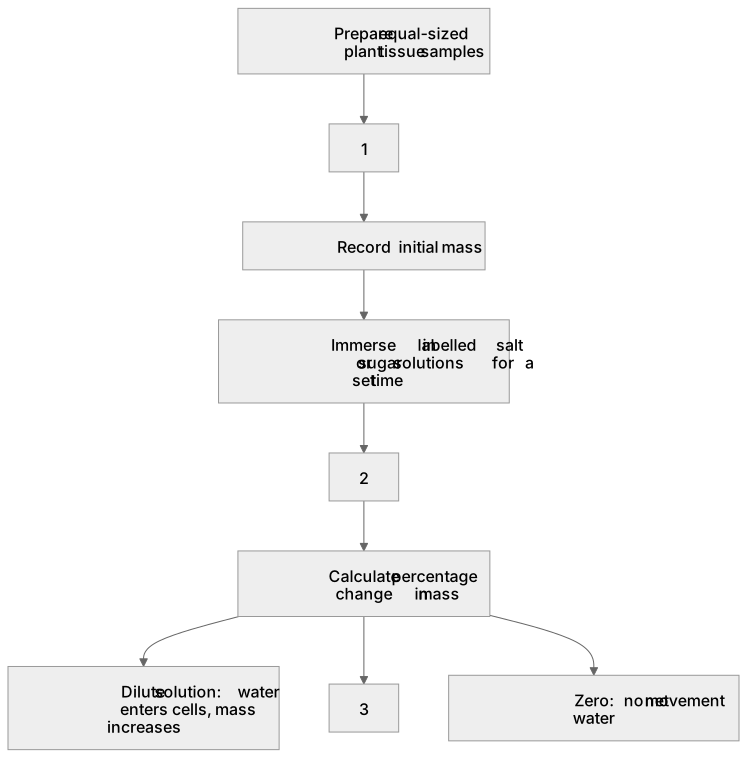
1Box 1
2Box 2
3Box 3
There is more to this lesson
The full lesson goes on to check your understanding and help you earn the marks. Create a free account to carry on, with your progress saved.
A week of Premium from your first lesson · Then the free plan continues · No card, no charge
Test your understanding of Osmosis: Required practical activity 3: investigate the effect of a range of concentrations of salt or sugar solutions on the mass of plant tissue.
Active recall beats re-reading. Take an instant quiz now to test what you’ve learned and lock it into long-term memory.
A week of Premium from your first lesson · Then the free plan continues · No card, no charge