AQA · GCSE · Biology
Course version: 8461 · Version from Sept 2018
Osmosis is the diffusion of water from a dilute solution to a concentrated…
Full specification wording
Osmosis: Osmosis is the diffusion of water from a dilute solution to a concentrated solution through a partially permeable membrane.
This statement gives the formal definition of osmosis.
Checked against the AQA 8461 specification (opens in a new tab) on .
- Point 2 of 6
- 2 key terms
Study notes
From the checked teaching notes for this specification point.
The idea
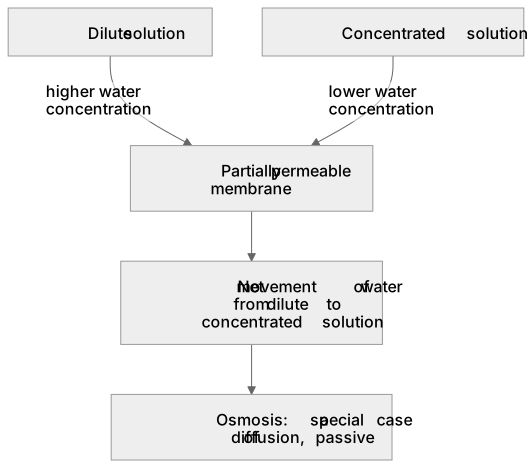
This statement gives the formal definition of osmosis. Water molecules move randomly in all directions, but a partially permeable membrane lets small water molecules pass while blocking larger solute molecules. If one side is a dilute solution and the other a concentrated solution, more water crosses from the dilute side to the concentrated side than in the reverse direction, producing a net movement of water. The dilute solution has the higher water concentration; the concentrated solution has the lower water concentration. Osmosis is therefore a special case of diffusion and is passive.
For example: A potato cylinder in distilled water gains mass because water enters its cells, while a cylinder in strong sugar solution loses mass because water leaves.
What earns the marks
- Identifies the substance that moves in osmosis as water, not dissolved solutes.
- States that the membrane involved is partially permeable, so water passes through but larger solute particles do not.
- Describes the direction of net water movement as from a dilute solution to a concentrated solution.
- Links dilute and concentrated solutions to higher and lower water concentrations respectively.
- Explains that osmosis is a form of diffusion and is passive, requiring no energy from respiration.
- Applies the definition to a practical context, such as mass changes in potato tissue placed in different sugar solutions.
Common mistakes and how to put them right
Defining osmosis as the movement of water from a concentrated solution to a dilute solution.
Put it right by stating that water moves from the dilute solution to the concentrated solution.
Stating that solutes diffuse through the partially permeable membrane during osmosis.
Put it right by stating that only water molecules move through the membrane in osmosis.
Describing the membrane as fully permeable or impermeable.
Put it right by stating that it is partially permeable, allowing water through but not larger solute molecules.
Exam tips
- Learn the definition as a complete sentence containing water, partially permeable membrane, and dilute-to-concentrated direction.
- In application questions, name the dilute and concentrated sides before stating the direction of water movement.
- Use the phrase net movement of water to show that water crosses both ways but the overall movement is in one direction.
Try the lesson
The start of the Osmosis: Osmosis is the diffusion of water from a dilute solution to a concentrated solution through a partially permeable membrane. lesson, made from checked teaching notes for this specification point.
Have a go first
Which substance diffuses during osmosis?
Listen
This statement gives the formal definition of osmosis. Water molecules move randomly in all directions, but a partially permeable membrane lets small water molecules pass while blocking larger solute molecules. If one side is a dilute solution and the other a concentrated solution, more water crosses from the dilute side to the concentrated side than in the reverse direction, producing a net movement of water. The dilute solution has the higher water concentration; the concentrated solution has the lower water concentration. Osmosis is therefore a special case of diffusion and is passive. For example, a potato cylinder in distilled water gains mass because water enters its cells, while a cylinder in strong sugar solution loses mass because water leaves. A strong answer earns marks for these points. Identifies the substance that moves in osmosis as water, not dissolved solutes. States that the membrane involved is partially permeable, so water passes through but larger solute particles do not. Describes the direction of net water movement as from a dilute solution to a concentrated solution. Links dilute and concentrated solutions to higher and lower water concentrations respectively. A common slip: Defining osmosis as the movement of water from a concentrated solution to a dilute solution. Instead, stating that water moves from the dilute solution to the concentrated solution. Exam tip: Learn the definition as a complete sentence containing water, partially permeable membrane, and dilute-to-concentrated direction.
See it
Key words
Say what each word means before you turn the card.
Osmosis
Try answering aloud or in your head before turning the card.
Partially permeable membrane
Try answering aloud or in your head before turning the card.
See every definition
- Osmosis
- The diffusion of water from a dilute solution to a concentrated solution through a partially permeable membrane.
- Partially permeable membrane
- A membrane that lets small water molecules pass while blocking larger solute molecules.
Label the diagram
Some boxes have lost their names. Pick the right name for each number.
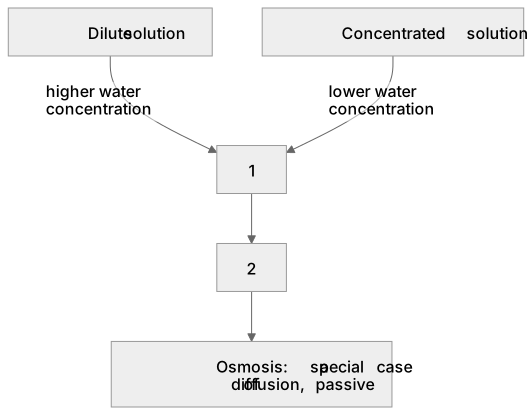
1Box 1
2Box 2
There is more to this lesson
The full lesson goes on to check your understanding and help you earn the marks. Create a free account to carry on, with your progress saved.
A week of Premium from your first lesson · Then the free plan continues · No card, no charge
Test your understanding of Osmosis: Osmosis is the diffusion of water from a dilute solution to a concentrated solution through a partially permeable membrane.
Active recall beats re-reading. Take an instant quiz now to test what you’ve learned and lock it into long-term memory.
A week of Premium from your first lesson · Then the free plan continues · No card, no charge