AQA · GCSE · Biology
Course version: 8461 · Version from Sept 2018
Students should be able to: • use simple compound measures of rate of…
Full specification wording
Osmosis: Students should be able to: • use simple compound measures of rate of water uptake • use percentages • calculate percentage gain and loss of mass of plant tissue.
Osmosis practical work produces numerical data that must be processed.
Checked against the AQA 8461 specification (opens in a new tab) on .
- Point 3 of 6
- 4 key terms
Study notes
From the checked teaching notes for this specification point.
The idea
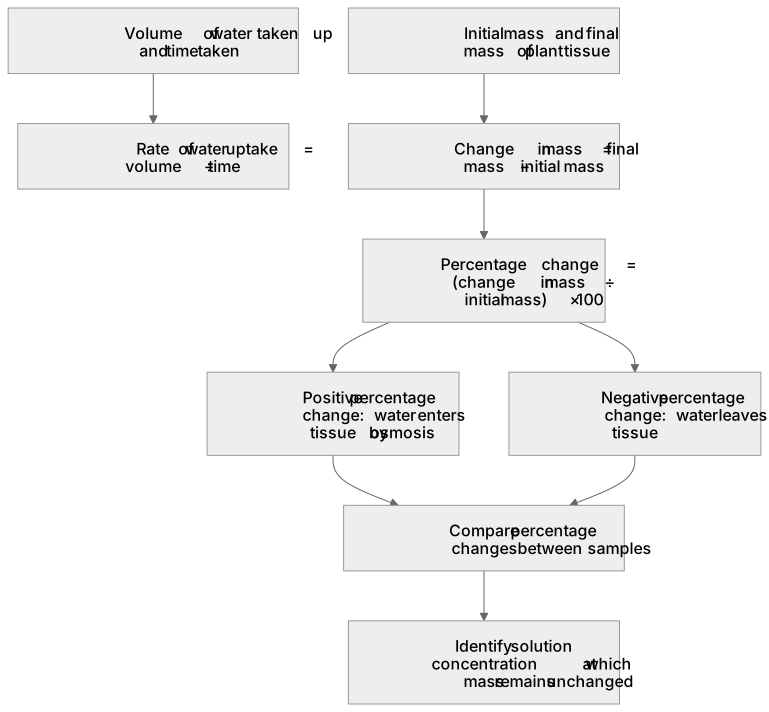
Osmosis practical work produces numerical data that must be processed. Rate of water uptake is a compound measure: divide the volume of water taken up by the time taken, for example 12 cm³ ÷ 4 minutes = 3 cm³ per minute. Percentage change in mass compares the change with the starting mass: percentage change = (change in mass ÷ initial mass) × 100. A potato cylinder starting at 5.0 g and finishing at 5.8 g gains 0.8 g, so the percentage gain is (0.8 ÷ 5.0) × 100 = 16%. A cylinder falling from 5.0 g to 4.5 g loses 0.5 g, so the percentage loss is (0.5 ÷ 5.0) × 100 = 10%. Percentage change allows fair comparison between samples of different starting masses.
What earns the marks
- Calculates rate of water uptake by dividing the volume of water taken up by the time taken, with correct units such as cm³ per minute.
- Calculates percentage change in mass using the formula (change in mass ÷ initial mass) × 100.
- Distinguishes percentage gain from percentage loss by the sign or direction of the mass change.
- Uses initial mass, not final mass, as the denominator when calculating percentage change.
- Interprets positive percentage change as water entering the tissue by osmosis and negative percentage change as water leaving.
- Compares percentage changes between samples to identify the solution concentration at which mass remains unchanged.
Common mistakes and how to put them right
Dividing by final mass instead of initial mass when finding percentage change.
Put it right by dividing the change in mass by the starting mass.
Forgetting to multiply by 100 and reporting a decimal as a percentage.
Put it right by completing the calculation with × 100 and adding the percentage sign.
Calculating rate of water uptake as volume multiplied by time.
Put it right by dividing the volume taken up by the time taken.
Exam tips
- Write the formula, substitute the values, then give the answer with the correct unit or percentage sign.
- Show whether a mass change is a gain or a loss, and keep the sign consistent with the direction of water movement.
- For rate questions, check that the time unit in the answer matches the time unit given in the question.
Try the lesson
The start of the Osmosis: Students should be able to: • use simple compound measures of rate of water uptake • use percentages • calculate percentage gain and loss of mass of plant tissue. lesson, made from checked teaching notes for this specification point.
Have a go first
A plant shoot takes up 30 cm³ of water in 5 minutes. Calculate the rate of water uptake in cm³ per minute.
Listen
Osmosis practical work produces numerical data that must be processed. Rate of water uptake is a compound measure: divide the volume of water taken up by the time taken, for example 12 cm³ ÷ 4 minutes = 3 cm³ per minute. Percentage change in mass compares the change with the starting mass: percentage change = (change in mass ÷ initial mass) × 100. A potato cylinder starting at 5.0 g and finishing at 5.8 g gains 0.8 g, so the percentage gain is (0.8 ÷ 5.0) × 100 = 16%. A cylinder falling from 5.0 g to 4.5 g loses 0.5 g, so the percentage loss is (0.5 ÷ 5.0) × 100 = 10%. Percentage change allows fair comparison between samples of different starting masses. A strong answer earns marks for these points. Calculates rate of water uptake by dividing the volume of water taken up by the time taken, with correct units such as cm³ per minute. Calculates percentage change in mass using the formula (change in mass ÷ initial mass) × 100. Distinguishes percentage gain from percentage loss by the sign or direction of the mass change. Uses initial mass, not final mass, as the denominator when calculating percentage change. A common slip: Dividing by final mass instead of initial mass when finding percentage change. Instead, dividing the change in mass by the starting mass. Exam tip: Write the formula, substitute the values, then give the answer with the correct unit or percentage sign.
See it
Key words
Say what each word means before you turn the card.
Compound measures of rate
Try answering aloud or in your head before turning the card.
Percentage change calculations
Try answering aloud or in your head before turning the card.
Quantitative interpretation of osmosis data
Try answering aloud or in your head before turning the card.
Fair comparison of experimental samples
Try answering aloud or in your head before turning the card.
See every definition
- Compound measures of rate
- A measure found by dividing the volume of water taken up by the time taken, for example 12 cm³ ÷ 4 minutes = 3 cm³ per minute.
- Percentage change calculations
- Working out the change in mass compared with the starting mass, using (change in mass ÷ initial mass) × 100.
- Quantitative interpretation of osmosis data
- Reading a positive percentage change as water entering the tissue by osmosis and a negative percentage change as water leaving.
- Fair comparison of experimental samples
- Using percentage change to compare samples of different starting masses.
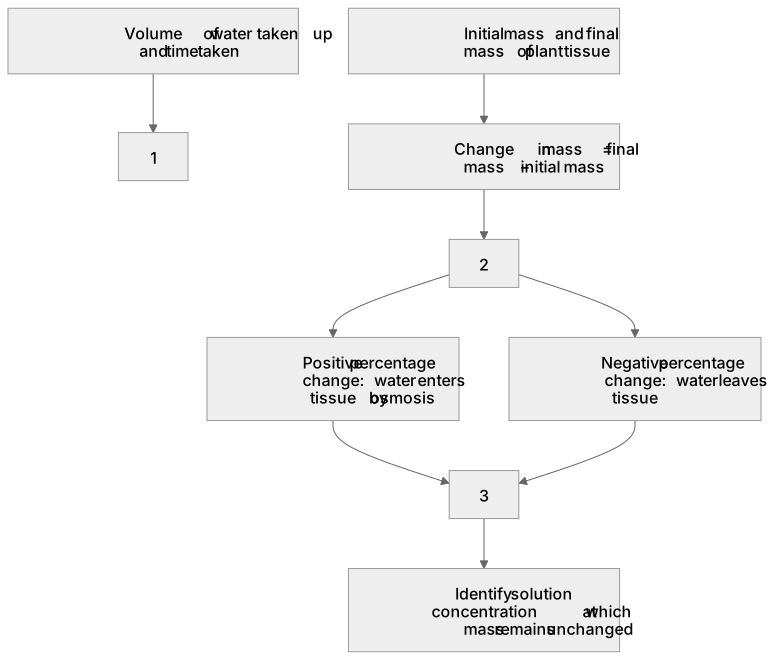
Label the diagram
Some boxes have lost their names. Pick the right name for each number.
1Box 1
2Box 2
3Box 3
There is more to this lesson
The full lesson goes on to check your understanding and help you earn the marks. Create a free account to carry on, with your progress saved.
A week of Premium from your first lesson · Then the free plan continues · No card, no charge
Test your understanding of Osmosis: Students should be able to: • use simple compound measures of rate of water uptake • use percentages • calculate percentage gain and loss of mass of plant tissue.
Active recall beats re-reading. Take an instant quiz now to test what you’ve learned and lock it into long-term memory.
A week of Premium from your first lesson · Then the free plan continues · No card, no charge