AQA · GCSE · Biology
Course version: 8461 · Version from Sept 2018
Plant defence responses: Mechanical adaptations.
Mechanical adaptations are physical features of a plant that deter herbivores.
Checked against the AQA 8461 specification (opens in a new tab) on .
- Point 6 of 7
Study notes
From the checked teaching notes for this specification point.
The idea
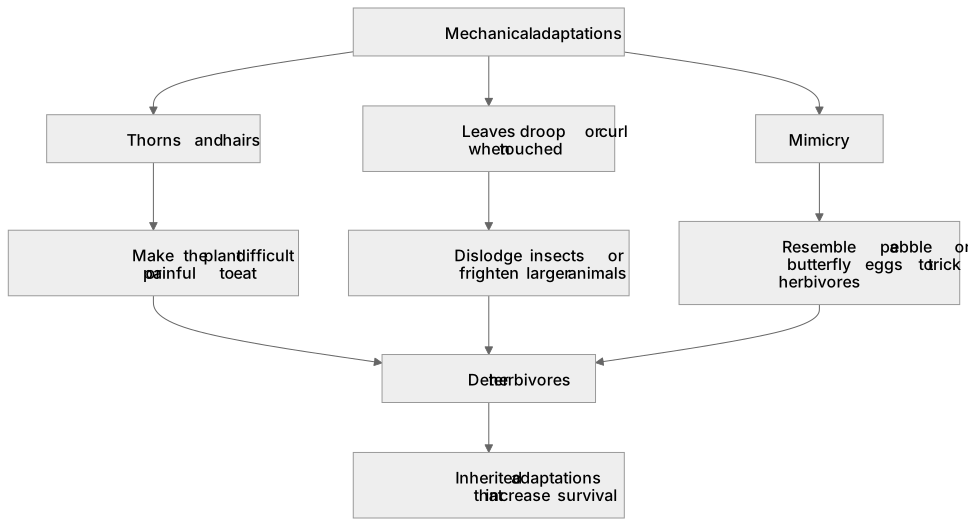
Mechanical adaptations are physical features of a plant that deter herbivores. Unlike physical plant defences, which resist invasion by microorganisms, mechanical adaptations specifically protect against animals. Examples include thorns and hairs, which make the plant difficult or painful to eat. Leaves that droop or curl when touched can dislodge insects or frighten larger animals. Mimicry is another mechanical adaptation, where a plant resembles another organism or object to trick herbivores, such as looking like a pebble or having patterns that resemble butterfly eggs to deter egg-laying. These features are inherited adaptations that increase survival.
What earns the marks
- Mechanical adaptations are physical features that deter herbivores from eating the plant.
- Examples include thorns and hairs, which can wound or deter animals.
- Leaves which droop or curl when touched act to dislodge insects or frighten herbivores.
- Mimicry tricks animals, for example by resembling stones or mimicking the presence of insect eggs.
- Mechanical adaptations are distinct from physical defences, which protect against microorganisms.
Common mistakes and how to put them right
Conflating mechanical adaptations with physical defences.
Put it right by remembering mechanical adaptations deter herbivores, while physical defences resist microorganisms.
Forgetting mimicry is a mechanical adaptation.
Put it right by including examples like plants that look like pebbles to avoid being eaten.
Thinking thorns protect against pathogens.
Put it right by stating thorns deter herbivores, not microscopic pathogens.
Exam tips
- Clearly distinguish between mechanical adaptations (against herbivores) and physical defences (against pathogens).
- Name specific examples like thorns, hairs, drooping leaves, or mimicry when asked for mechanical adaptations.
Try the lesson
The start of the Plant defence responses: Mechanical adaptations. lesson, made from checked teaching notes for this specification point.
Have a go first
Which mechanical adaptation helps a plant defend itself by making it harder for animals to reach and eat its leaves?
Listen
Mechanical adaptations are physical features of a plant that deter herbivores. Unlike physical plant defences, which resist invasion by microorganisms, mechanical adaptations specifically protect against animals. Examples include thorns and hairs, which make the plant difficult or painful to eat. Leaves that droop or curl when touched can dislodge insects or frighten larger animals. Mimicry is another mechanical adaptation, where a plant resembles another organism or object to trick herbivores, such as looking like a pebble or having patterns that resemble butterfly eggs to deter egg-laying. These features are inherited adaptations that increase survival. A strong answer earns marks for these points. Mechanical adaptations are physical features that deter herbivores from eating the plant. Examples include thorns and hairs, which can wound or deter animals. Leaves which droop or curl when touched act to dislodge insects or frighten herbivores. Mimicry tricks animals, for example by resembling stones or mimicking the presence of insect eggs. A common slip: Conflating mechanical adaptations with physical defences. Instead, remembering mechanical adaptations deter herbivores, while physical defences resist microorganisms. Exam tip: Clearly distinguish between mechanical adaptations (against herbivores) and physical defences (against pathogens).
See it
Label the diagram
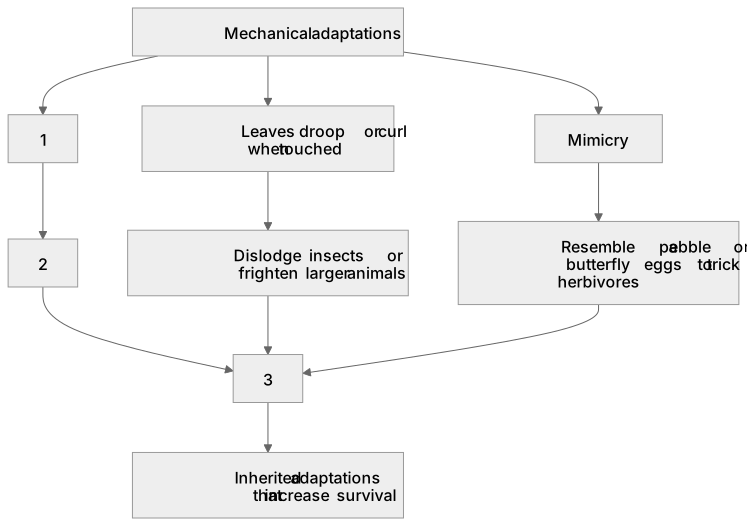
Some boxes have lost their names. Pick the right name for each number.
1Box 1
2Box 2
3Box 3
There is more to this lesson
The full lesson goes on to check your understanding and help you earn the marks. Create a free account to carry on, with your progress saved.
A week of Premium from your first lesson · Then the free plan continues · No card, no charge
Test your understanding of Plant defence responses: Mechanical adaptations.
Active recall beats re-reading. Take an instant quiz now to test what you’ve learned and lock it into long-term memory.
A week of Premium from your first lesson · Then the free plan continues · No card, no charge