AQA · GCSE · Biology
Course version: 8461 · Version from Sept 2018
Thorns and hairs deter animals. • Leaves which droop or curl when touched.…
Full specification wording
Plant defence responses: Thorns and hairs deter animals. • Leaves which droop or curl when touched. • Mimicry to trick animals.
This statement gives three mechanical defences.
Checked against the AQA 8461 specification (opens in a new tab) on .
- Point 7 of 7
- 4 key terms
Study notes
From the checked teaching notes for this specification point.
The idea
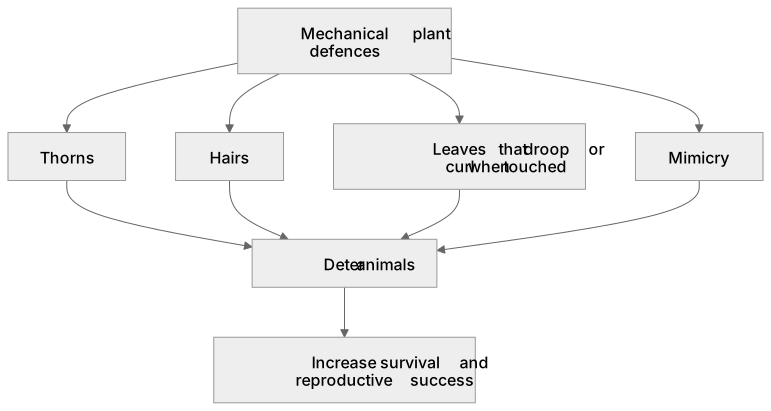
This statement gives three mechanical defences. Thorns and hairs deter animals: thorns are sharp structures that wound a feeding herbivore, while hairs create a rough or irritating surface that is difficult to bite or walk on. Leaves that droop or curl when touched move away from the animal, reducing the tissue available to eat and sometimes dislodging small insects. Mimicry tricks animals by making a plant resemble something else, such as another organism or an inedible object, so the herbivore avoids it. A useful method is to ask how each feature changes the animal's behaviour. For example, a thorn causes pain, a hair blocks access, a curling leaf removes food, and mimicry causes mistaken identity. All are inherited adaptations that raise survival and reproductive success.
What earns the marks
- Thorns are sharp structures that wound or deter feeding animals.
- Hairs on leaves or stems create a barrier or irritant surface that deters animals.
- Leaves that droop or curl when touched reduce the tissue available to herbivores.
- Mimicry makes a plant resemble another organism or object, tricking animals into avoiding it.
- Each defence can be assessed by observing animal feeding behaviour or plant damage.
Common mistakes and how to put them right
Treating thorns and hairs as identical.
Put it right by describing thorns as sharp wounding structures and hairs as surface barriers.
Believing touch-induced leaf movement is random.
Put it right by explaining that it is a defensive response that reduces herbivory.
Confusing mimicry with camouflage.
Put it right by stating that mimicry resembles a specific model, while camouflage blends with the background.
Exam tips
- For each defence, state the feature and then the effect on the animal's behaviour.
- Use precise terms such as deter, wound, barrier and mimicry rather than vague words like 'stop'.
- Explain the survival advantage of each adaptation in one linked sentence.
Try the lesson
The start of the Plant defence responses: Thorns and hairs deter animals. • Leaves which droop or curl when touched. • Mimicry to trick animals. lesson, made from checked teaching notes for this specification point.
Have a go first
Some plants have leaves that droop or curl quickly when an animal touches them. How does this mechanical adaptation help to defend the plant?
Listen
This statement gives three mechanical defences. Thorns and hairs deter animals: thorns are sharp structures that wound a feeding herbivore, while hairs create a rough or irritating surface that is difficult to bite or walk on. Leaves that droop or curl when touched move away from the animal, reducing the tissue available to eat and sometimes dislodging small insects. Mimicry tricks animals by making a plant resemble something else, such as another organism or an inedible object, so the herbivore avoids it. A useful method is to ask how each feature changes the animal's behaviour. For example, a thorn causes pain, a hair blocks access, a curling leaf removes food, and mimicry causes mistaken identity. All are inherited adaptations that raise survival and reproductive success. A strong answer earns marks for these points. Thorns are sharp structures that wound or deter feeding animals. Hairs on leaves or stems create a barrier or irritant surface that deters animals. Leaves that droop or curl when touched reduce the tissue available to herbivores. Mimicry makes a plant resemble another organism or object, tricking animals into avoiding it. A common slip: Treating thorns and hairs as identical. Instead, describing thorns as sharp wounding structures and hairs as surface barriers. Exam tip: For each defence, state the feature and then the effect on the animal's behaviour.
See it
Key words
Say what each word means before you turn the card.
Thorns
Try answering aloud or in your head before turning the card.
Hairs
Try answering aloud or in your head before turning the card.
Mimicry
Try answering aloud or in your head before turning the card.
Adaptation
Try answering aloud or in your head before turning the card.
See every definition
- Thorns
- Sharp structures that wound a feeding herbivore and so deter animals.
- Hairs
- Structures that create a rough or irritating surface which is difficult to bite or walk on.
- Mimicry
- Making a plant resemble something else, such as another organism or an inedible object, so the herbivore avoids it.
- Adaptation
- An inherited feature that raises survival and reproductive success.
Label the diagram
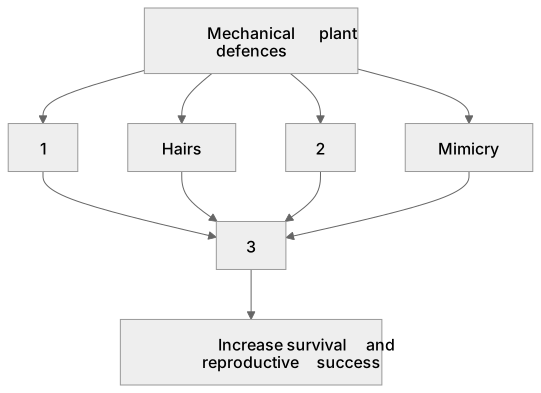
Some boxes have lost their names. Pick the right name for each number.
1Box 1
2Box 2
3Box 3
There is more to this lesson
The full lesson goes on to check your understanding and help you earn the marks. Create a free account to carry on, with your progress saved.
A week of Premium from your first lesson · Then the free plan continues · No card, no charge
Test your understanding of Plant defence responses: Thorns and hairs deter animals. • Leaves which droop or curl when touched. • Mimicry to trick animals.
Active recall beats re-reading. Take an instant quiz now to test what you’ve learned and lock it into long-term memory.
A week of Premium from your first lesson · Then the free plan continues · No card, no charge