AQA · GCSE · Biology
Course version: 8461 · Version from Sept 2018
A tissue is a group of cells with a similar structure and function.
Full specification wording
Principles of organisation: A tissue is a group of cells with a similar structure and function.
In multicellular organisms, cells that share a similar structure and carry out the same job are grouped together to form a tissue.
Checked against the AQA 8461 specification (opens in a new tab) on .
- Point 2 of 4
- 4 key terms
Study notes
From the checked teaching notes for this specification point.
The idea
In multicellular organisms, cells that share a similar structure and carry out the same job are grouped together to form a tissue. Working as a tissue allows a job to be done more effectively than a single cell could manage alone. For example, muscular tissue contains muscle cells that contract to move parts of the body, glandular tissue contains secretory cells that release substances such as enzymes, and epithelial tissue covers and protects surfaces. In plants, palisade mesophyll tissue contains many chloroplasts for photosynthesis, while xylem tissue transports water and mineral ions. Recognising tissues as the level between cells and organs helps you explain how the organ systems of a plant or animal are built up and how each level contributes to the functioning of the whole organism.
What earns the marks
- Define a tissue as a group of cells with a similar structure and function.
- Give named examples of tissues, such as muscular, glandular, epithelial, xylem or palisade mesophyll tissue.
- Explain that cells in a tissue work together to carry out a shared function more efficiently.
- Relate the structure of the tissue to its function, for example muscle tissue contains contractile cells that shorten to produce movement.
- Place tissue correctly in the hierarchy: cells form tissues, tissues form organs, organs form organ systems.
- Distinguish tissue from organ by noting that an organ contains several different tissues working together.
Common mistakes and how to put them right
Calling a single cell a tissue.
Put it right: A tissue is a group of similar cells working together.
Describing an organ as a tissue.
Put it right: An organ is made of several tissues and performs a specific function.
Assuming all cells in a tissue are identical in every way.
Put it right: They share a similar structure and function, which may still vary in detail.
Exam tips
- Learn at least two animal and two plant tissue examples with their functions so you can answer both context and definition questions.
- When defining a tissue, include both parts of the definition: similar structure and shared function.
- Use the hierarchy cell, tissue, organ, organ system, organism to structure answers about levels of organisation.
Try the lesson
The start of the Principles of organisation: A tissue is a group of cells with a similar structure and function. lesson, made from checked teaching notes for this specification point.
Have a go first
What is a tissue? Select the correct answer.
Listen
In multicellular organisms, cells that share a similar structure and carry out the same job are grouped together to form a tissue. Working as a tissue allows a job to be done more effectively than a single cell could manage alone. For example, muscular tissue contains muscle cells that contract to move parts of the body, glandular tissue contains secretory cells that release substances such as enzymes, and epithelial tissue covers and protects surfaces. In plants, palisade mesophyll tissue contains many chloroplasts for photosynthesis, while xylem tissue transports water and mineral ions. Recognising tissues as the level between cells and organs helps you explain how the organ systems of a plant or animal are built up and how each level contributes to the functioning of the whole organism. A strong answer earns marks for these points. Define a tissue as a group of cells with a similar structure and function. Give named examples of tissues, such as muscular, glandular, epithelial, xylem or palisade mesophyll tissue. Explain that cells in a tissue work together to carry out a shared function more efficiently. Relate the structure of the tissue to its function, for example muscle tissue contains contractile cells that shorten to produce movement. A common slip: Calling a single cell a tissue. Instead, a tissue is a group of similar cells working together. Exam tip: Learn at least two animal and two plant tissue examples with their functions so you can answer both context and definition questions.
See it
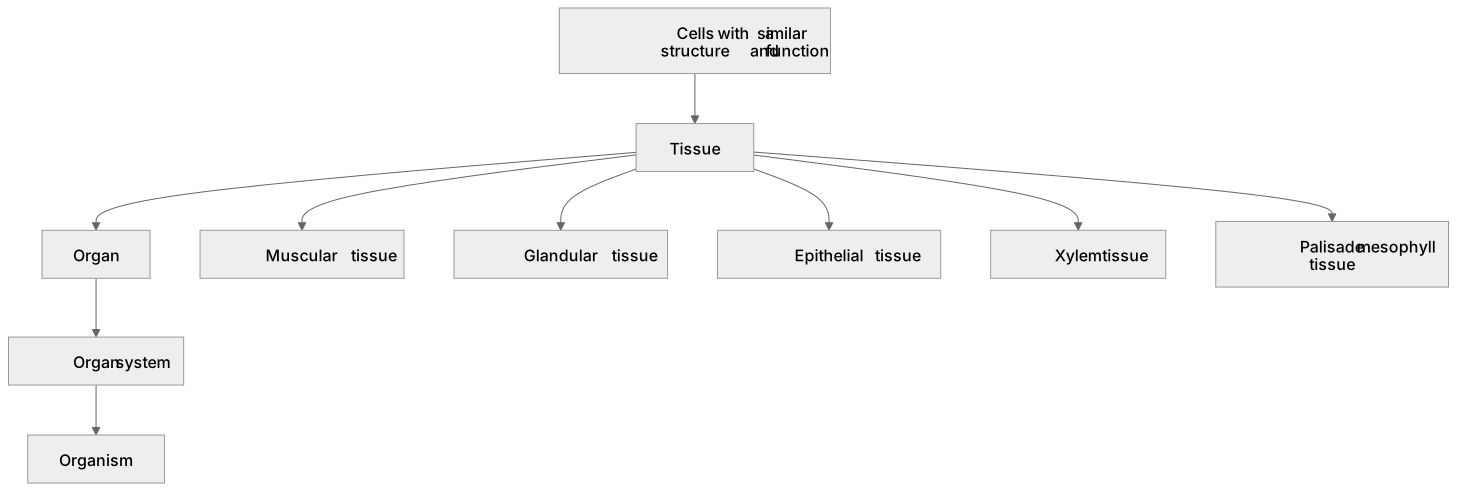
Key words
Say what each word means before you turn the card.
Tissue
Try answering aloud or in your head before turning the card.
Organ
Try answering aloud or in your head before turning the card.
Organ system
Try answering aloud or in your head before turning the card.
Levels of organisation
Try answering aloud or in your head before turning the card.
See every definition
- Tissue
- A group of cells with a similar structure and function.
- Organ
- A structure made of several different tissues working together and performing a specific function.
- Organ system
- A level of organisation formed when organs are built up together, contributing to the functioning of the whole organism.
- Levels of organisation
- The hierarchy in which cells form tissues, tissues form organs, and organs form organ systems.
Label the diagram
Some boxes have lost their names. Pick the right name for each number.
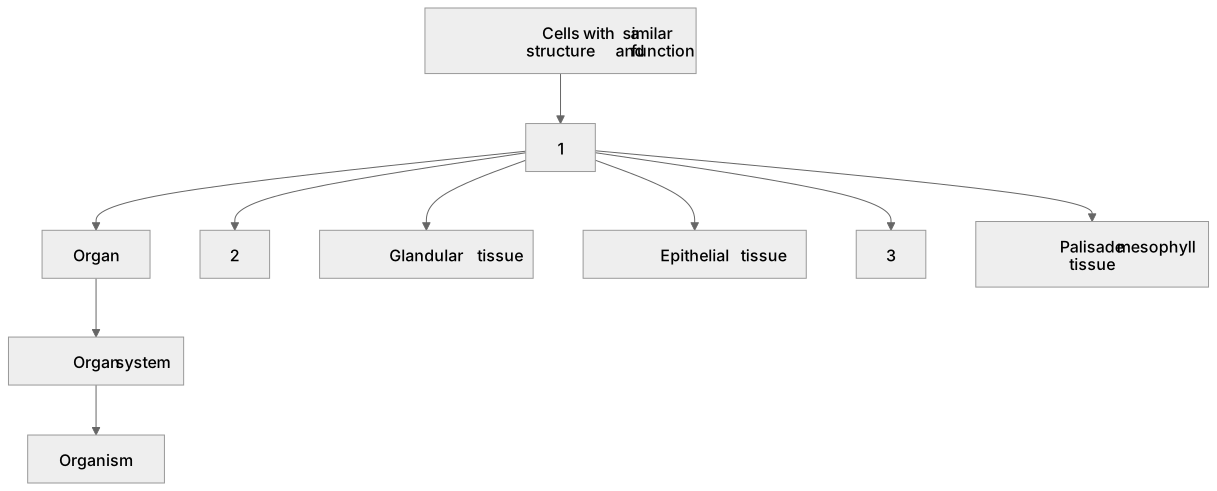
1Box 1
2Box 2
3Box 3
There is more to this lesson
The full lesson goes on to check your understanding and help you earn the marks. Create a free account to carry on, with your progress saved.
A week of Premium from your first lesson · Then the free plan continues · No card, no charge
Test your understanding of Principles of organisation: A tissue is a group of cells with a similar structure and function.
Active recall beats re-reading. Take an instant quiz now to test what you’ve learned and lock it into long-term memory.
A week of Premium from your first lesson · Then the free plan continues · No card, no charge