AQA · GCSE · Biology
Course version: 8461 · Version from Sept 2018
Monoclonal antibodies are produced from a single clone of cells.
Full specification wording
Producing monoclonal antibodies: Monoclonal antibodies are produced from a single clone of cells.
A clone is a group of genetically identical cells descended from one parent cell.
Checked against the AQA 8461 specification (opens in a new tab) on .
- Point 2 of 8
- 2 key terms
Study notes
From the checked teaching notes for this specification point.
The idea
A clone is a group of genetically identical cells descended from one parent cell. In monoclonal antibody production, one antibody-secreting cell is isolated and grown so that all resulting cells are identical. Because every cell in the clone carries the same antibody gene, every cell secretes the same antibody molecule. This gives a single, uniform antibody rather than the mixture found in blood plasma. For example, a hybridoma cell making an antibody against a specific antigen can be cultured; the culture contains millions of identical hybridoma cells, all releasing identical antibodies. The word monoclonal means one clone, so the antibodies are identical in shape. Note that this entire topic is assessed at Higher Tier only.
What earns the marks
- A clone is a population of genetically identical cells derived from a single parent cell.
- Monoclonal means that all the antibody molecules come from one clone of antibody-producing cells.
- Because the cells are genetically identical, they all produce the same antibody with the same specificity.
- A single hybridoma cell can be cultured to produce many identical cells, each secreting identical antibodies.
- The antibodies are identical in amino acid sequence and therefore in shape and binding site.
- Monoclonal antibodies are uniform, unlike the mixture of antibodies produced by a whole organism.
Common mistakes and how to put them right
Thinking that monoclonal means one antibody molecule.
Put it right: One clone of cells producing many identical antibody molecules.
Confusing a clone with a tissue or organ.
Put it right: A clone is a group of genetically identical cells, not a body part.
Assuming all antibodies in the blood are monoclonal.
Put it right: Blood contains many different antibodies, so a monoclonal antibody must be produced from a selected clone.
Exam tips
- Define clone and monoclonal in the first sentence of an answer to secure the key idea.
- Link the single clone to identical antibody shape and specificity, not just to identical cells.
- Remember that the production and application of monoclonal antibodies is a Higher Tier only topic.
Try the lesson
The start of the Producing monoclonal antibodies: Monoclonal antibodies are produced from a single clone of cells. lesson, made from checked teaching notes for this specification point.
Have a go first
Monoclonal antibodies are used in medicine for diagnosis and treatment. Which statement correctly describes the origin of the cells used to produce a specific monoclonal antibody?
Listen
A clone is a group of genetically identical cells descended from one parent cell. In monoclonal antibody production, one antibody-secreting cell is isolated and grown so that all resulting cells are identical. Because every cell in the clone carries the same antibody gene, every cell secretes the same antibody molecule. This gives a single, uniform antibody rather than the mixture found in blood plasma. For example, a hybridoma cell making an antibody against a specific antigen can be cultured; the culture contains millions of identical hybridoma cells, all releasing identical antibodies. The word monoclonal means one clone, so the antibodies are identical in shape. Note that this entire topic is assessed at Higher Tier only. A strong answer earns marks for these points. A clone is a population of genetically identical cells derived from a single parent cell. Monoclonal means that all the antibody molecules come from one clone of antibody-producing cells. Because the cells are genetically identical, they all produce the same antibody with the same specificity. A single hybridoma cell can be cultured to produce many identical cells, each secreting identical antibodies. A common slip: Thinking that monoclonal means one antibody molecule. Instead, one clone of cells producing many identical antibody molecules. Exam tip: Define clone and monoclonal in the first sentence of an answer to secure the key idea.
See it
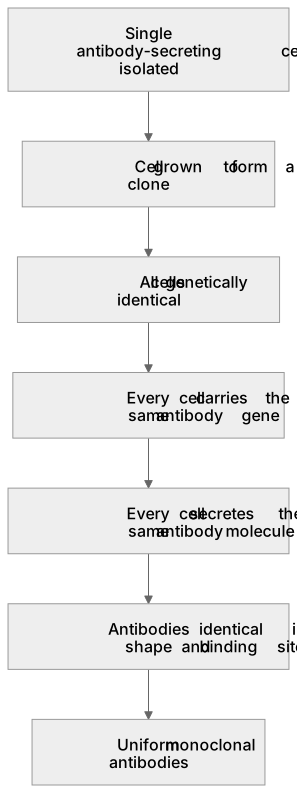
Put it in order
Put these steps in the order they happen.
- 1. Uniform monoclonal antibodies
- 2. Antibodies identical in shape and binding site
- 3. All cells genetically identical
- 4. Every cell secretes the same antibody molecule
- 5. Single antibody-secreting cell isolated
- 6. Cell grown to form a clone
- 7. Every cell carries the same antibody gene
Key words
Say what each word means before you turn the card.
Clone
Try answering aloud or in your head before turning the card.
Monoclonal
Try answering aloud or in your head before turning the card.
See every definition
- Clone
- A group of genetically identical cells descended from one parent cell.
- Monoclonal
- All the antibody molecules come from one clone of antibody-producing cells, so they are identical in shape.
Label the diagram
Some boxes have lost their names. Pick the right name for each number.
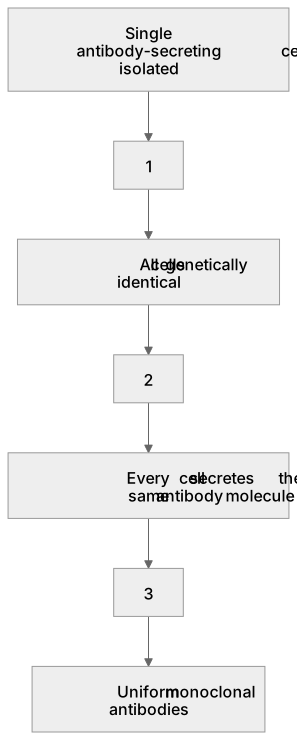
1Box 1
2Box 2
3Box 3
There is more to this lesson
The full lesson goes on to check your understanding and help you earn the marks. Create a free account to carry on, with your progress saved.
A week of Premium from your first lesson · Then the free plan continues · No card, no charge
Test your understanding of Producing monoclonal antibodies: Monoclonal antibodies are produced from a single clone of cells.
Active recall beats re-reading. Take an instant quiz now to test what you’ve learned and lock it into long-term memory.
A week of Premium from your first lesson · Then the free plan continues · No card, no charge