AQA · GCSE · Biology
Course version: 8461 · Version from Sept 2018
Students should be able to describe how monoclonal antibodies are produced.
Full specification wording
Producing monoclonal antibodies: Students should be able to describe how monoclonal antibodies are produced.
Monoclonal antibodies are identical antibodies produced from a single clone of cells, designed to target one specific protein antigen.
Checked against the AQA 8461 specification (opens in a new tab) on .
- Point 1 of 8
Study notes
From the checked teaching notes for this specification point.
The idea
Monoclonal antibodies are identical antibodies produced from a single clone of cells, designed to target one specific protein antigen. For example, to make antibodies for pregnancy tests, a mouse is injected with the hCG hormone (antigen). The mouse's immune system produces B-lymphocytes that make the specific anti-hCG antibody. These lymphocytes are extracted and fused with a tumour cell to form a hybridoma cell. The hybridoma retains the tumour cell's ability to divide rapidly and the lymphocyte's ability to produce the desired antibody. Single hybridoma cells are cloned to give many identical cells, and the antibodies they secrete are collected and purified. Note: this entire topic is assessed at Higher Tier only.
What earns the marks
- A specific antigen (e.g., hCG) is injected into a mouse to stimulate an immune response.
- B-lymphocytes that produce the specific desired antibody are extracted from the mouse.
- The hybridoma cells can divide rapidly by mitosis while continuously producing the specific antibody.
- A single hybridoma cell is cloned to produce many identical cells, and the monoclonal antibodies are collected and purified.
Common mistakes and how to put them right
Stating that the mouse directly produces monoclonal antibodies.
Put it right by explaining that mouse lymphocytes must first be fused with tumour cells to form hybridomas.
Confusing the roles of the two cell types.
Put it right by specifying that lymphocytes produce the antibody, while tumour cells provide the ability to divide rapidly.
Believing monoclonal antibodies can bind to multiple different antigens.
Put it right by stating they come from a single clone and are specific to one single binding site on one protein antigen.
Applying this content to Foundation tier exams.
Put it right by remembering that the production and application of monoclonal antibodies is strictly Higher Tier only.
Exam tips
- Always sequence the production steps logically: antigen injection, lymphocyte extraction, cell fusion, hybridoma cloning, and antibody purification.
- Use the specific term 'hybridoma' and explicitly state its dual function: rapid cell division and specific antibody production.
- Remember that monoclonal antibody production and its applications are strictly Higher Tier only content.
Try the lesson
The start of the Producing monoclonal antibodies: Students should be able to describe how monoclonal antibodies are produced. lesson, made from checked teaching notes for this specification point.
Have a go first
During the production of monoclonal antibodies, which type of cell is fused with a tumour cell to form a hybridoma?
Listen
Monoclonal antibodies are identical antibodies produced from a single clone of cells, designed to target one specific protein antigen. For example, to make antibodies for pregnancy tests, a mouse is injected with the hCG hormone (antigen). The mouse's immune system produces B-lymphocytes that make the specific anti-hCG antibody. These lymphocytes are extracted and fused with a tumour cell to form a hybridoma cell. The hybridoma retains the tumour cell's ability to divide rapidly and the lymphocyte's ability to produce the desired antibody. Single hybridoma cells are cloned to give many identical cells, and the antibodies they secrete are collected and purified. Note: this entire topic is assessed at Higher Tier only. A strong answer earns marks for these points. A specific antigen (e.g., hCG) is injected into a mouse to stimulate an immune response. B-lymphocytes that produce the specific desired antibody are extracted from the mouse. The hybridoma cells can divide rapidly by mitosis while continuously producing the specific antibody. A single hybridoma cell is cloned to produce many identical cells, and the monoclonal antibodies are collected and purified. A common slip: Stating that the mouse directly produces monoclonal antibodies. Instead, explaining that mouse lymphocytes must first be fused with tumour cells to form hybridomas. Exam tip: Always sequence the production steps logically: antigen injection, lymphocyte extraction, cell fusion, hybridoma cloning, and antibody purification.
See it
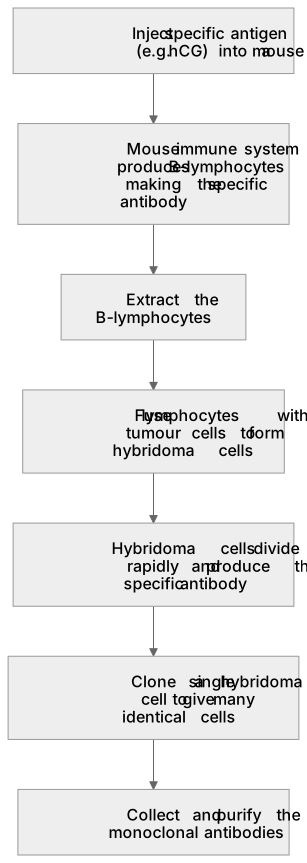
Put it in order
Put these steps in the order they happen.
- 1. Collect and purify the monoclonal antibodies
- 2. Clone a single hybridoma cell to give many identical cells
- 3. Extract the B-lymphocytes
- 4. Hybridoma cells divide rapidly and produce the specific antibody
- 5. Inject specific antigen (e.g. hCG) into a mouse
- 6. Mouse immune system produces B-lymphocytes making the specific antibody
- 7. Fuse lymphocytes with tumour cells to form hybridoma cells
Label the diagram
Some boxes have lost their names. Pick the right name for each number.
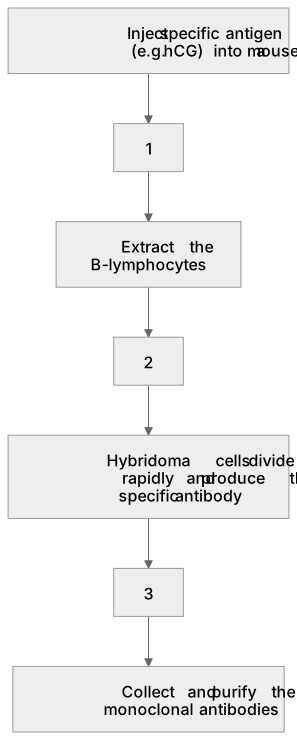
1Box 1
2Box 2
3Box 3
There is more to this lesson
The full lesson goes on to check your understanding and help you earn the marks. Create a free account to carry on, with your progress saved.
A week of Premium from your first lesson · Then the free plan continues · No card, no charge
Test your understanding of Producing monoclonal antibodies: Students should be able to describe how monoclonal antibodies are produced.
Active recall beats re-reading. Take an instant quiz now to test what you’ve learned and lock it into long-term memory.
A week of Premium from your first lesson · Then the free plan continues · No card, no charge