AQA · GCSE · Biology
Course version: 8461 · Version from Sept 2018
(HT only) Students should understand and use inverse proportion – the…
Full specification wording
Rate of photosynthesis: (HT only) Students should understand and use inverse proportion – the inverse square law and light intensity in the context of photosynthesis.
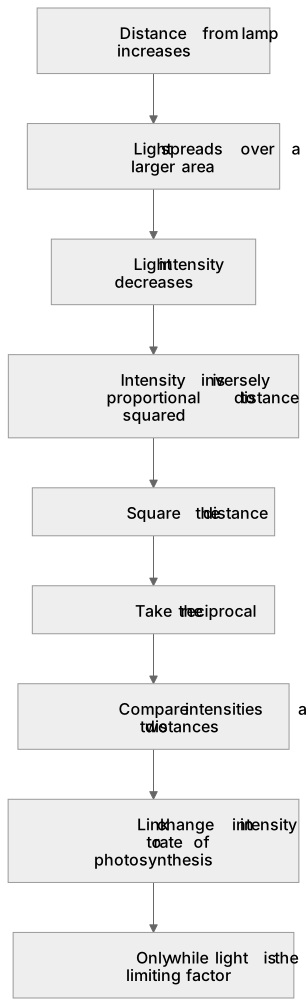
Light intensity decreases with distance from a lamp because the light spreads out over a larger area.
Checked against the AQA 8461 specification (opens in a new tab) on .
- Point 5 of 9
- 3 key terms
Study notes
From the checked teaching notes for this specification point.
The idea
Light intensity decreases with distance from a lamp because the light spreads out over a larger area. The inverse square law states that light intensity is inversely proportional to the square of the distance: intensity ∝ 1 ÷ distance². If the distance doubles, the intensity falls to one quarter of its previous value; if the distance trebles, the intensity falls to one ninth. In photosynthesis, this means that moving a lamp twice as far away can reduce the rate if light is the limiting factor, but only while light remains limiting. To use the law, square the distance, then take the reciprocal. For example, at 0.50 m the intensity is proportional to 1 ÷ 0.50² = 4 arbitrary units, and at 1.00 m it is proportional to 1 ÷ 1.00² = 1 arbitrary unit. The law predicts the shape of a rate against distance graph, which rises steeply as distance decreases.
What earns the marks
- State that light intensity is inversely proportional to the square of the distance from a point source.
- Use the relationship intensity ∝ 1 ÷ distance² to compare intensities at two distances.
- Calculate the effect of doubling or trebling the distance on light intensity.
- Explain that the inverse square law applies while light intensity is the limiting factor.
- Interpret a graph of rate against distance in terms of the inverse square relationship.
- Recognise that the law assumes a point source and no other limiting factors.
Common mistakes and how to put them right
Treating intensity as inversely proportional to distance rather than to distance squared.
Put it right by squaring the distance before taking the reciprocal.
Forgetting to square the distance when comparing two positions.
Put it right by writing distance² in the calculation.
Assuming the rate always follows the inverse square law.
Put it right by noting that other factors limit the rate at close distances or high intensities.
Exam tips
- Show the squared distance in your working before taking the reciprocal.
- Use ratio reasoning: doubling distance gives one quarter of the intensity.
- Link any calculated change in intensity to the rate only when light is limiting.
Try the lesson
The start of the Rate of photosynthesis: (HT only) Students should understand and use inverse proportion – the inverse square law and light intensity in the context of photosynthesis. lesson, made from checked teaching notes for this specification point.
Have a go first
A lamp is moved so that its distance from a pondweed is doubled. According to the inverse square law, what happens to the light intensity at the pondweed?
Listen
Light intensity decreases with distance from a lamp because the light spreads out over a larger area. The inverse square law states that light intensity is inversely proportional to the square of the distance: intensity ∝ 1 ÷ distance². If the distance doubles, the intensity falls to one quarter of its previous value; if the distance trebles, the intensity falls to one ninth. In photosynthesis, this means that moving a lamp twice as far away can reduce the rate if light is the limiting factor, but only while light remains limiting. To use the law, square the distance, then take the reciprocal. For example, at 0.50 m the intensity is proportional to 1 ÷ 0.50² = 4 arbitrary units, and at 1.00 m it is proportional to 1 ÷ 1.00² = 1 arbitrary unit. The law predicts the shape of a rate against distance graph, which rises steeply as distance decreases. A strong answer earns marks for these points. State that light intensity is inversely proportional to the square of the distance from a point source. Use the relationship intensity ∝ 1 ÷ distance² to compare intensities at two distances. Calculate the effect of doubling or trebling the distance on light intensity. Explain that the inverse square law applies while light intensity is the limiting factor. A common slip: Treating intensity as inversely proportional to distance rather than to distance squared. Instead, squaring the distance before taking the reciprocal. Exam tip: Show the squared distance in your working before taking the reciprocal.
See it
Key words
Say what each word means before you turn the card.
inverse square law
Try answering aloud or in your head before turning the card.
light intensity
Try answering aloud or in your head before turning the card.
rate against distance graph
Try answering aloud or in your head before turning the card.
See every definition
- inverse square law
- Light intensity is inversely proportional to the square of the distance, so intensity ∝ 1 ÷ distance².
- light intensity
- A quantity that decreases with distance from a lamp because the light spreads out over a larger area.
- rate against distance graph
- A graph whose shape the law predicts, rising steeply as distance decreases.
Label the diagram
Some boxes have lost their names. Pick the right name for each number.
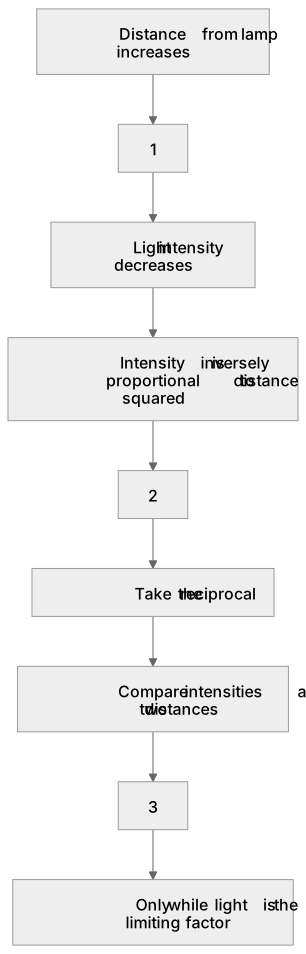
1Box 1
2Box 2
3Box 3
There is more to this lesson
The full lesson goes on to check your understanding and help you earn the marks. Create a free account to carry on, with your progress saved.
A week of Premium from your first lesson · Then the free plan continues · No card, no charge
Test your understanding of Rate of photosynthesis: (HT only) Students should understand and use inverse proportion – the inverse square law and light intensity in the context of photosynthesis.
Active recall beats re-reading. Take an instant quiz now to test what you’ve learned and lock it into long-term memory.
A week of Premium from your first lesson · Then the free plan continues · No card, no charge