AQA · GCSE · Biology
Course version: 8461 · Version from Sept 2018
(HT only) Students should be able to explain graphs of photosynthesis rate…
Full specification wording
Rate of photosynthesis: (HT only) Students should be able to explain graphs of photosynthesis rate involving two or three factors and decide which is the limiting factor.
A limiting factor is the factor in shortest supply that holds the rate below its potential maximum.
Checked against the AQA 8461 specification (opens in a new tab) on .
- Point 4 of 9
- 3 key terms
Study notes
From the checked teaching notes for this specification point.
The idea
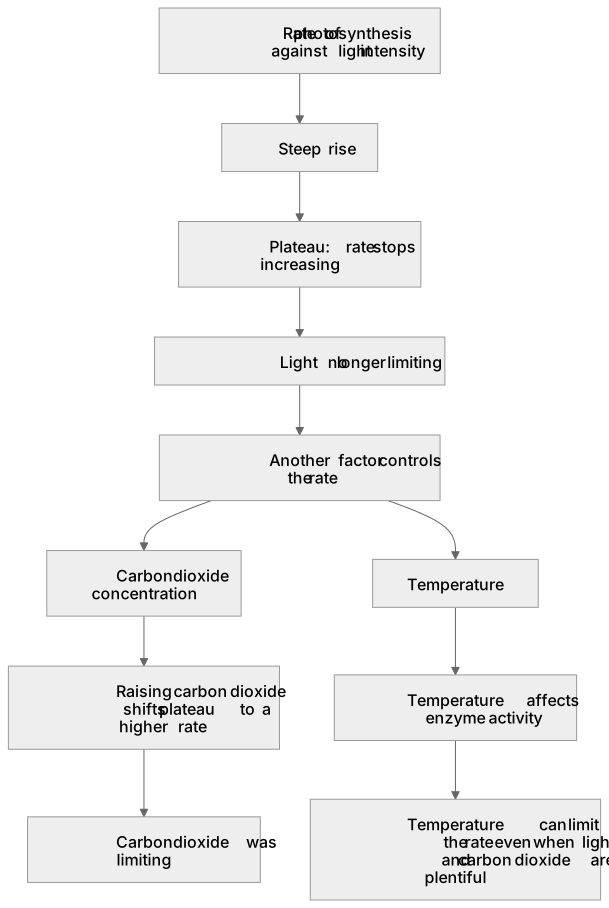
A limiting factor is the factor in shortest supply that holds the rate below its potential maximum. On a graph of rate against light intensity, the curve rises steeply, then flattens into a plateau. The plateau shows that light is no longer limiting, so another factor, such as carbon dioxide concentration or temperature, now controls the rate. If the carbon dioxide concentration is raised, the plateau shifts to a higher rate, showing that carbon dioxide was limiting. With three factors, compare curves at the same value on the x-axis: the curve with the highest rate has the most favourable combination, and the factor that differs between curves is the one limiting the lower curve. To decide the limiting factor, identify the factor being changed, then ask which other factor could raise the rate further.
What earns the marks
- Define a limiting factor as the factor in shortest supply that restricts the rate of photosynthesis.
- Describe the shape of a rate graph: an initial steep rise, then a plateau where the rate stops increasing.
- Explain that on the plateau, the factor plotted on the x-axis is no longer limiting.
- Use differences between curves at the same x-value to identify which factor is limiting the lower curve.
- Apply the reasoning to two or three factors, including light intensity, carbon dioxide concentration and temperature.
- Recognise that temperature affects enzyme activity, so it can limit the rate even when light and carbon dioxide are plentiful.
Common mistakes and how to put them right
Saying the rate is zero on the plateau.
Put it right by stating the rate is constant and limited by another factor.
Assuming the factor on the x-axis always limits the rate.
Put it right by checking whether raising another factor would increase the rate.
Confusing the steep section with the plateau.
Put it right by linking the steep section to the plotted factor being limiting and the plateau to a different factor taking over.
Exam tips
- Quote values from the graph, such as the light intensity where the plateau begins, to support your explanation.
- Compare curves at the same x-value rather than at different points along the axis.
- Name the limiting factor explicitly and justify your choice with evidence from the graph.
Try the lesson
The start of the Rate of photosynthesis: (HT only) Students should be able to explain graphs of photosynthesis rate involving two or three factors and decide which is the limiting factor. lesson, made from checked teaching notes for this specification point.
Have a go first
A student measures the rate of photosynthesis of pondweed at an optimal temperature of 25 °C while increasing the light intensity. The rate rises at first, then levels off. Carbon dioxide concentration is kept low and constant. Which factor is limiting the rate once the graph has levelled off?
Listen
A limiting factor is the factor in shortest supply that holds the rate below its potential maximum. On a graph of rate against light intensity, the curve rises steeply, then flattens into a plateau. The plateau shows that light is no longer limiting, so another factor, such as carbon dioxide concentration or temperature, now controls the rate. If the carbon dioxide concentration is raised, the plateau shifts to a higher rate, showing that carbon dioxide was limiting. With three factors, compare curves at the same value on the x-axis: the curve with the highest rate has the most favourable combination, and the factor that differs between curves is the one limiting the lower curve. To decide the limiting factor, identify the factor being changed, then ask which other factor could raise the rate further. A strong answer earns marks for these points. Define a limiting factor as the factor in shortest supply that restricts the rate of photosynthesis. Describe the shape of a rate graph: an initial steep rise, then a plateau where the rate stops increasing. Explain that on the plateau, the factor plotted on the x-axis is no longer limiting. Use differences between curves at the same x-value to identify which factor is limiting the lower curve. A common slip: Saying the rate is zero on the plateau. Instead, stating the rate is constant and limited by another factor. Exam tip: Quote values from the graph, such as the light intensity where the plateau begins, to support your explanation.
See it
Key words
Say what each word means before you turn the card.
limiting factor
Try answering aloud or in your head before turning the card.
plateau
Try answering aloud or in your head before turning the card.
rate graph
Try answering aloud or in your head before turning the card.
See every definition
- limiting factor
- The factor in shortest supply that holds the rate below its potential maximum.
- plateau
- The flat part of the curve where light is no longer limiting, so another factor now controls the rate.
- rate graph
- A graph of rate against light intensity that rises steeply, then flattens into a plateau.
Label the diagram
Some boxes have lost their names. Pick the right name for each number.
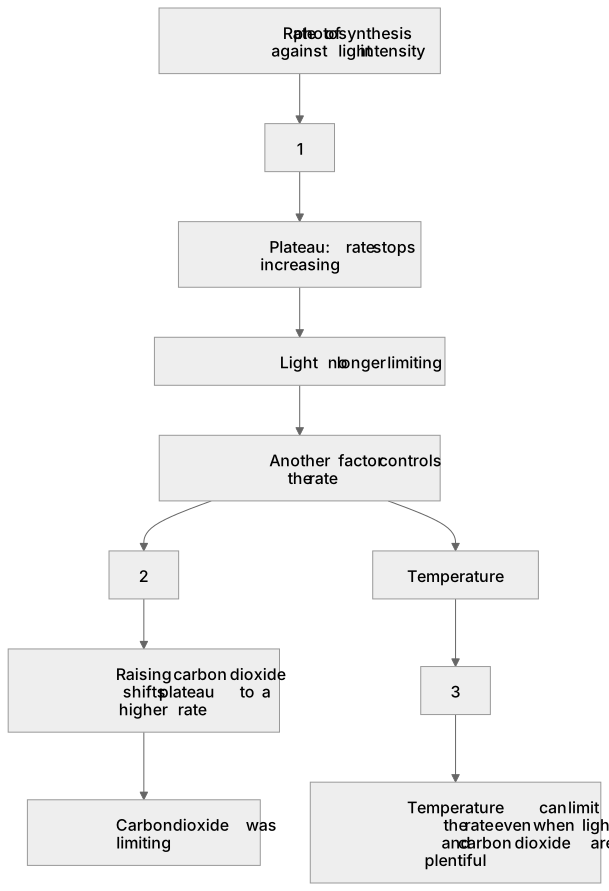
1Box 1
2Box 2
3Box 3
There is more to this lesson
The full lesson goes on to check your understanding and help you earn the marks. Create a free account to carry on, with your progress saved.
A week of Premium from your first lesson · Then the free plan continues · No card, no charge
Test your understanding of Rate of photosynthesis: (HT only) Students should be able to explain graphs of photosynthesis rate involving two or three factors and decide which is the limiting factor.
Active recall beats re-reading. Take an instant quiz now to test what you’ve learned and lock it into long-term memory.
A week of Premium from your first lesson · Then the free plan continues · No card, no charge