AQA · GCSE · Biology
Course version: 8461 · Version from Sept 2018
Students should be able to explain the effects of temperature, light…
Full specification wording
Rate of photosynthesis: Students should be able to explain the effects of temperature, light intensity, carbon dioxide concentration, and the amount of chlorophyll on the rate of photosynthesis.
Photosynthesis rate depends on several interacting factors.
Checked against the AQA 8461 specification (opens in a new tab) on .
- Point 1 of 9
Study notes
From the checked teaching notes for this specification point.
The idea
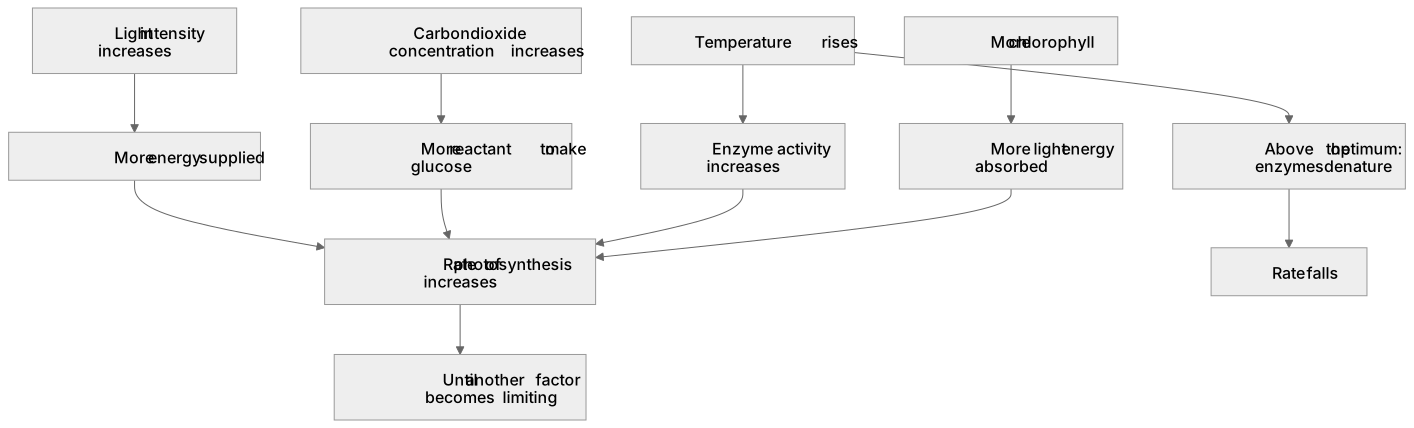
Photosynthesis rate depends on several interacting factors. Light intensity supplies energy for the reaction, so raising it increases the rate until another factor becomes limiting. Carbon dioxide is a reactant, so increasing its concentration raises the rate until limited elsewhere. Temperature affects enzyme activity: the rate rises with temperature up to an optimum, then falls rapidly as enzymes denature. Chlorophyll amount determines how much light energy can be absorbed, so more chlorophyll supports a faster rate. A practical example is pondweed exposed to a lamp: moving the lamp closer increases light intensity and oxygen bubbles per minute, but eventually the rate levels off.
What earns the marks
- Light intensity: as light intensity increases, the rate of photosynthesis increases because more energy is supplied, until another factor becomes limiting.
- Carbon dioxide concentration: increasing carbon dioxide concentration increases the rate because it is a reactant used to make glucose, until another factor becomes limiting.
- Temperature: the rate increases with temperature up to an optimum because enzyme activity increases, then decreases at higher temperatures because enzymes denature.
- Chlorophyll amount: a greater amount of chlorophyll allows more light energy to be absorbed, so the rate of photosynthesis increases.
- Limiting factor idea: at any point the factor in shortest supply limits the rate, so changing other factors may have little effect until that factor is relieved.
Common mistakes and how to put them right
Saying the rate keeps rising indefinitely with light intensity.
Put it right: It plateaus when another factor becomes limiting.
Stating that high temperature increases the rate without limit.
Put it right: Above the optimum enzymes denature and the rate falls.
Confusing chlorophyll amount with light intensity.
Put it right: Chlorophyll is the pigment amount in the chloroplast, while light intensity is the external light supply.
Exam tips
- Link each factor to its biological role: light and chlorophyll for energy absorption, carbon dioxide as a reactant, temperature for enzyme activity.
- Use the phrase 'until another factor becomes limiting' when describing a plateau on a graph.
- When explaining temperature, refer to enzymes and denaturation rather than saying heat 'kills' the plant.
Try the lesson
The start of the Rate of photosynthesis: Students should be able to explain the effects of temperature, light intensity, carbon dioxide concentration, and the amount of chlorophyll on the rate of photosynthesis. lesson, made from checked teaching notes for this specification point.
Have a go first
A plant is kept in bright light with plenty of carbon dioxide at 25 °C. Its rate of photosynthesis is high. What happens to the rate of photosynthesis if the temperature is lowered to 5 °C?
Listen
Photosynthesis rate depends on several interacting factors. Light intensity supplies energy for the reaction, so raising it increases the rate until another factor becomes limiting. Carbon dioxide is a reactant, so increasing its concentration raises the rate until limited elsewhere. Temperature affects enzyme activity: the rate rises with temperature up to an optimum, then falls rapidly as enzymes denature. Chlorophyll amount determines how much light energy can be absorbed, so more chlorophyll supports a faster rate. A practical example is pondweed exposed to a lamp: moving the lamp closer increases light intensity and oxygen bubbles per minute, but eventually the rate levels off. A strong answer earns marks for these points. Light intensity: as light intensity increases, the rate of photosynthesis increases because more energy is supplied, until another factor becomes limiting. Carbon dioxide concentration: increasing carbon dioxide concentration increases the rate because it is a reactant used to make glucose, until another factor becomes limiting. Temperature: the rate increases with temperature up to an optimum because enzyme activity increases, then decreases at higher temperatures because enzymes denature. Chlorophyll amount: a greater amount of chlorophyll allows more light energy to be absorbed, so the rate of photosynthesis increases. A common slip: Saying the rate keeps rising indefinitely with light intensity. Instead, it plateaus when another factor becomes limiting. Exam tip: Link each factor to its biological role: light and chlorophyll for energy absorption, carbon dioxide as a reactant, temperature for enzyme activity.
See it
Label the diagram
Some boxes have lost their names. Pick the right name for each number.
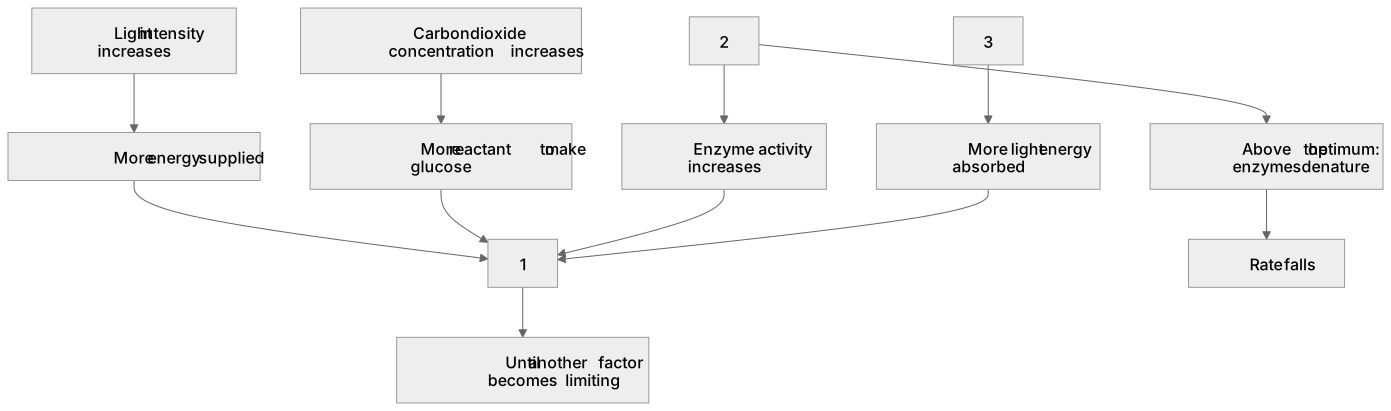
1Box 1
2Box 2
3Box 3
There is more to this lesson
The full lesson goes on to check your understanding and help you earn the marks. Create a free account to carry on, with your progress saved.
A week of Premium from your first lesson · Then the free plan continues · No card, no charge
Test your understanding of Rate of photosynthesis: Students should be able to explain the effects of temperature, light intensity, carbon dioxide concentration, and the amount of chlorophyll on the rate of photosynthesis.
Active recall beats re-reading. Take an instant quiz now to test what you’ve learned and lock it into long-term memory.
A week of Premium from your first lesson · Then the free plan continues · No card, no charge