AQA · GCSE · Biology
Course version: 8461 · Version from Sept 2018
Bacteria can evolve rapidly because they reproduce at a fast rate.
Full specification wording
Resistant bacteria: Bacteria can evolve rapidly because they reproduce at a fast rate.
Evolution by natural selection needs inherited variation and many generations.
Checked against the AQA 8461 specification (opens in a new tab) on .
- Point 1 of 10
Study notes
From the checked teaching notes for this specification point.
The idea
Evolution by natural selection needs inherited variation and many generations. Bacteria reproduce by simple cell division, so one cell can become a large population in a short time. For example, under favourable conditions some bacteria divide roughly every twenty minutes, so a single cell could in theory produce over a million descendants in a few hours. Each division can copy mutations, and because so many generations occur, useful new alleles spread quickly. If an antibiotic is present, bacteria with a mutation giving resistance survive and reproduce, while non-resistant cells die. The fast reproduction rate therefore speeds up natural selection, allowing resistance to appear and spread rapidly through a population. This explains why resistant strains emerge so quickly in hospitals and farms.
What earns the marks
- States that bacteria reproduce by simple cell division, producing genetically identical offspring apart from mutations.
- Explains that a fast reproduction rate produces many generations in a short time.
- Links many generations to a greater chance of beneficial mutations arising and being selected.
- Applies the idea to antibiotic resistance, where resistant bacteria survive and reproduce while others die.
- Uses a numerical or everyday example, such as division every twenty minutes, to show rapid population growth.
Common mistakes and how to put them right
Saying bacteria mutate because they need to survive.
Put it right: Mutations arise at random and selection then favours resistant cells.
Confusing evolution with an individual bacterium changing during its lifetime.
Put it right: The population changes over generations.
Assuming all bacteria are identical.
Put it right: Mutations produce variation on which selection can act.
Exam tips
- Use the phrase reproduce at a fast rate and link it directly to many generations.
- Include the natural selection sequence: variation, selection pressure, survival, reproduction, increased frequency.
- Refer to bacteria as a population, not as one organism evolving.
Try the lesson
The start of the Resistant bacteria: Bacteria can evolve rapidly because they reproduce at a fast rate. lesson, made from checked teaching notes for this specification point.
Have a go first
Which statement best explains why bacteria can evolve much more rapidly than multicellular organisms like mammals?
Listen
Evolution by natural selection needs inherited variation and many generations. Bacteria reproduce by simple cell division, so one cell can become a large population in a short time. For example, under favourable conditions some bacteria divide roughly every twenty minutes, so a single cell could in theory produce over a million descendants in a few hours. Each division can copy mutations, and because so many generations occur, useful new alleles spread quickly. If an antibiotic is present, bacteria with a mutation giving resistance survive and reproduce, while non-resistant cells die. The fast reproduction rate therefore speeds up natural selection, allowing resistance to appear and spread rapidly through a population. This explains why resistant strains emerge so quickly in hospitals and farms. A strong answer earns marks for these points. States that bacteria reproduce by simple cell division, producing genetically identical offspring apart from mutations. Explains that a fast reproduction rate produces many generations in a short time. Links many generations to a greater chance of beneficial mutations arising and being selected. Applies the idea to antibiotic resistance, where resistant bacteria survive and reproduce while others die. A common slip: Saying bacteria mutate because they need to survive. Instead, mutations arise at random and selection then favours resistant cells. Exam tip: Use the phrase reproduce at a fast rate and link it directly to many generations.
See it
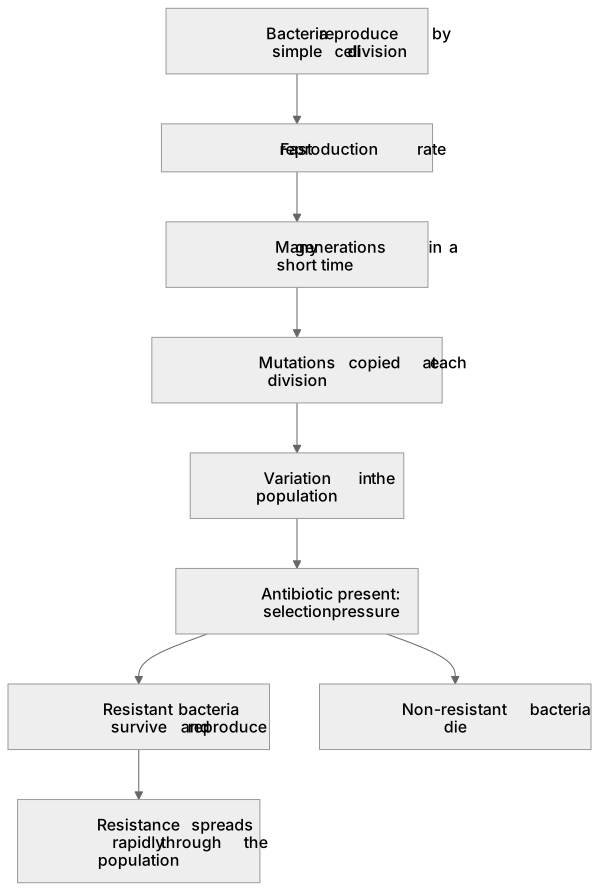
Label the diagram
Some boxes have lost their names. Pick the right name for each number.
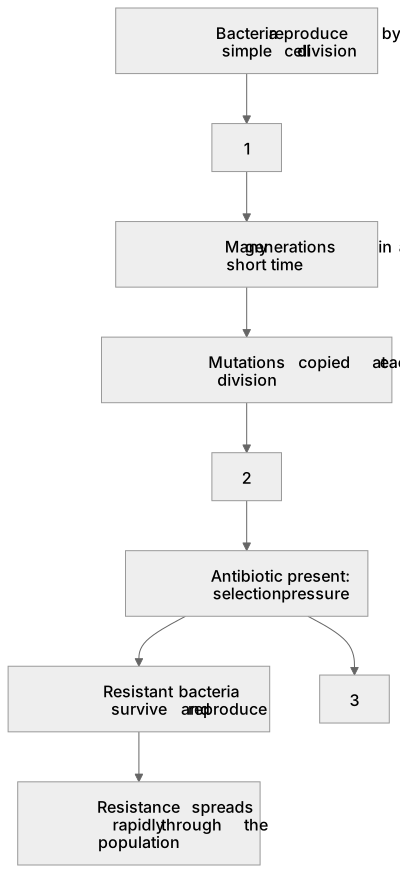
1Box 1
2Box 2
3Box 3
There is more to this lesson
The full lesson goes on to check your understanding and help you earn the marks. Create a free account to carry on, with your progress saved.
A week of Premium from your first lesson · Then the free plan continues · No card, no charge
Test your understanding of Resistant bacteria: Bacteria can evolve rapidly because they reproduce at a fast rate.
Active recall beats re-reading. Take an instant quiz now to test what you’ve learned and lock it into long-term memory.
A week of Premium from your first lesson · Then the free plan continues · No card, no charge