AQA · GCSE · Biology
Course version: 8461 · Version from Sept 2018
From the offspring those with the desired characteristic are bred together.
Full specification wording
Selective breeding: From the offspring those with the desired characteristic are bred together.
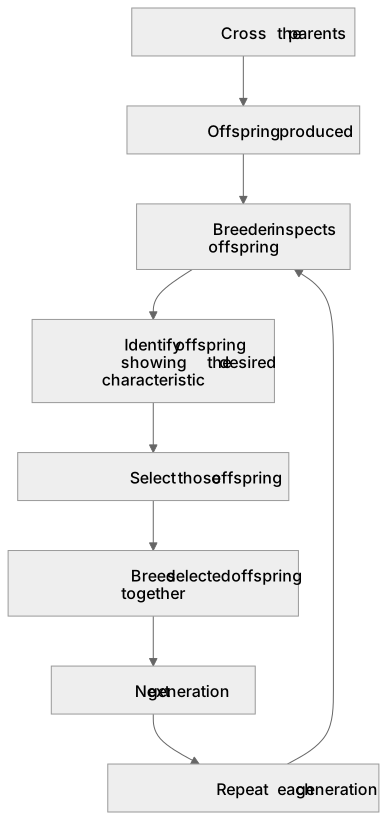
Once the first generation of offspring has been produced, the breeder examines the young and identifies which individuals actually display the desired characteristic.
Checked against the AQA 8461 specification (opens in a new tab) on .
- Point 6 of 9
Study notes
From the checked teaching notes for this specification point.
The idea
Once the first generation of offspring has been produced, the breeder examines the young and identifies which individuals actually display the desired characteristic. Only those individuals are kept and allowed to breed with each other; the rest are removed from the breeding programme. This is the selection step, and it is repeated each generation. For example, a farmer wanting disease-resistant wheat grows plants from crossed parents, then breeds together only the seedlings that survive infection. Because the chosen parents both carry the favourable alleles, a greater proportion of their offspring should show the characteristic, so the population mean shifts towards the desired trait over successive rounds.
What earns the marks
- The breeder inspects the offspring of the initial cross and identifies individuals that show the desired characteristic.
- Only offspring showing the desired characteristic are selected as parents for the next generation.
- Selected individuals are bred together, not with unselected individuals from the wider population.
- Offspring lacking the desired characteristic are not used for further breeding.
- The process is repeated each generation, so the proportion of offspring with the desired characteristic tends to increase.
- Selection acts on phenotype, but the underlying effect is to increase the frequency of favourable alleles in the breeding population.
Common mistakes and how to put them right
Thinking that all offspring from the first cross are automatically bred together.
Put it right: Only those showing the desired characteristic are selected.
Confusing selection with genetic modification.
Put it right: Selective breeding chooses existing variation rather than inserting a gene.
Assuming the desired characteristic appears in every offspring immediately.
Put it right: It becomes more common over successive generations of selection.
Exam tips
- Use the phrase ‘select and breed together’ to make the selection step explicit.
- Link the choice of parents to the increased chance of offspring inheriting favourable alleles.
- If asked to describe the process, sequence it as: choose parents, cross them, select offspring, breed selected offspring together, repeat.
Try the lesson
The start of the Selective breeding: From the offspring those with the desired characteristic are bred together. lesson, made from checked teaching notes for this specification point.
Have a go first
A farmer wants cows that produce more milk. After breeding a bull and a cow, the farmer must choose which offspring to breed next. According to selective breeding, which offspring should be bred together?
Listen
Once the first generation of offspring has been produced, the breeder examines the young and identifies which individuals actually display the desired characteristic. Only those individuals are kept and allowed to breed with each other; the rest are removed from the breeding programme. This is the selection step, and it is repeated each generation. For example, a farmer wanting disease-resistant wheat grows plants from crossed parents, then breeds together only the seedlings that survive infection. Because the chosen parents both carry the favourable alleles, a greater proportion of their offspring should show the characteristic, so the population mean shifts towards the desired trait over successive rounds. A strong answer earns marks for these points. The breeder inspects the offspring of the initial cross and identifies individuals that show the desired characteristic. Only offspring showing the desired characteristic are selected as parents for the next generation. Selected individuals are bred together, not with unselected individuals from the wider population. Offspring lacking the desired characteristic are not used for further breeding. A common slip: Thinking that all offspring from the first cross are automatically bred together. Instead, only those showing the desired characteristic are selected. Exam tip: Use the phrase ‘select and breed together’ to make the selection step explicit.
See it
Label the diagram
Some boxes have lost their names. Pick the right name for each number.
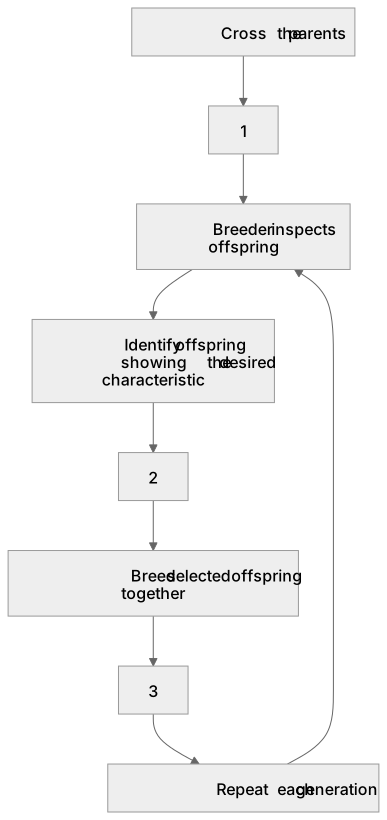
1Box 1
2Box 2
3Box 3
There is more to this lesson
The full lesson goes on to check your understanding and help you earn the marks. Create a free account to carry on, with your progress saved.
A week of Premium from your first lesson · Then the free plan continues · No card, no charge
Test your understanding of Selective breeding: From the offspring those with the desired characteristic are bred together.
Active recall beats re-reading. Take an instant quiz now to test what you’ve learned and lock it into long-term memory.
A week of Premium from your first lesson · Then the free plan continues · No card, no charge