AQA · GCSE · Biology
Course version: 8461 · Version from Sept 2018
This continues over many generations until all the offspring show the…
Full specification wording
Selective breeding: This continues over many generations until all the offspring show the desired characteristic.
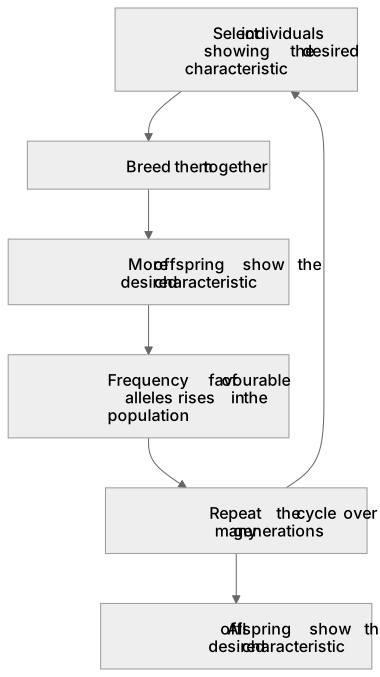
Selective breeding is not a single event; it is a repeated cycle.
Checked against the AQA 8461 specification (opens in a new tab) on .
- Point 7 of 9
- 4 key terms
Study notes
From the checked teaching notes for this specification point.
The idea
Selective breeding is not a single event; it is a repeated cycle. In each generation the breeder selects individuals showing the desired characteristic and breeds them together. Because those parents are more likely to carry the favourable alleles, more of their offspring show the trait. Repeating the cycle over many generations steadily raises the frequency of the favourable alleles in the population. Eventually, if selection is strong and the trait is reliably inherited, nearly all offspring show the desired characteristic, producing a breed or variety that breeds true for that trait. In practice, complete uniformity may take many years and can be limited by genetic variation, environmental effects and the appearance of inherited problems.
What earns the marks
- Selective breeding is a repeated cycle carried out over many generations.
- Each generation involves selecting individuals with the desired characteristic and breeding them together.
- The frequency of favourable alleles in the population increases across generations.
- The proportion of offspring showing the desired characteristic rises over time.
- The endpoint is a population in which essentially all offspring show the desired characteristic.
- The process can take many generations and may be limited by remaining variation or inherited defects.
Common mistakes and how to put them right
Believing that all offspring show the desired characteristic after one generation.
Put it right: Many generations of selection are usually needed.
Thinking that selection changes an individual’s genes during its lifetime.
Put it right: Selection changes which alleles are passed on to the next generation.
Assuming the process always produces a perfect result.
Put it right: Inbreeding and remaining variation can prevent complete uniformity.
Exam tips
- Use the phrase ‘over many generations’ to show understanding of the timescale.
- Explain the endpoint as a population in which all offspring show the desired characteristic.
- Link the increase in offspring showing the trait to the increased frequency of favourable alleles.
Try the lesson
The start of the Selective breeding: This continues over many generations until all the offspring show the desired characteristic. lesson, made from checked teaching notes for this specification point.
Have a go first
A breeder selects and breeds the fastest horses. This process is repeated over many generations. What is the intended final outcome of this continuous selection?
Listen
Selective breeding is not a single event; it is a repeated cycle. In each generation the breeder selects individuals showing the desired characteristic and breeds them together. Because those parents are more likely to carry the favourable alleles, more of their offspring show the trait. Repeating the cycle over many generations steadily raises the frequency of the favourable alleles in the population. Eventually, if selection is strong and the trait is reliably inherited, nearly all offspring show the desired characteristic, producing a breed or variety that breeds true for that trait. In practice, complete uniformity may take many years and can be limited by genetic variation, environmental effects and the appearance of inherited problems. A strong answer earns marks for these points. Selective breeding is a repeated cycle carried out over many generations. Each generation involves selecting individuals with the desired characteristic and breeding them together. The frequency of favourable alleles in the population increases across generations. The proportion of offspring showing the desired characteristic rises over time. A common slip: Believing that all offspring show the desired characteristic after one generation. Instead, many generations of selection are usually needed. Exam tip: Use the phrase ‘over many generations’ to show understanding of the timescale.
See it
Key words
Say what each word means before you turn the card.
Repeated artificial selection
Try answering aloud or in your head before turning the card.
Allele frequency change
Try answering aloud or in your head before turning the card.
Breeding true for a characteristic
Try answering aloud or in your head before turning the card.
Limits of selective breeding
Try answering aloud or in your head before turning the card.
See every definition
- Repeated artificial selection
- A repeated cycle carried out over many generations in which individuals showing the desired characteristic are selected and bred together.
- Allele frequency change
- The frequency of favourable alleles in the population increases across generations.
- Breeding true for a characteristic
- The endpoint is a population in which essentially all offspring show the desired characteristic.
- Limits of selective breeding
- The process can take many generations and may be limited by remaining variation or inherited defects.
Label the diagram
Some boxes have lost their names. Pick the right name for each number.
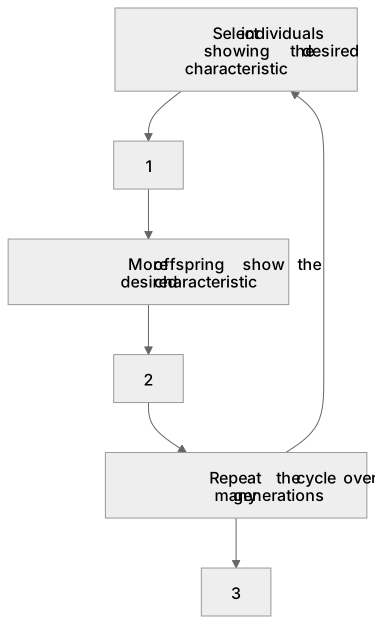
1Box 1
2Box 2
3Box 3
There is more to this lesson
The full lesson goes on to check your understanding and help you earn the marks. Create a free account to carry on, with your progress saved.
A week of Premium from your first lesson · Then the free plan continues · No card, no charge
Test your understanding of Selective breeding: This continues over many generations until all the offspring show the desired characteristic.
Active recall beats re-reading. Take an instant quiz now to test what you’ve learned and lock it into long-term memory.
A week of Premium from your first lesson · Then the free plan continues · No card, no charge