AQA · GCSE · Biology
Course version: 8461 · Version from Sept 2018
The characteristic can be chosen for usefulness or appearance: • Disease…
Full specification wording
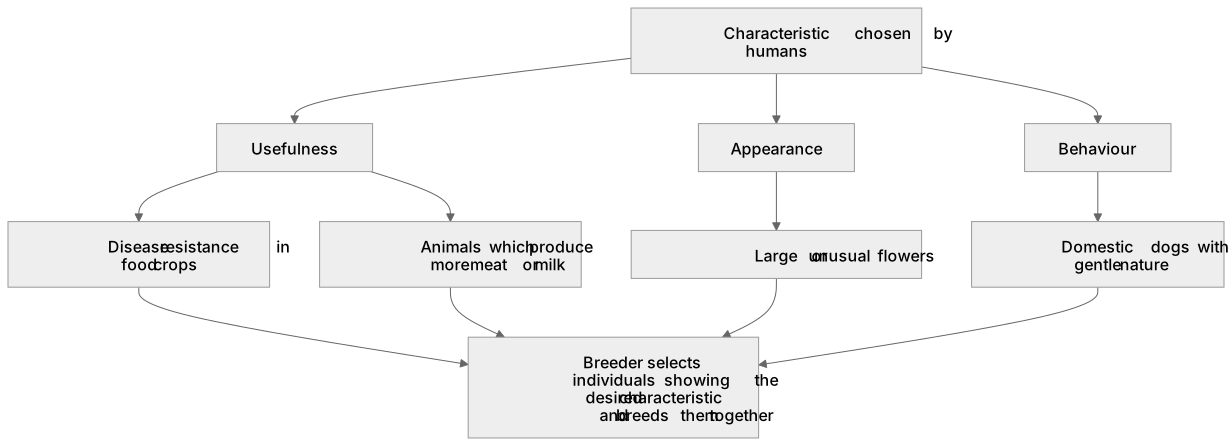
Selective breeding: The characteristic can be chosen for usefulness or appearance: • Disease resistance in food crops. • Animals which produce more meat or milk. • Domestic dogs with a gentle nature. • Large or unusual flowers.
Humans choose which characteristic to select for, based on usefulness, appearance, or behaviour.
Checked against the AQA 8461 specification (opens in a new tab) on .
- Point 8 of 9
- 4 key terms
Study notes
From the checked teaching notes for this specification point.
The idea
Humans choose which characteristic to select for, based on usefulness, appearance, or behaviour. Usefulness includes traits improving food production, such as disease resistance in crops or higher meat or milk yield in farm animals. Appearance includes traits valued for aesthetics, such as large or unusual flowers in ornamental plants. Behavioural traits are also selected, such as a gentle nature in domestic dogs for companionship. The same underlying process applies in every case: identify individuals showing the desired trait and breed them together. Selective breeding is driven by human priorities, which may be economic, agricultural, aesthetic, or behavioural, rather than by natural selection.
What earns the marks
- The characteristic selected for can be chosen for usefulness, appearance or behaviour.
- Disease resistance in food crops is an example of a useful characteristic.
- Animals that produce more meat or milk are examples of useful characteristics.
- Domestic dogs with a gentle nature are an example of a characteristic chosen for behaviour or temperament.
- Large or unusual flowers are an example of a characteristic chosen for appearance.
- In each case the breeder selects individuals showing the desired characteristic and breeds them together.
Common mistakes and how to put them right
Thinking that only appearance can be selected for; the correction is that usefulness, such as disease resistance or yield, is also commonly selected for.
Confusing selective breeding with natural selection.
Put it right: Humans choose the characteristic in selective breeding.
Treating the examples as separate processes.
Put it right: All four examples use the same select-and-breed method.
Exam tips
- Give at least one usefulness example and one appearance or behavioural example when asked to explain the range of characteristics.
- Name the specific organism and the specific characteristic, for example disease resistance in wheat or large flowers in a garden plant.
- Link each example back to the idea that humans choose which individuals breed.
Try the lesson
The start of the Selective breeding: The characteristic can be chosen for usefulness or appearance: • Disease resistance in food crops. • Animals which produce more meat or milk. • Domestic dogs with a gentle nature. • Large or unusual flowers. lesson, made from checked teaching notes for this specification point.
Have a go first
Selective breeding is used to develop specific characteristics in organisms. Which of the following is an example of a characteristic chosen primarily for its usefulness rather than its appearance?
Listen
Humans choose which characteristic to select for, based on usefulness, appearance, or behaviour. Usefulness includes traits improving food production, such as disease resistance in crops or higher meat or milk yield in farm animals. Appearance includes traits valued for aesthetics, such as large or unusual flowers in ornamental plants. Behavioural traits are also selected, such as a gentle nature in domestic dogs for companionship. The same underlying process applies in every case: identify individuals showing the desired trait and breed them together. Selective breeding is driven by human priorities, which may be economic, agricultural, aesthetic, or behavioural, rather than by natural selection. A strong answer earns marks for these points. The characteristic selected for can be chosen for usefulness, appearance or behaviour. Disease resistance in food crops is an example of a useful characteristic. Animals that produce more meat or milk are examples of useful characteristics. Domestic dogs with a gentle nature are an example of a characteristic chosen for behaviour or temperament. A common slip: Thinking that only appearance can be selected for. Instead, usefulness, such as disease resistance or yield, is also commonly selected for. Exam tip: Give at least one usefulness example and one appearance or behavioural example when asked to explain the range of characteristics.
See it
Key words
Say what each word means before you turn the card.
Human-directed selection
Try answering aloud or in your head before turning the card.
Agricultural usefulness
Try answering aloud or in your head before turning the card.
Aesthetic and behavioural traits
Try answering aloud or in your head before turning the card.
Economic and practical priorities
Try answering aloud or in your head before turning the card.
See every definition
- Human-directed selection
- Humans choose which characteristic to select for, based on usefulness, appearance, or behaviour, rather than natural selection.
- Agricultural usefulness
- Usefulness includes traits improving food production, such as disease resistance in crops or higher meat or milk yield in farm animals.
- Aesthetic and behavioural traits
- Appearance includes traits valued for aesthetics, such as large or unusual flowers, and behavioural traits are also selected, such as a gentle nature in domestic dogs.
- Economic and practical priorities
- Selective breeding is driven by human priorities, which may be economic, agricultural, aesthetic, or behavioural.
Label the diagram
Some boxes have lost their names. Pick the right name for each number.
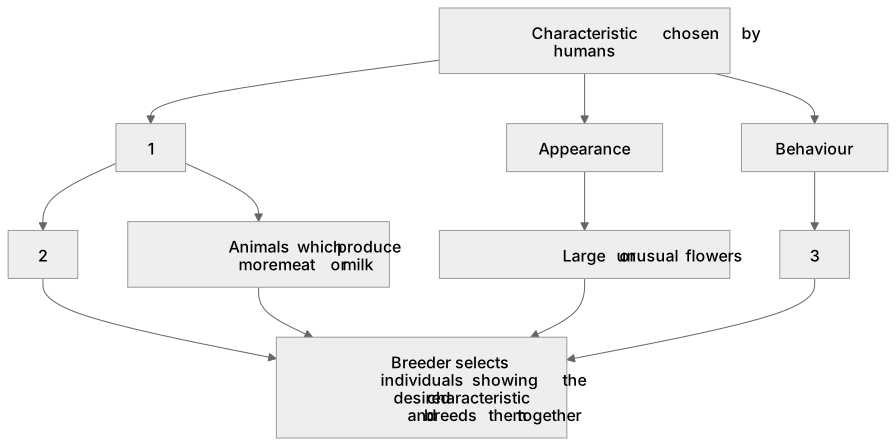
1Box 1
2Box 2
3Box 3
There is more to this lesson
The full lesson goes on to check your understanding and help you earn the marks. Create a free account to carry on, with your progress saved.
A week of Premium from your first lesson · Then the free plan continues · No card, no charge
Test your understanding of Selective breeding: The characteristic can be chosen for usefulness or appearance: • Disease resistance in food crops. • Animals which produce more meat or milk. • Domestic dogs with a gentle nature. • Large or unusual flowers.
Active recall beats re-reading. Take an instant quiz now to test what you’ve learned and lock it into long-term memory.
A week of Premium from your first lesson · Then the free plan continues · No card, no charge