AQA · GCSE · Biology
Course version: 8461 · Version from Sept 2018
Asexual reproduction involves only one parent and no fusion of gametes.
Full specification wording
Sexual and asexual reproduction: Asexual reproduction involves only one parent and no fusion of gametes.
Asexual reproduction is a form of reproduction in which a single organism produces offspring without a partner.
Checked against the AQA 8461 specification (opens in a new tab) on .
- Point 4 of 5
- 2 key terms
Study notes
From the checked teaching notes for this specification point.
The idea
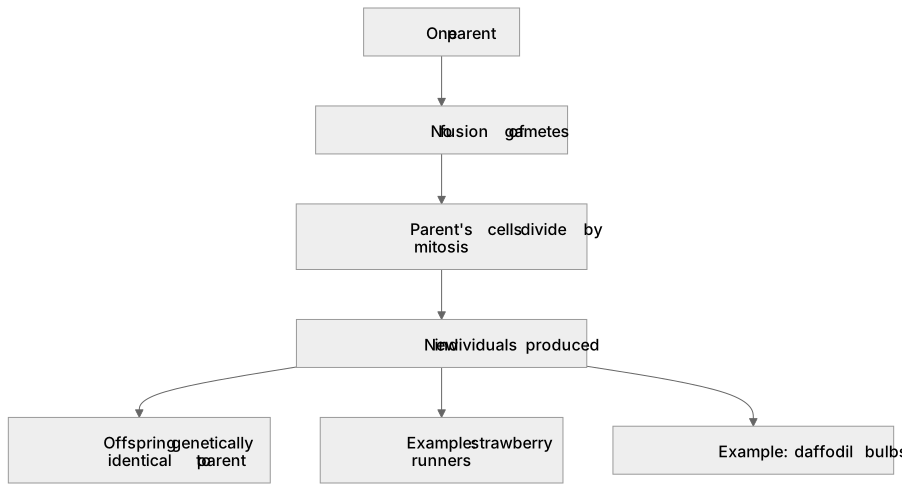
Asexual reproduction is a form of reproduction in which a single organism produces offspring without a partner. Because only one parent is involved, there is no fusion of gametes: no sperm and egg, or pollen and egg cell, combine. Instead, the parent's cells divide by mitosis to produce new individuals. For example, a strawberry plant can send out runners that grow into new plants. The offspring inherit all their genetic information from the one parent, so they are genetically identical to it. This contrasts with sexual reproduction, which requires two parents and the fusion of gametes. Asexual reproduction is common in some plants and fungi, and it allows rapid population growth in stable environments.
What earns the marks
- Asexual reproduction involves only one parent organism, with no second parent contributing genetic material.
- No fusion of gametes occurs, so there is no joining of a male and female sex cell.
- The offspring are produced from the parent's cells by mitosis, not by fertilisation.
- Examples include runners in strawberry plants and bulb formation in daffodils.
- Because there is no fusion of gametes, the offspring are genetically identical to the parent, forming clones.
Common mistakes and how to put them right
Thinking that asexual reproduction involves two parents but no gametes.
Put it right: Only one parent is involved.
Confusing asexual reproduction with mitosis itself.
Put it right: Mitosis is the cell division process used in eukaryotes, while asexual reproduction is the whole reproductive process.
Believing that gametes are produced but simply do not fuse.
Put it right: No gametes are involved at all in asexual reproduction.
Exam tips
- State clearly that one parent is involved and that gametes do not fuse, using both ideas in your answer.
- Use a named example such as strawberry runners or daffodil bulbs to support your explanation.
- Link asexual reproduction to genetically identical offspring, because this follows directly from the absence of gamete fusion.
Try the lesson
The start of the Sexual and asexual reproduction: Asexual reproduction involves only one parent and no fusion of gametes. lesson, made from checked teaching notes for this specification point.
Have a go first
Which statement describes asexual reproduction?
Listen
Asexual reproduction is a form of reproduction in which a single organism produces offspring without a partner. Because only one parent is involved, there is no fusion of gametes: no sperm and egg, or pollen and egg cell, combine. Instead, the parent's cells divide by mitosis to produce new individuals. For example, a strawberry plant can send out runners that grow into new plants. The offspring inherit all their genetic information from the one parent, so they are genetically identical to it. This contrasts with sexual reproduction, which requires two parents and the fusion of gametes. Asexual reproduction is common in some plants and fungi, and it allows rapid population growth in stable environments. A strong answer earns marks for these points. Asexual reproduction involves only one parent organism, with no second parent contributing genetic material. No fusion of gametes occurs, so there is no joining of a male and female sex cell. The offspring are produced from the parent's cells by mitosis, not by fertilisation. Examples include runners in strawberry plants and bulb formation in daffodils. A common slip: Thinking that asexual reproduction involves two parents but no gametes. Instead, only one parent is involved. Exam tip: State clearly that one parent is involved and that gametes do not fuse, using both ideas in your answer.
See it
Key words
Say what each word means before you turn the card.
Asexual reproduction
Try answering aloud or in your head before turning the card.
Clones
Try answering aloud or in your head before turning the card.
See every definition
- Asexual reproduction
- A form of reproduction involving only one parent, with no fusion of gametes.
- Clones
- Offspring that are genetically identical to the parent because there is no fusion of gametes.
Label the diagram
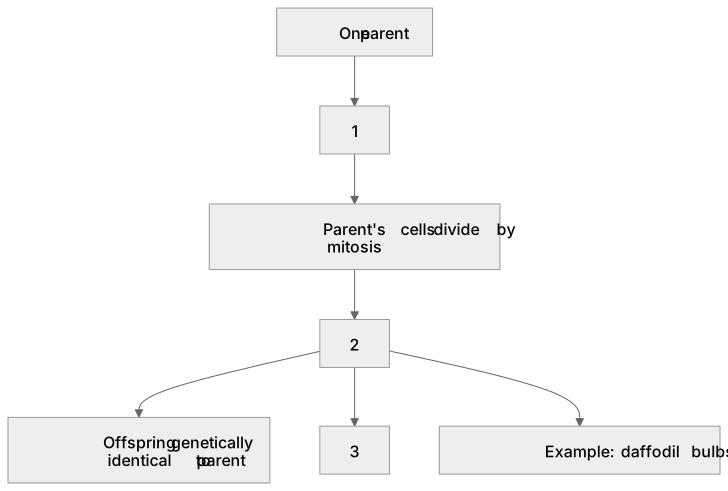
Some boxes have lost their names. Pick the right name for each number.
1Box 1
2Box 2
3Box 3
There is more to this lesson
The full lesson goes on to check your understanding and help you earn the marks. Create a free account to carry on, with your progress saved.
A week of Premium from your first lesson · Then the free plan continues · No card, no charge
Test your understanding of Sexual and asexual reproduction: Asexual reproduction involves only one parent and no fusion of gametes.
Active recall beats re-reading. Take an instant quiz now to test what you’ve learned and lock it into long-term memory.
A week of Premium from your first lesson · Then the free plan continues · No card, no charge