AQA · GCSE · Biology
Course version: 8461 · Version from Sept 2018
Students should be able to describe the steps which give rise to new…
Full specification wording
Speciation (biology only): Students should be able to describe the steps which give rise to new species.
Speciation is the formation of new species from existing populations.
Checked against the AQA 8461 specification (opens in a new tab) on .
- Point 7 of 7
- 4 key terms
Study notes
From the checked teaching notes for this specification point.
The idea
Speciation is the formation of new species from existing populations. The process begins with variation: individuals in a population differ because of mutations and sexual reproduction. If part of the population becomes geographically or reproductively isolated, for example by a river, mountain range or island colonisation, the two groups can no longer interbreed freely. Each group experiences different selection pressures, so different alleles are favoured. Over many generations, natural selection changes the allele frequencies in each population. Eventually the groups become so genetically different that they cannot interbreed to produce fertile offspring, which means they are now separate species.
What earns the marks
- Variation exists within a population due to mutations and sexual reproduction.
- Populations can become isolated by geographical barriers or other mechanisms that prevent interbreeding.
- Different selection pressures act on the separated populations.
- Individuals with advantageous alleles are more likely to survive and reproduce, passing on those alleles.
- Allele frequencies change over many generations in each population.
- The populations become reproductively isolated and can no longer produce fertile offspring, forming new species.
Common mistakes and how to put them right
Saying an individual organism evolves.
Put it right: Populations evolve as allele frequencies change over generations.
Thinking isolation alone causes speciation.
Put it right: Isolation must be followed by different selection pressures and genetic change over many generations.
Confusing a new species with a new variety.
Put it right: A new species is reproductively isolated and cannot produce fertile offspring with the original population.
Exam tips
- Write the steps in a logical sequence: variation, isolation, selection, change in allele frequency, reproductive isolation.
- Use the phrase cannot interbreed to produce fertile offspring when defining a new species.
- Refer to allele frequencies changing in populations rather than saying individuals change.
Try the lesson
The start of the Speciation (biology only): Students should be able to describe the steps which give rise to new species. lesson, made from checked teaching notes for this specification point.
Have a go first
Two populations of the same species become geographically isolated by a new mountain range. What is the next step required for speciation to occur?
Listen
Speciation is the formation of new species from existing populations. The process begins with variation: individuals in a population differ because of mutations and sexual reproduction. If part of the population becomes geographically or reproductively isolated, for example by a river, mountain range or island colonisation, the two groups can no longer interbreed freely. Each group experiences different selection pressures, so different alleles are favoured. Over many generations, natural selection changes the allele frequencies in each population. Eventually the groups become so genetically different that they cannot interbreed to produce fertile offspring, which means they are now separate species. A strong answer earns marks for these points. Variation exists within a population due to mutations and sexual reproduction. Populations can become isolated by geographical barriers or other mechanisms that prevent interbreeding. Different selection pressures act on the separated populations. Individuals with advantageous alleles are more likely to survive and reproduce, passing on those alleles. A common slip: Saying an individual organism evolves. Instead, populations evolve as allele frequencies change over generations. Exam tip: Write the steps in a logical sequence: variation, isolation, selection, change in allele frequency, reproductive isolation.
See it
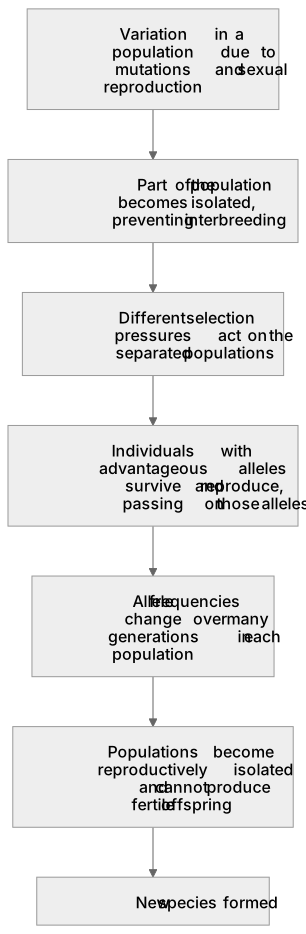
Put it in order
Put these steps in the order they happen.
- 1. New species formed
- 2. Populations become reproductively isolated and cannot produce fertile offspring
- 3. Different selection pressures act on the separated populations
- 4. Allele frequencies change over many generations in each population
- 5. Variation in a population due to mutations and sexual reproduction
- 6. Part of the population becomes isolated, preventing interbreeding
- 7. Individuals with advantageous alleles survive and reproduce, passing on those alleles
Key words
Say what each word means before you turn the card.
Variation and mutation
Try answering aloud or in your head before turning the card.
Geographical and reproductive isolation
Try answering aloud or in your head before turning the card.
Natural selection
Try answering aloud or in your head before turning the card.
Formation of new species
Try answering aloud or in your head before turning the card.
See every definition
- Variation and mutation
- Individuals in a population differ because of mutations and sexual reproduction.
- Geographical and reproductive isolation
- Part of a population becomes separated, for example by a river, mountain range or island colonisation, so the two groups can no longer interbreed freely.
- Natural selection
- Different selection pressures mean different alleles are favoured, so advantageous alleles are passed on and allele frequencies change over many generations.
- Formation of new species
- Groups become so genetically different that they cannot interbreed to produce fertile offspring, which means they are now separate species.
Label the diagram
Some boxes have lost their names. Pick the right name for each number.
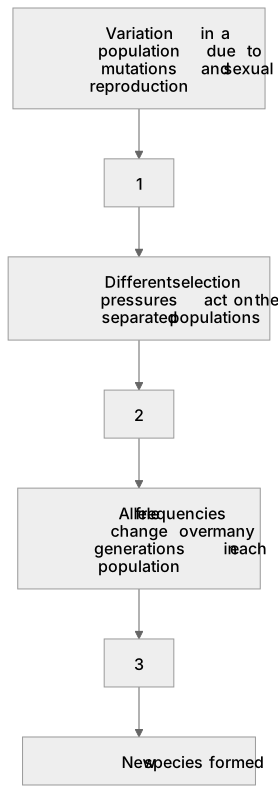
1Box 1
2Box 2
3Box 3
There is more to this lesson
The full lesson goes on to check your understanding and help you earn the marks. Create a free account to carry on, with your progress saved.
A week of Premium from your first lesson · Then the free plan continues · No card, no charge
Test your understanding of Speciation (biology only): Students should be able to describe the steps which give rise to new species.
Active recall beats re-reading. Take an instant quiz now to test what you’ve learned and lock it into long-term memory.
A week of Premium from your first lesson · Then the free plan continues · No card, no charge