AQA · GCSE · Biology
Course version: 8461 · Version from Sept 2018
Alfred Wallace did much pioneering work on speciation but more evidence…
Full specification wording
Speciation (biology only): Alfred Wallace did much pioneering work on speciation but more evidence over time has led to our current understanding of the theory of speciation.
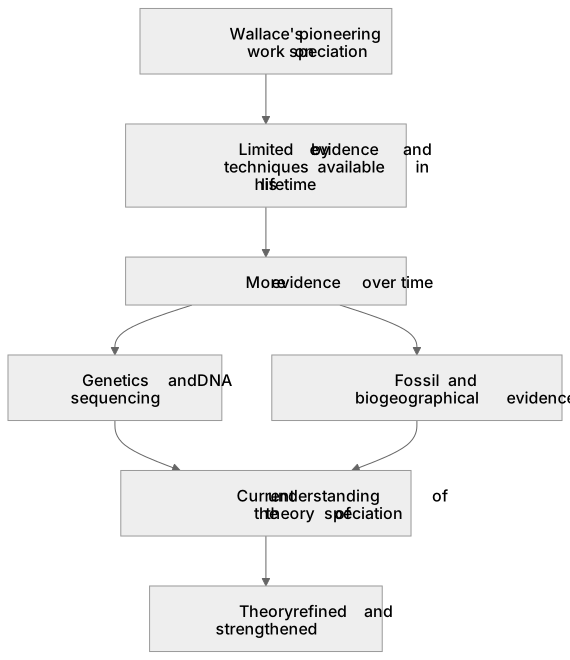
Wallace's work on speciation was pioneering because he linked geographical isolation, variation and natural selection to the formation of new species at a time when these ideas were new.
Checked against the AQA 8461 specification (opens in a new tab) on .
- Point 6 of 7
- 4 key terms
Study notes
From the checked teaching notes for this specification point.
The idea
Wallace's work on speciation was pioneering because he linked geographical isolation, variation and natural selection to the formation of new species at a time when these ideas were new. However, science is self-correcting: later evidence from genetics, DNA sequencing, fossils, biogeography and laboratory studies has refined and strengthened the theory. For example, modern genetics explains how mutations create new alleles and how reproductive isolation can arise through changes in mating behaviour, chromosomes or fertility. This shows how scientific explanations develop as new evidence accumulates.
What earns the marks
- Wallace produced pioneering ideas about how new species form through isolation and natural selection.
- His work was limited by the evidence and techniques available in his lifetime.
- Later evidence from genetics and DNA sequencing has explained how variation and reproductive isolation arise.
- Fossil and biogeographical evidence has supported and extended the theory of speciation.
- The current theory is stronger because it is supported by multiple independent lines of evidence.
- Scientific theories are revised and refined as new evidence is collected, rather than remaining fixed.
Common mistakes and how to put them right
Claiming Wallace's theory was completely wrong.
Put it right: His core ideas were pioneering and broadly supported, but later evidence refined them.
Thinking the current theory of speciation came only from Wallace.
Put it right: It developed from many scientists and many types of evidence over time.
Assuming scientific theories never change.
Put it right: Theories are updated when new evidence requires revision.
Exam tips
- Use the phrase more evidence over time to show how the theory developed rather than implying Wallace was simply mistaken.
- Give at least one type of later evidence, such as DNA sequencing or fossil evidence, to support your explanation.
- Link the development of the theory to the idea that science is based on evidence and is open to revision.
Try the lesson
The start of the Speciation (biology only): Alfred Wallace did much pioneering work on speciation but more evidence over time has led to our current understanding of the theory of speciation. lesson, made from checked teaching notes for this specification point.
Have a go first
Alfred Russel Wallace did pioneering work on speciation. How has the scientific understanding of speciation developed since his original research?
Listen
Wallace's work on speciation was pioneering because he linked geographical isolation, variation and natural selection to the formation of new species at a time when these ideas were new. However, science is self-correcting: later evidence from genetics, DNA sequencing, fossils, biogeography and laboratory studies has refined and strengthened the theory. For example, modern genetics explains how mutations create new alleles and how reproductive isolation can arise through changes in mating behaviour, chromosomes or fertility. This shows how scientific explanations develop as new evidence accumulates. A strong answer earns marks for these points. Wallace produced pioneering ideas about how new species form through isolation and natural selection. His work was limited by the evidence and techniques available in his lifetime. Later evidence from genetics and DNA sequencing has explained how variation and reproductive isolation arise. Fossil and biogeographical evidence has supported and extended the theory of speciation. A common slip: Claiming Wallace's theory was completely wrong. Instead, his core ideas were pioneering and broadly supported, but later evidence refined them. Exam tip: Use the phrase more evidence over time to show how the theory developed rather than implying Wallace was simply mistaken.
See it
Key words
Say what each word means before you turn the card.
Pioneering scientific work
Try answering aloud or in your head before turning the card.
Development of scientific theories
Try answering aloud or in your head before turning the card.
Genetic and fossil evidence
Try answering aloud or in your head before turning the card.
Reproductive isolation
Try answering aloud or in your head before turning the card.
See every definition
- Pioneering scientific work
- Alfred Wallace did much pioneering work on speciation, linking geographical isolation, variation and natural selection to the formation of new species when these ideas were new.
- Development of scientific theories
- Scientific theories are revised and refined as new evidence is collected, rather than remaining fixed, so the current theory of speciation is stronger because it is supported by multiple independent lines of evidence.
- Genetic and fossil evidence
- Later evidence from genetics, DNA sequencing, fossils and biogeography has refined and strengthened the theory of speciation.
- Reproductive isolation
- Modern genetics explains how mutations create new alleles and how reproductive isolation can arise through changes in mating behaviour, chromosomes or fertility.
Label the diagram
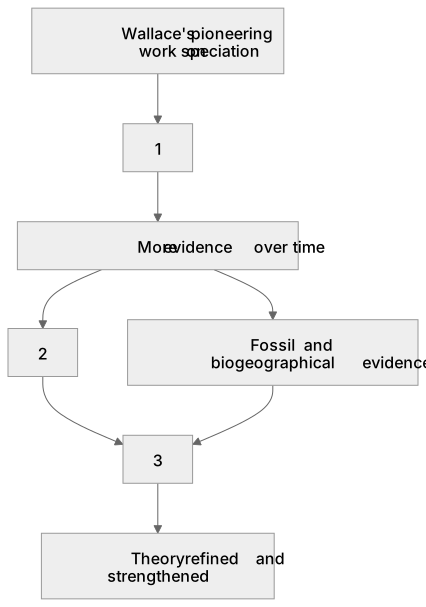
Some boxes have lost their names. Pick the right name for each number.
1Box 1
2Box 2
3Box 3
There is more to this lesson
The full lesson goes on to check your understanding and help you earn the marks. Create a free account to carry on, with your progress saved.
A week of Premium from your first lesson · Then the free plan continues · No card, no charge
Test your understanding of Speciation (biology only): Alfred Wallace did much pioneering work on speciation but more evidence over time has led to our current understanding of the theory of speciation.
Active recall beats re-reading. Take an instant quiz now to test what you’ve learned and lock it into long-term memory.
A week of Premium from your first lesson · Then the free plan continues · No card, no charge