AQA · GCSE · Biology
Course version: 8461 · Version from Sept 2018
Wallace worked worldwide gathering evidence for evolutionary theory.
Full specification wording
Speciation (biology only): Wallace worked worldwide gathering evidence for evolutionary theory.
Alfred Russel Wallace was a British naturalist who independently developed ideas about evolution by natural selection.
Checked against the AQA 8461 specification (opens in a new tab) on .
- Point 4 of 7
- 3 key terms
Study notes
From the checked teaching notes for this specification point.
The idea
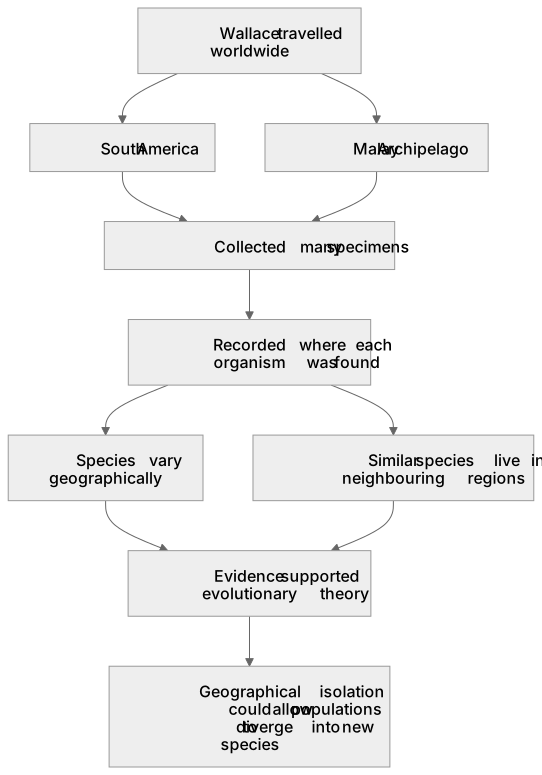
Alfred Russel Wallace was a British naturalist who independently developed ideas about evolution by natural selection. Unlike Darwin, who largely worked from his Beagle collections and British observations, Wallace travelled extensively across South America and the Malay Archipelago, collecting thousands of specimens and recording where each was found. This worldwide fieldwork gave him evidence that species vary geographically and that similar species often live in neighbouring regions. For example, his observations of animals on separate islands helped him link variation, isolation and the formation of new species. His letters to Darwin prompted the joint presentation of their ideas in 1858.
What earns the marks
- Wallace travelled widely, including in South America and the Malay Archipelago, rather than working only in one country.
- He collected many specimens and recorded detailed information about where each organism was found.
- His worldwide observations showed that closely related species often occupy neighbouring geographical areas.
- He used patterns in variation and distribution to support the idea that species change over time.
- His evidence contributed to the development of evolutionary theory alongside Darwin's work.
- He recognised that geographical isolation could allow populations to diverge into new species.
Common mistakes and how to put them right
Thinking Wallace worked only in Britain or only with fossils.
Put it right: He gathered evidence through worldwide fieldwork on living organisms.
Confusing Wallace with Lamarck or claiming Wallace invented natural selection alone.
Put it right: Wallace independently reached similar conclusions to Darwin and they presented their ideas jointly.
Assuming Wallace's evidence was purely theoretical with no specimens.
Put it right: His conclusions were based on extensive collecting and recording of real organisms.
Exam tips
- Name specific regions such as South America or the Malay Archipelago to show precise knowledge rather than saying only that he travelled.
- Link Wallace's worldwide evidence to the idea that species vary and can change, rather than listing places without explanation.
- Use phrases such as gathered evidence and supported evolutionary theory to keep answers focused on the specification statement.
Try the lesson
The start of the Speciation (biology only): Wallace worked worldwide gathering evidence for evolutionary theory. lesson, made from checked teaching notes for this specification point.
Have a go first
Alfred Russel Wallace helped to develop the theory of evolution by natural selection. How did Wallace gather the evidence that supported this theory?
Listen
Alfred Russel Wallace was a British naturalist who independently developed ideas about evolution by natural selection. Unlike Darwin, who largely worked from his Beagle collections and British observations, Wallace travelled extensively across South America and the Malay Archipelago, collecting thousands of specimens and recording where each was found. This worldwide fieldwork gave him evidence that species vary geographically and that similar species often live in neighbouring regions. For example, his observations of animals on separate islands helped him link variation, isolation and the formation of new species. His letters to Darwin prompted the joint presentation of their ideas in 1858. A strong answer earns marks for these points. Wallace travelled widely, including in South America and the Malay Archipelago, rather than working only in one country. He collected many specimens and recorded detailed information about where each organism was found. His worldwide observations showed that closely related species often occupy neighbouring geographical areas. He used patterns in variation and distribution to support the idea that species change over time. A common slip: Thinking Wallace worked only in Britain or only with fossils. Instead, he gathered evidence through worldwide fieldwork on living organisms. Exam tip: Name specific regions such as South America or the Malay Archipelago to show precise knowledge rather than saying only that he travelled.
See it
Key words
Say what each word means before you turn the card.
Evidence for evolution
Try answering aloud or in your head before turning the card.
Worldwide fieldwork and specimen collection
Try answering aloud or in your head before turning the card.
Geographical distribution of species
Try answering aloud or in your head before turning the card.
See every definition
- Evidence for evolution
- Information gathered worldwide that supported the idea that species change over time.
- Worldwide fieldwork and specimen collection
- Travelling extensively across regions such as South America and the Malay Archipelago, collecting thousands of specimens and recording where each was found.
- Geographical distribution of species
- The pattern that species vary geographically and that similar species often live in neighbouring regions.
Label the diagram
Some boxes have lost their names. Pick the right name for each number.
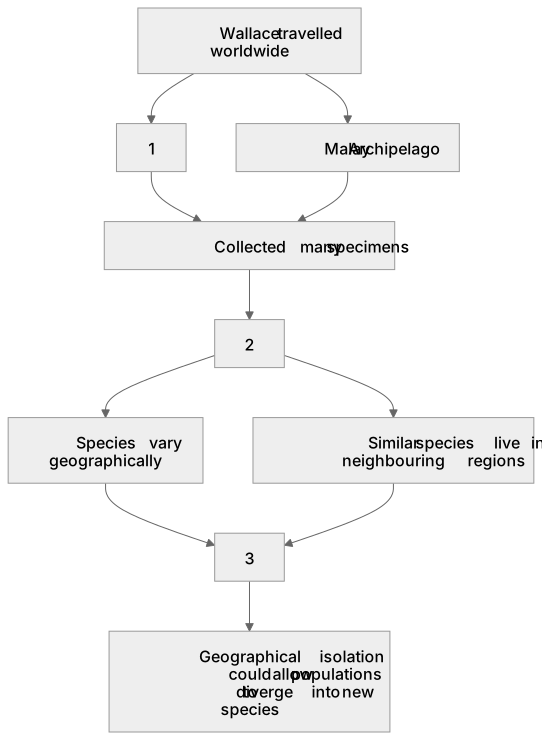
1Box 1
2Box 2
3Box 3
There is more to this lesson
The full lesson goes on to check your understanding and help you earn the marks. Create a free account to carry on, with your progress saved.
A week of Premium from your first lesson · Then the free plan continues · No card, no charge
Test your understanding of Speciation (biology only): Wallace worked worldwide gathering evidence for evolutionary theory.
Active recall beats re-reading. Take an instant quiz now to test what you’ve learned and lock it into long-term memory.
A week of Premium from your first lesson · Then the free plan continues · No card, no charge