AQA · GCSE · Biology
Course version: 8461 · Version from Sept 2018
He is best known for his work on warning colouration in animals and his…
Full specification wording
Speciation (biology only): He is best known for his work on warning colouration in animals and his theory of speciation.
Wallace is particularly remembered for two connected areas of work.
Checked against the AQA 8461 specification (opens in a new tab) on .
- Point 5 of 7
- 4 key terms
Study notes
From the checked teaching notes for this specification point.
The idea
Wallace is particularly remembered for two connected areas of work. First, he studied warning colouration, where prey animals have bright, conspicuous patterns that predators learn to avoid because the prey is toxic or dangerous. He also described mimicry, where a harmless species resembles a warningly coloured species and gains protection. Second, he developed ideas about speciation: populations that become separated can accumulate different variations, and over many generations they may become so different that they can no longer interbreed to produce fertile offspring. His island observations supported this because related species on different islands showed distinct features.
What earns the marks
- Warning colouration makes a toxic or dangerous organism conspicuous to predators.
- Predators learn to associate the bright pattern with an unpleasant experience and avoid similar prey.
- Mimicry occurs when a harmless species resembles a warningly coloured species and gains protection.
- Speciation involves populations becoming reproductively isolated so that gene flow between them stops.
- Different selection pressures in separated environments cause different variations to be favoured.
- Over many generations the separated populations become sufficiently different to be classified as different species.
Common mistakes and how to put them right
Confusing warning colouration with camouflage.
Put it right: Warning colouration is conspicuous and advertises danger, whereas camouflage helps an organism blend in.
Thinking speciation happens in a single generation.
Put it right: Speciation requires many generations of variation, selection and reproductive isolation.
Believing that isolation alone creates new species.
Put it right: Isolation must be followed by different selection pressures and genetic changes over time.
Exam tips
- Use the term reproductive isolation and explain that the populations can no longer interbreed to produce fertile offspring.
- When describing warning colouration, state the benefit to the prey and the learning response of the predator.
- Keep the example brief and relevant, such as a brightly coloured toxic frog, rather than writing a long story.
Try the lesson
The start of the Speciation (biology only): He is best known for his work on warning colouration in animals and his theory of speciation. lesson, made from checked teaching notes for this specification point.
Have a go first
Wallace is well known for his work on warning colouration in animals. What is warning colouration?
Listen
Wallace is particularly remembered for two connected areas of work. First, he studied warning colouration, where prey animals have bright, conspicuous patterns that predators learn to avoid because the prey is toxic or dangerous. He also described mimicry, where a harmless species resembles a warningly coloured species and gains protection. Second, he developed ideas about speciation: populations that become separated can accumulate different variations, and over many generations they may become so different that they can no longer interbreed to produce fertile offspring. His island observations supported this because related species on different islands showed distinct features. A strong answer earns marks for these points. Warning colouration makes a toxic or dangerous organism conspicuous to predators. Predators learn to associate the bright pattern with an unpleasant experience and avoid similar prey. Mimicry occurs when a harmless species resembles a warningly coloured species and gains protection. Speciation involves populations becoming reproductively isolated so that gene flow between them stops. A common slip: Confusing warning colouration with camouflage. Instead, warning colouration is conspicuous and advertises danger, whereas camouflage helps an organism blend in. Exam tip: Use the term reproductive isolation and explain that the populations can no longer interbreed to produce fertile offspring.
See it
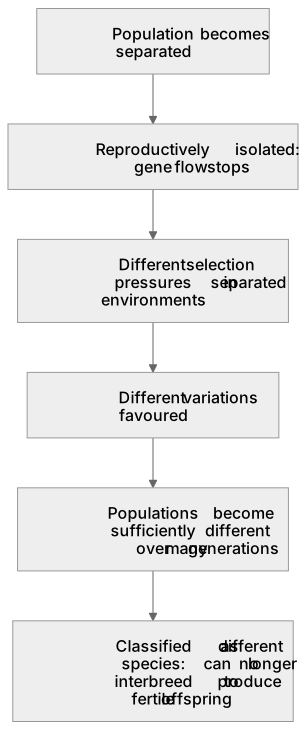
Put it in order
Put these steps in the order they happen.
- 1. Different selection pressures in separated environments
- 2. Reproductively isolated: gene flow stops
- 3. Population becomes separated
- 4. Classified as different species: can no longer interbreed to produce fertile offspring
- 5. Populations become sufficiently different over many generations
- 6. Different variations favoured
Key words
Say what each word means before you turn the card.
Warning colouration
Try answering aloud or in your head before turning the card.
Mimicry
Try answering aloud or in your head before turning the card.
Reproductive isolation
Try answering aloud or in your head before turning the card.
Speciation
Try answering aloud or in your head before turning the card.
See every definition
- Warning colouration
- Bright, conspicuous patterns on prey animals that predators learn to avoid because the prey is toxic or dangerous.
- Mimicry
- When a harmless species resembles a warningly coloured species and gains protection.
- Reproductive isolation
- Populations becoming separated so that gene flow between them stops and they can no longer interbreed to produce fertile offspring.
- Speciation
- Populations that become separated accumulate different variations and over many generations may become so different that they can no longer interbreed to produce fertile offspring.
Label the diagram
Some boxes have lost their names. Pick the right name for each number.
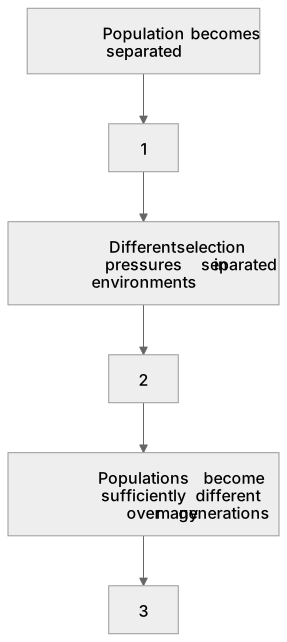
1Box 1
2Box 2
3Box 3
There is more to this lesson
The full lesson goes on to check your understanding and help you earn the marks. Create a free account to carry on, with your progress saved.
A week of Premium from your first lesson · Then the free plan continues · No card, no charge
Test your understanding of Speciation (biology only): He is best known for his work on warning colouration in animals and his theory of speciation.
Active recall beats re-reading. Take an instant quiz now to test what you’ve learned and lock it into long-term memory.
A week of Premium from your first lesson · Then the free plan continues · No card, no charge